The best LMS for sales training depends on whether you want a sales LMS built for sellers or a company-wide LMS that sales also uses. Revspire is a sales LMS: onboarding paths, SCORM courses, certification and AI role-play by video or a live voice call, in the same platform as the content and playbooks reps use with buyers, so teams use it in place of a separate LMS for sellers. For sales readiness platforms with learning, look at Allego, Highspot, Mindtickle, SalesHood, Seismic Learning or Showpad, or Gong Enable inside Gong. For a general LMS, 360Learning, Absorb LMS, Continu, Docebo, iSpring Learn, Juno Journey, LearnUpon, Learn:Up, Litmos, Sana Learn or TalentLMS.
Short answer
The 19 best LMS for sales training in 2026 are Revspire, Allego, Highspot, Mindtickle, SalesHood, Seismic Learning, Showpad, Gong Enable, 360Learning, Absorb LMS, Continu, Docebo, iSpring Learn, Juno Journey, LearnUpon, Learn:Up, Litmos, Sana Learn and TalentLMS. Which one fits depends on whether you need a general learning system, a sales-specific readiness platform, or training built into the tools reps already use.
- Revspire: pick it when you want seller training, practice and certification in the same system as content and deal rooms, and can leave compliance training in a corporate LMS; priced by module with unlimited user licenses (about $25,000 USD a year on average).
- Allego: pick it when field reps learn on the road, often offline.
- Showpad: pick it when field sellers need content and training in one app.
- TalentLMS: pick it when you want published prices and a free plan to test with.
Revspire publishes this guide and has one entry. The full list below is grouped by type, not ranked.
If you are still deciding whether you need an LMS or a sales enablement platform at all, read our LMS vs sales enablement platform guide first. This page assumes you are choosing a learning management system for sales teams and compares 19 options with the pricing each vendor publishes, one limitation each and when to choose them.
Last updated: 9 November 2026
What changed on 9 November 2026: we added six general LMSs that sales teams also shortlist (Absorb LMS, Continu, iSpring Learn, Juno Journey, LearnUpon and Litmos), with prices read on each vendor’s own page that day, and updated the Revspire entry for SCORM and its Conversation Intelligence module.
Disclosure: Revspire publishes this list. Revspire has one entry, in the group of sales platforms with built-in training, and is not ranked above other tools. Tools are grouped by type and listed alphabetically within each group. Every price and feature below was checked on the vendor’s own website on 27 October 2026.
Best LMS for sales training compared
| Tool | Type | Best for | Published pricing (checked 27 Oct to 9 Nov 2026) |
|---|---|---|---|
| Revspire | Sales LMS in a revenue enablement platform | A sales LMS and AI practice in the platform reps use for content and deals | Per module, unlimited user licenses; about $25,000 USD a year |
| Gong Enable | Training in a revenue platform | Teams already recording calls in Gong | Not published; no free trial |
| Allego | Sales readiness platform | Mobile and offline field teams | Per user per month, billed annually; no figures |
| Highspot | Sales readiness platform | Training next to a content library | Not published; training from the Better plan |
| Mindtickle | Sales readiness platform | Large onboarding and everboarding programs | Not published |
| SalesHood | Sales readiness platform | Building programs from existing content | Not published; Essential, Pro, Unlimited |
| Seismic Learning | Sales readiness platform | Course-led training with recertification | Not published on the pages we opened |
| Showpad | Sales readiness platform | Field sales with certification workflows | Not published; licensed per user |
| 360Learning | General LMS | Small teams starting monthly | Team $8 per user a month (up to 100 users) |
| Absorb LMS | General LMS | Mobile and offline learning | Not published; Vendr median $20,000 a year (51 purchases) |
| Continu | General LMS | Tracks, workshops and video coaching | Not published; plans by monthly active users |
| Docebo | General LMS | Enterprise and extended-enterprise learning | Not published; priced on active learners |
| iSpring Learn | General LMS | A published per-active-user price | $6.91 per active user a month at 100 users |
| Juno Journey | General LMS and LXP | HR-led programs with a sales track | $8 per user a month, billed yearly, up to 200 users |
| LearnUpon | General LMS | Separate portals for each audience | Not published; plans from 100 users |
| Learn:Up (formerly WorkRamp) | General LMS with sales simulations | Fast-growing companies | Not shown on the product page |
| Litmos | General LMS | Training tied to Salesforce records | Not published; quoted on active learners |
| Sana Learn | General LMS and LXP (AI-native) | Company-wide learning with AI authoring and an AI tutor | Not published; tailored to company size and needs |
| TalentLMS | General LMS | Published prices and a free plan | Free (5 users); Core $119, Grow $229, Pro $449 a month |
For every vendor’s published price or dated contract data in one table, see our sales training platform pricing guide.
What is a sales LMS?
A sales LMS (sales learning management system) is software that delivers, tracks and certifies training for sellers: onboarding paths, product and methodology courses, quizzes, practice and certification. A general LMS does this for every employee. An LMS for sales training adds practice on buyer conversations, manager scorecards and a link to the content and deals reps work on.
Sales teams buy an LMS for onboarding, product launches and ongoing skills. When you evaluate one, check for these, in this order:
- Role-based paths: separate onboarding for SDRs, account executives and partners, so nobody repeats material they do not need.
- Practice, not only courses: role-play or pitch recording with scoring, because reading about objection handling is not the same as doing it.
- Certification on skill: a pass based on a scored practice or pitch, not only on finishing a course.
- Links to selling content: lessons that point to the same approved decks and battlecards reps use with buyers.
- Reinforcement: short refreshers after onboarding and after each launch.
- Manager view: who is ready for which conversations, by team.
Keep paths short. Gartner’s survey of 1,026 B2B sellers (January to March 2024) found 72% feel overwhelmed by the number of skills their job requires, and overwhelmed sellers were 45% less likely to attain quota (Gartner, 16 September 2024). That is a correlation, but it argues for fewer, focused modules. Our sales readiness checklist helps define what “ready” means before you build paths.
Sales LMSs inside a revenue platform
These put the job of a sales LMS, onboarding, practice and certification, next to the calls, deals and content sellers already work with. Revspire covers onboarding paths, SCORM courses and certification, so teams use it in place of a separate LMS for sellers. We build it, so we are biased; the reasons, and when to skip it, are set out below.
Revspire
Best for: Teams that want a sales LMS and AI practice in the platform reps already use for content and deals.
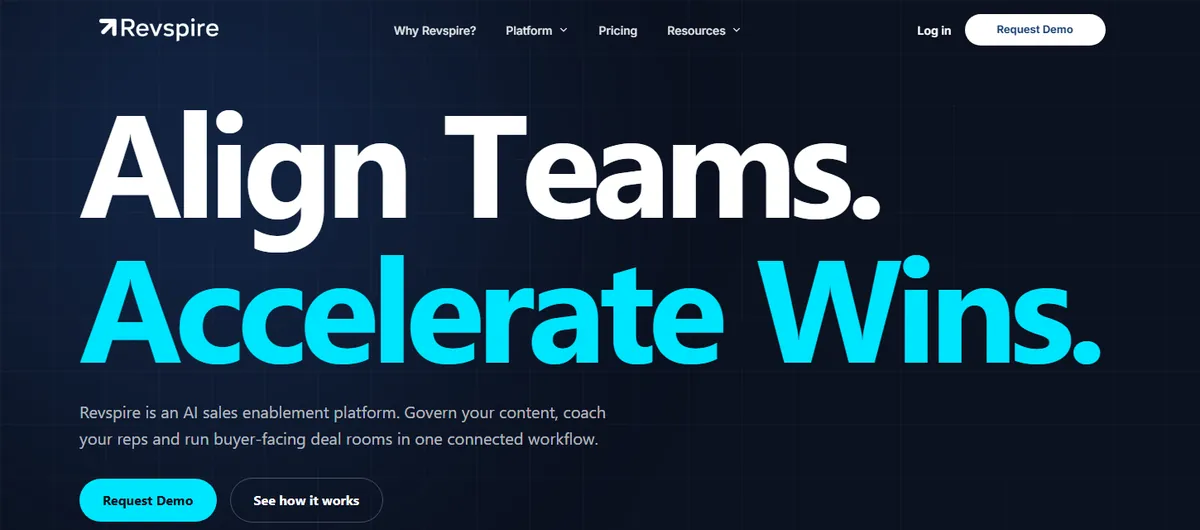
- What it does: Revspire’s AI Sales Training and Coaching module, sold as Academy (training and certification), covers seller onboarding, training and certification without a separate LMS, with courses built from video, PDF, SCORM packages, quizzes and live sessions. Reps practice buyer conversations with AI video role-play and deal-specific objection practice, get instant AI scores for clarity, confidence and objection handling, and managers track readiness and improvement by team. Training uses the same approved content and playbooks as Content Hub and deal rooms, and Partner Portal runs partner training and certifications on the same engine, and Revspire Conversation Intelligence scores recorded sales calls on seven behaviors and suggests courses for the weak ones.
- Customer result: Digiplug: partner certification completion went from 55% to 85% within 90 days.
- Pricing: priced by module with unlimited user licenses; about $25,000 USD a year on average (Revspire pricing).
- Limitation: Revspire courses accept SCORM packages, but its published integrations include no LMS or HRIS connector, so compliance and HR training records should stay in your corporate LMS.
- Choose it when: you want seller training, practice and certification in the same system as content and deal rooms, and can leave compliance training in a corporate LMS.
Gong Enable
Best for: Teams already recording calls in Gong.
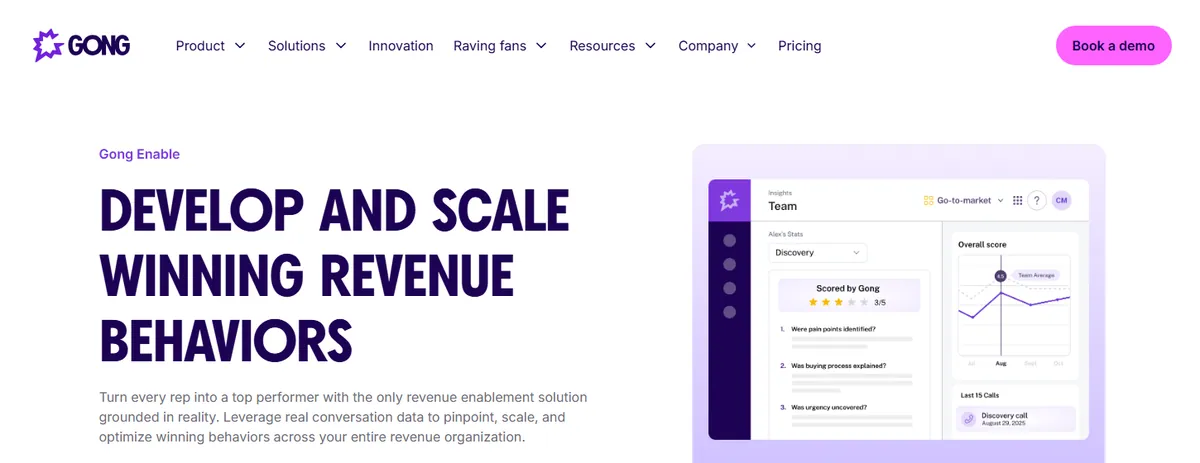
- What it does: Lessons (role-specific programs with micro-learning, practice and assessments), AI Trainer that turns past calls into role-plays, Dry Run practice before meetings and AI Call Reviewer scoring (Gong Enable).
- Pricing: not published; Gong prices per-user licenses plus a platform fee (Gong pricing, checked 27 October 2026).
- Limitation: the page does not mention certification and says there is no free trial.
- Choose it when: lessons should draw on your own recorded calls.
Sales readiness platforms with LMS features
These platforms are built for revenue teams and include courses, paths, practice and certification. Our sales readiness platforms guide and sales training platforms guide compare them on readiness and training more broadly.
Allego
Best for: Mobile and offline field teams.
- What it does: Modern Learning gives new hires guided experiences by role, lets reps learn on mobile or offline, supports instructor-led sessions alongside LMS integrations, and uses AI to turn existing material into programs with courses, reinforcement and reminders (Allego Modern Learning).
- Pricing: per user per month, billed annually upfront; no figures; typical contract three years; lower list price for channel and partner users (Allego pricing, checked 27 October 2026).
- Limitation: the Modern Learning page does not mention SCORM or certification paths, so confirm both.
- Choose it when: field reps learn on the road, often offline.
Highspot
Best for: Training next to a content library.
- What it does: role-specific learning paths, AI-accelerated course authoring, adaptive learning that lets reps skip what they have mastered, SCORM import, role-based certifications and AI role-play tied to deal context (Highspot sales training).
- Pricing: not published; training features start on the Better plan, described as “Train and practice” (Highspot pricing, checked 27 October 2026). Vendr reports a median Highspot contract of $60,005 a year (351 purchases, February 2026).
- Limitation: the entry Good plan lists no training features, and Highspot is now part of Seismic, which also sells Seismic Learning.
- Choose it when: training should live next to the content library reps already use.
Mindtickle
Best for: Large onboarding and everboarding programs.
- What it does: one platform for onboarding, everboarding, coaching and certifications, with microlearning on mobile, assessments, AI role-plays, AI translation and document-to-video tools, and a Readiness Index that links programs to skill gains; it integrates with CRM, HRIS and 100+ tools (Mindtickle training).
- Pricing: not published (Mindtickle pricing, checked 27 October 2026). Vendr reports a median Mindtickle contract of $44,356 a year (65 purchases, February 2026).
- Limitation: the training page does not mention SCORM, which matters if you plan to import existing courses.
- Choose it when: you run large onboarding cohorts and want readiness scored by role.
SalesHood
Best for: Building programs from existing content.
- What it does: an AI Program Builder turns existing material into onboarding, learning and certification programs, with learning paths, milestones, courses, assessments and coaching feedback (SalesHood learning management).
- Pricing: not published; Essential, Pro and Unlimited; AI role-play and AI pitch practice allow 40, 80 or unlimited submissions per license (SalesHood pricing, checked 27 October 2026).
- Limitation: Essential caps learning paths at 10 and AI practice at 40 submissions per license.
- Choose it when: you want programs built quickly from content you already have.
Seismic Learning
Best for: Course-led training with recertification.
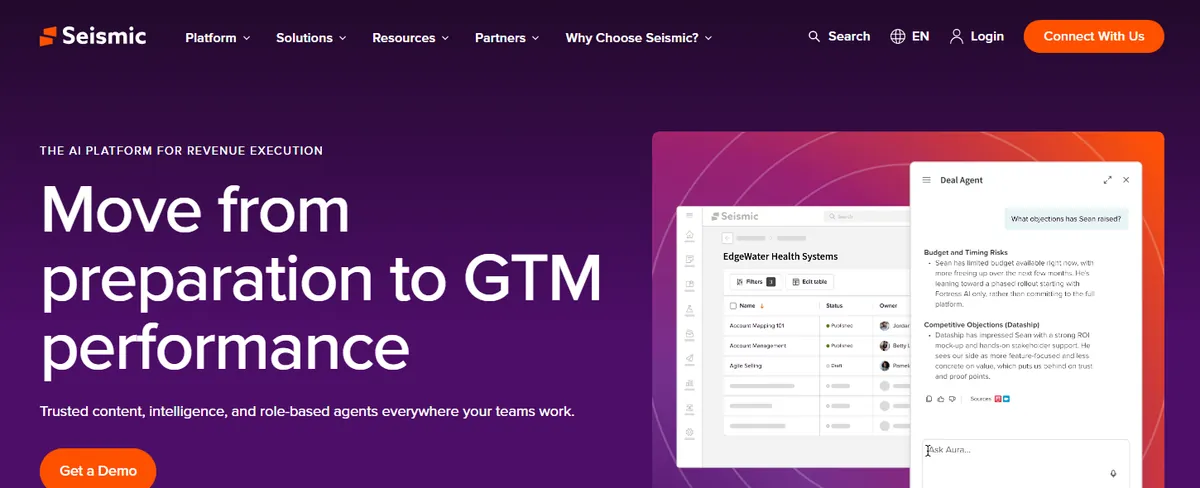
- What it does: interactive online training courses, AI-powered role-plays, personalized coaching plans and AI feedback, with an option to integrate your LMS (Seismic Learning); certifications are learning paths that issue certificates and can expire once or on a recurring basis, with automatic reassignment 30 days before expiry (Seismic Learning help: certifications).
- Pricing: no prices on the Seismic pages we opened (checked 27 October 2026). Vendr reports a median Seismic contract of $31,950 a year (415 purchases, February 2026).
- Limitation: the product page does not mention SCORM or learning paths; the detail comes from the help center.
- Choose it when: recurring certification on a fixed cycle matters, for example after each product release.
Already on Seismic Learning and weighing a move? Our Seismic Learning alternatives guide covers what to export and ten replacements.
Showpad
Best for: Field sales with certification workflows.

- What it does: role-based learning paths, automated certification workflows, Roleplay AI, coaching dashboards and competency evaluations that link scores to courses (Showpad Sales Readiness).
- Pricing: not published; Professional includes the training library and courses, Advanced adds Roleplay AI, knowledge checks and certifications, and Expert adds Authoring AI; licensed per user (Showpad pricing, checked 27 October 2026). Vendr reports a median Showpad contract of $34,875 a year (50 purchases, February 2026).
- Limitation: certifications and role-play start at Advanced, not Professional.
- Choose it when: field sellers need content and training in one app.
General LMSs that sales teams use
These serve the whole company. They are strong on courses, standards and administration; check how much sales-specific practice they offer.
360Learning
Best for: Small teams starting monthly.
- What it does: an LMS with AI-assisted authoring, an AI Companion, a SCORM player and integrations with HRIS systems such as Workday, Microsoft Teams, Slack and Zoom (360Learning pricing).
- Pricing: Team $8 per user a month for up to 100 users, billed monthly with no annual commitment; Business and Enterprise custom; no minimum users; 30-day free trial (checked 27 October 2026).
- Limitation: the pricing page does not mention Salesforce or sales role-play.
- Choose it when: a small team wants to start this month without an annual contract.
Absorb LMS
Best for: Field and mobile sales teams that learn offline.
- What it does: an AI-powered LMS whose sales training page lists an Absorb app for Salesforce, predictive AI that suggests courses, automated enrollment, certification tracking and delivery, gamification, and iOS and Android apps that also work offline (Absorb sales training, checked 9 November 2026).
- Pricing: not published; quoted on active learners. Vendr reports a median Absorb contract of $20,000 a year from 51 purchases, ranging from $5,151 to $49,025 (last updated February 2026).
- Limitation: the sales training page does not mention AI role-play or SCORM.
- Choose it when: one LMS must serve sales and the rest of the company, and reps need to learn on mobile, offline.
Continu
Best for: Mid-size and large companies that want tracks, workshops and video coaching in one LMS.
- What it does: an LMS with learning tracks, SCORM, assessments, workshops, learning journeys and automation workflows on every plan; Professional adds Continu AI, video coaching, multi-language support and Extend for external users (Continu pricing, checked 9 November 2026).
- Pricing: no prices published; plans by monthly active users: Growth under 1,000, Professional 1,000 to 5,000 and Enterprise above 5,000. The FAQ says implementation is 10% of the first-year contract value.
- Limitation: Salesforce is not mentioned on the pricing page, and Continu AI starts on Professional.
- Choose it when: you want video coaching and external learners in a general LMS and train more than a few hundred people.
Docebo
Best for: Enterprise and extended-enterprise learning.
- What it does: the Elevate plan includes certification and compliance tracking and AI-powered content creation; Enterprise adds extended enterprise for up to 10 domains; Docebo for Salesforce adds in-context learning inside Salesforce (Docebo pricing).
- Pricing: not published; priced on active learner usage (monthly, yearly or registered active user models) (checked 27 October 2026).
- Limitation: Docebo for Salesforce is a paid add-on, and AI content creation uses credits.
- Choose it when: one LMS must serve employees, partners and customers.
iSpring Learn
Best for: Budget-conscious teams that want a published per-active-user price.
- What it does: iSpring’s corporate LMS, sold beside the iSpring Suite course authoring tool, which costs $970 per author a year (iSpring Suite pricing, checked 9 November 2026).
- Pricing: Business $6.91 per active user a month for 100 users, shown as $8,286 a year, where a user is active after one login in the month; Enterprise is quoted for larger teams (iSpring LMS pricing, checked 9 November 2026).
- Limitation: the LMS pricing page lists no sales-specific features such as AI role-play or a CRM integration.
- Choose it when: you want to build courses in PowerPoint-style authoring and pay only for people who log in.
Juno Journey
Best for: HR-led programs where sales is one audience among employees, customers and partners.
- What it does: an LLM-native “people readiness platform”: Juno Training (an LMS with AI authoring, certification management and compliance courses), Juno Growth (an LXP with personal development plans), Revenue Enablement journeys, and partner academies with certification programs. Its MCP server lets ChatGPT, Claude, GitHub Copilot or Cursor build and assign courses after you confirm (Juno Journey, checked 9 November 2026).
- Pricing: Juno Training and Juno Growth are each $8 per user a month, billed yearly, for up to 200 users; above 200 users, and for the customer and partner workspaces, prices are custom (Juno Journey pricing, checked 9 November 2026).
- Limitation: the pages we checked name no AI role-play, call recording or sales content library.
- Choose it when: HR owns learning and wants one platform for onboarding, compliance and careers, with sales training as one track. See our Juno Journey alternatives for sales-specific options.
LearnUpon
Best for: Companies training employees, customers and partners in separate branded portals.
- What it does: an LMS whose pricing page compares SCORM and xAPI support, a Salesforce integration and single sign-on across its plans, with portals for separate audiences and an implementation consultant, customer success and 24/7 support on every plan (LearnUpon pricing, checked 9 November 2026).
- Pricing: no prices published; plans are tailored, from 100 users for employees, 300 for customer education and 150 for associations.
- Limitation: minimums start at 100 users, and the page does not show which features sit on which plan.
- Choose it when: you run customer or partner education beside employee training and want a separate portal for each audience.
Learn:Up (formerly WorkRamp)
Best for: Fast-growing companies.
- What it does: Confirm’s AI-first LMS, formerly WorkRamp, with AI simulations for sales conversations, video and written pitch certifications, AI Assist course drafting, and integrations with Salesforce, Slack, Zoom, Okta and Google Workspace (Learn:Up). See our WorkRamp pricing page.
- Pricing: no prices on the product page; add-on products are sold separately (checked 27 October 2026).
- Limitation: the page does not describe how deep the Salesforce integration goes.
- Choose it when: one LMS should cover employee training and sales certification.
Litmos
Best for: Salesforce-centred companies training reps, customers and channel partners.
- What it does: an LMS whose Salesforce integration trains licensed users, contacts and community users, covers employee, customer, channel and compliance training, and combines Salesforce data with training data in dashboards (Litmos for Salesforce, checked 9 November 2026).
- Pricing: not published; quoted on active learners, feature tier and contract length. Vendr notes that optional content libraries can add an estimated 20 to 40% to the contract (February 2026).
- Limitation: its Salesforce page does not mention AI role-play or certifications.
- Choose it when: training must be tracked against Salesforce records for reps, customers and partners.
Sana Learn
Best for: Company-wide learning where L&D wants AI course creation and an AI tutor for every employee, with sales as one audience.
- What it does: an AI-native learning platform that combines an LMS, LXP, authoring tool and virtual classroom: an AI tutor for each learner, courses generated from source material such as PDFs, answers to learner questions with cited sources, and automated enrollments and learning analytics. It is SCORM compliant. Sana is now part of Workday; Sana Learn runs alongside any HR system, and Workday customers can also buy Workday Learning, powered by Sana (Sana Learn, checked 26 November 2026).
- Pricing: not published; Sana says it tailors pricing to company size and needs (Sana Learn FAQ, checked 26 November 2026).
- Limitation: the product page names no AI sales role-play, call scoring or sales content library.
- Choose it when: you want one AI learning platform for every employee; for sales-focused options, see our Sana Learn alternatives.
TalentLMS
Best for: Published prices and a free plan.
- What it does: an LMS with SCORM 1.2, Tin Can and cmi5 support and gamification on every plan, TalentCraft AI course creation with credits that vary by plan, and a HubSpot integration from Core (TalentLMS pricing).
- Pricing: Free for up to 5 users and 10 courses; Core $119, Grow $229 and Pro $449 a month, priced on unique users who log in each month; annual billing 20% off; Enterprise custom (checked 27 October 2026).
- Limitation: the pricing page does not mention Salesforce or AI role-play.
- Choose it when: you want published prices and a free plan to test with.
Sales training LMS features to compare
Every LMS for sales training on this list delivers courses. What separates them is what happens around the course. Compare these seven features in a trial that uses one real onboarding path, not a demo course.
Courses and learning paths
A sales training LMS should let enablement build courses from material it already has, such as video, slides, PDFs and quizzes, and sequence them into paths by role, so SDRs, account executives and partners each get their own onboarding. Check how quickly a manager can update a lesson after a product launch.
SCORM and existing content
If you have courses from an authoring tool or a previous LMS, confirm that the sales LMS imports SCORM packages and reports completions from them. General LMSs treat SCORM as standard; on readiness platforms, check it before you plan a migration.
Certification
Look for certification based on a scored practice or pitch, not only on finishing a course, with pass marks, manager approval and renewal dates. Records you can share by link make it easy to show who is ready for which conversations.
AI role-play
AI role-play lets reps practice a discovery call, a demo or an objection with an AI buyer and get a score before they talk to a real one. Ask whether practice runs by video, by live voice or by text, and whether scenarios can use your own personas and objections.
Manager coaching and scorecards
An LMS for sales teams should give managers a scorecard per rep: which skills are weak, which practice sessions to review and who needs coaching this week. Without it, completions are the only signal, and completions do not show who can sell.
CRM integration
A link to the CRM shows whether training changes results, such as ramp time, win rate and deal size by cohort. Check which CRMs connect out of the box and whether training data reaches the CRM or stays in the LMS.
Reporting
Reporting should answer readiness questions by team and by skill, not only list completions. Ask for a report that ties an onboarding path or a launch to pipeline, and check whether HR can export completions into its system of record.
How much does a sales LMS cost?
Sales LMS pricing depends on how the vendor counts users. General learning platforms that publish prices charge per user or per active user, from $6.91 per active user a month (iSpring Learn Business at 100 users) to about $9, or a flat monthly plan such as TalentLMS from $119 a month. Most others quote on active learners: Vendr’s February 2026 medians run from $19,300 a year (WorkRamp) to $44,356 (Mindtickle). Revspire is priced by module with unlimited user licenses; about $25,000 USD a year on average, so cost does not rise with headcount. Our sales LMS pricing guide compares 13 platforms, with the date each price was checked.
Sales LMS vs sales enablement platform
A sales LMS trains sellers: courses, paths, practice and certification. A sales enablement platform also manages the content reps send to buyers and the playbooks they follow, and some add deal rooms and call scoring. Many enablement platforms now include an LMS for sales training, so for seller training one platform can often do both jobs. Our LMS vs sales enablement platform guide covers the differences in more depth.
What usually stays in a corporate LMS is compliance and HR training. Before you move sales training out of your LMS, check three things: whether you need to import existing SCORM courses, whether HR needs seller completions in its system of record, and whether any sales training is mandatory for regulatory reasons.
How to choose an LMS for sales training
Shortlist two or three tools from the list above, then test each sales LMS on your own material:
- Pilot one real program. Rebuild your next new-hire cohort or product launch in two shortlisted tools, not a demo course.
- Score a practice session. Have the AI and two managers score the same role-play and compare.
- Check plan tiers. Certification, role-play and AI authoring often start above the entry plan, as at Showpad and Highspot.
- Price the users you have. Per-user, active-learner and per-module models give very different totals for a 300-seller team with partners. Per-module pricing with unlimited users, as at Revspire (about $25,000 a year on average), does not change with head count.
- Ask about content. Lessons should link to the live version of each deck, not a copy that goes stale. Revspire’s training, for example, uses the same approved content and playbooks as its Content Hub.
Our sales onboarding software guide covers onboarding-specific tools. To see training, practice and certification next to content and deal rooms, book a Revspire demo.
Testing on a budget first? Our list of free sales enablement tools covers TalentLMS and ten other tools with real free plans, and where each plan stops.
Training distributors and dealers? See our guide to sales training software for distributors, which compares partner LMSs, PRMs with training and enablement platforms with partner portals.
Comparing costs? Our sales LMS pricing guide sets out what 12 learning platforms charge and how each one counts users.
More guides on this topic: sales LMS requirements checklist template, LMS RFP template, SCORM and xAPI for sales training, 30-60-90 day sales onboarding plan template, microlearning for sales reps.
Frequently asked questions
What is a sales training LMS?
A sales training LMS is a learning management system set up to onboard and train salespeople: courses and paths by role, assessments, certification and progress reports. Sales-specific platforms add role-play practice, scoring and links to selling content.
What is the best LMS for sales teams?
If you want a sales LMS with AI role-play in the same platform as content and deal rooms, Revspire (we build it, so we are biased). For sales-only training with practice, readiness platforms such as Mindtickle, Allego, Highspot, Showpad, SalesHood and Seismic Learning fit best. If one LMS must serve the whole company, Docebo, 360Learning, Absorb LMS, Juno Journey, LearnUpon, Litmos, TalentLMS or Learn:Up are common choices.
For the shortlists teams build when they leave either vendor, see Highspot alternatives and Seismic alternatives.
What is the difference between a sales LMS and a sales coaching platform?
An LMS delivers and tracks courses and certifications. A coaching platform focuses on practice and feedback, often scoring role-plays or real calls. Many readiness platforms now do both.
Does a sales LMS need SCORM?
Only if you plan to import existing e-learning courses or export them. Highspot, 360Learning, TalentLMS, Continu and LearnUpon list SCORM support on the pages we checked, and Revspire courses accept SCORM packages; if you build all sales training from scratch, it matters less.
What is the difference between a sales LMS and a general LMS?
The software is often similar; the difference is how it is set up and what it connects to. A sales LMS, or sales learning management system, links courses to the CRM, adds practice such as pitch recording or AI role play, certifies reps on messaging and reports readiness by team. A corporate LMS run by HR centers on compliance and company-wide courses.
Can a sales LMS train partners and customers?
Some can. General LMSs such as Docebo and LearnUpon run separate portals for partners and customers, and some sales platforms run partner tracks and certifications on the same engine as employee training; in Revspire that is Partner Portal. For tools built for channel training, see our partner training LMS list.
What is the best LMS for sales onboarding?
The best LMS for sales onboarding gives each role its own path, adds scored practice before reps talk to buyers and shows managers who is ready. Any LMS for sales training on this list can run an onboarding path; for tools built around ramp time, see our sales onboarding software guide.
How we checked these tools
We described each of the 19 tools from its own website, with prices and features checked on 27 October 2026. The six general LMSs added on 9 November 2026 were checked on that date. Tools are grouped by type: sales readiness platforms with LMS features, sales LMSs inside a revenue platform, and general LMSs that sales teams use.
We did not run hands-on trials of the other tools or use review scores, and Revspire, which publishes this guide, is one of the 19. Prices and plan names change often, so confirm both on the vendor’s pricing page before you buy.
Sources
- Absorb LMS: sales training (checked 9 November 2026)
- Vendr: Absorb LMS pricing (checked 9 November 2026; data last updated February 2026)
- Continu pricing (checked 9 November 2026)
- iSpring LMS pricing (checked 9 November 2026)
- iSpring Suite pricing (checked 9 November 2026)
- Juno Journey (checked 9 November 2026)
- Juno Journey pricing (checked 9 November 2026)
- LearnUpon pricing (checked 9 November 2026)
- Litmos for Salesforce (checked 9 November 2026)
- Vendr: Litmos pricing (checked 9 November 2026; data last updated February 2026)
- Gartner Sales Survey Reveals Sellers Who Partner With AI Are 3.7 Times More Likely to Meet Quota, Gartner, 16 September 2024, accessed 27 October 2026
- Allego Modern Learning and Allego pricing, Allego, undated, accessed 27 October 2026
- Highspot sales training software and Highspot pricing, Highspot, undated, accessed 27 October 2026
- Mindtickle sales enablement programs and training and Mindtickle pricing, Mindtickle, undated, accessed 27 October 2026
- SalesHood learning management and SalesHood pricing, SalesHood, undated, accessed 27 October 2026
- Seismic Learning and Seismic Learning help center: certifications, Seismic, undated, accessed 27 October 2026
- Showpad Sales Readiness and Showpad pricing, Showpad, undated, accessed 27 October 2026
- Gong Enable and Gong pricing, Gong, undated, accessed 27 October 2026
- 360Learning pricing, 360Learning, undated, accessed 27 October 2026
- Docebo pricing, Docebo, undated, accessed 27 October 2026
- Learn:Up, Confirm, undated, accessed 27 October 2026
- TalentLMS pricing, TalentLMS, undated, accessed 27 October 2026
Leave a Reply