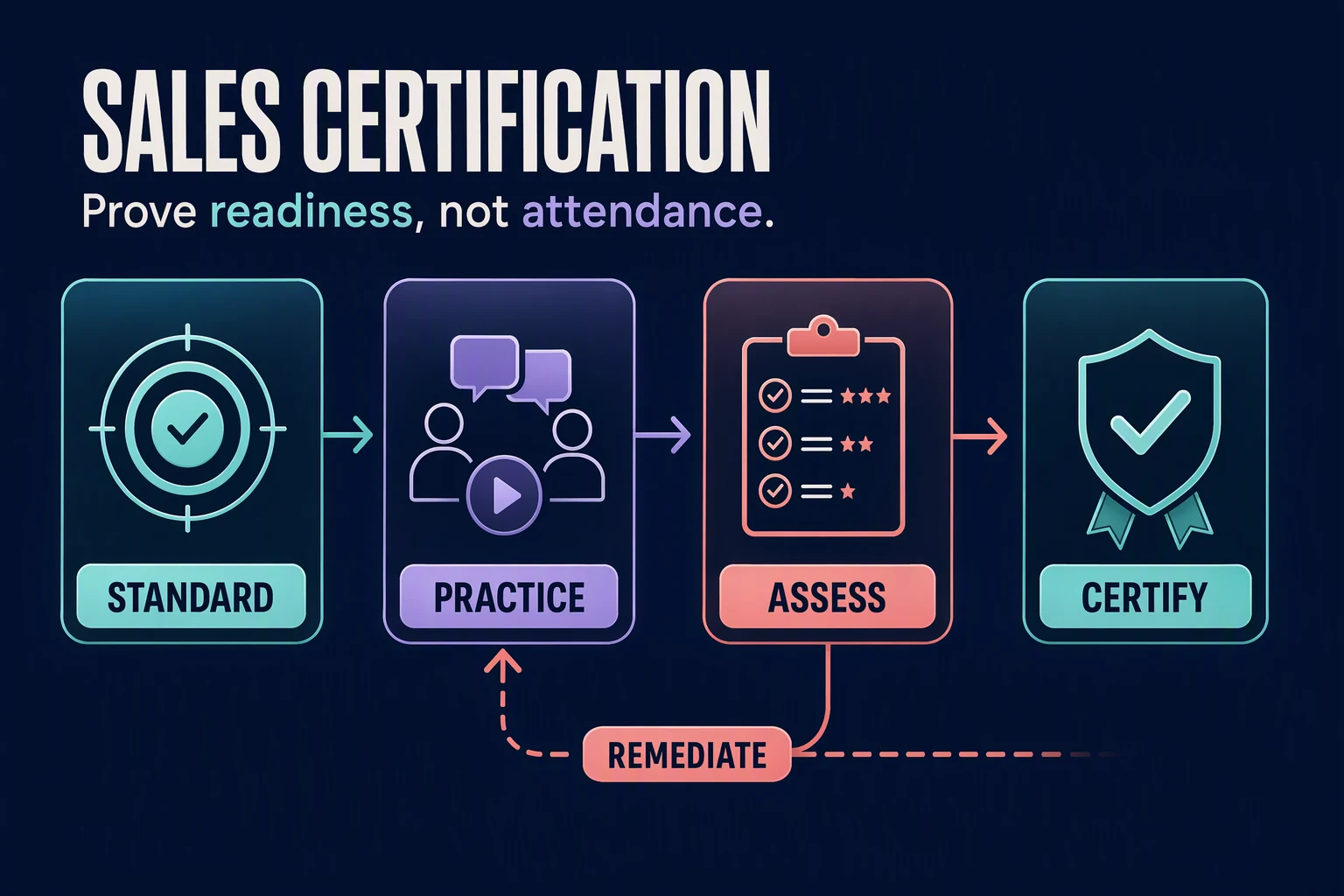
To build a sales certification program, decide which selling situations reps must prove they can handle, then test each with the right format: a knowledge test for facts, a scored role-play for conversations and a live call review for real behavior. Set pass marks before launch, publish a retake policy, and recertify when content changes.
This guide covers the whole program: what to certify, assessment formats, pass marks, attempts, recertification, a copyable rubric, tooling and how to measure impact without overclaiming. If you only need to weight an AI role-play scorecard and calibrate its scoring, our guide to sales readiness scorecards for AI role-plays and certification goes deeper on that one piece.
Last updated: 16 October 2026
What is a sales certification program?
A sales certification is a dated, evidence-backed claim that a rep can perform a specific selling task to a defined standard, for example “can run first-call discovery for the new security add-on without making unapproved claims.” A sales certification program is the system that defines those claims, assesses reps against them, records the result and decides when each claim expires.
Three things it is not:
- Not course completion. Completion shows exposure; certification shows performance. That is the core idea of sales readiness: ability proven before a seller meets buyers, not assumed because training happened.
- Not a performance review. It covers a bounded skill or knowledge area, not overall job performance. If results affect pay, territory or employment, treat the assessment like an employment test (see the fairness section below).
- Not an external credential. Professional bodies such as SMEI award individual sales credentials. An internal program certifies your product, your messaging and your sales process.
What should a sales certification include?
Certify the four areas where a rep’s mistakes cost deals, plus compliance where it applies. Each area needs a different kind of evidence:
| Area | Example claim | Best evidence | Typical format | Who signs off |
|---|---|---|---|---|
| Product knowledge | Can explain what the add-on does, who it is for, and how it is priced and packaged | Correct answers to scenario questions | Knowledge test (scenario-based) | Auto-scored; product marketing reviews the questions |
| Messaging and pitch | Can deliver the approved value story to a CFO in three minutes | Recorded pitch scored on a rubric | Video pitch or AI role-play | Enablement and the rep’s manager |
| Methodology and process | Can qualify an opportunity with our methodology and record it in the CRM | A completed work product (qualification notes, opportunity record) | Work sample review | Manager |
| Selling skills | Can handle the three most common pricing objections | Role-play scored on a rubric, then a sampled customer call | Role-play plus live call review | Manager (formal sign-off) |
| Compliance and risk (where relevant) | Never makes unapproved claims about security or regulatory status | Critical-error check across every format | Pass/fail gate | Enablement with legal or compliance |
Sales certification levels
Most programs need three or four levels, not one large exam:
- Foundation: every customer-facing employee. Product basics, ideal customer profile, positioning, compliance rules.
- Role: SDR, AE, account manager or customer success skills, such as first-call discovery for AEs or renewal conversations for account managers.
- Specialist: strategic accounts, technical overlay, a vertical, or partners.
- Launch: time-bound certifications for each new product, pricing change or messaging update. These are the ones that need to run fast and at scale.
How to build a sales certification program in 8 steps
- Write the claim and the decision it unlocks.
- Map each claim to evidence and an assessment format.
- Build scenarios and the rubric.
- Set the pass mark before anyone takes it.
- Write the attempts and remediation policy.
- Pilot and calibrate reviewers.
- Launch with a deadline, a record and a sign-off.
- Recertify, and retire what is out of date.
1. Write the claim and the decision it unlocks
Start with what certification allows. “Certified reps can position the add-on to customers; uncertified reps bring in a certified colleague” is a real decision. “Reps should complete the add-on certification” is not. Decide up front whether certification only guides coaching, unlocks an activity (pitching a product, taking inbound demos, a partner tier) or gates something heavier such as territory. The heavier the consequence, the more rigor you need in validation, review and HR involvement.
2. Map each claim to evidence and an assessment format
Assess the closest thing to the real job you can afford. Knowledge is cheap to test, conversations need a role-play, and actual behavior with buyers needs real calls. The formats table below shows what each one can and cannot prove.
3. Build scenarios and the rubric
Write scenarios from real deals: a persona, a situation, the objections that actually come up. Build two or three equivalent variants of each scenario so a retake tests skill, not memory of the last attempt. Then write a rubric with four to seven dimensions and a description of what each score level looks like, and list critical errors separately (the template below shows how).
4. Set the pass mark before anyone takes it
Fix the standard from the content, not from the results you hope to see. The pass marks section below explains a simple method for knowledge tests and role-plays.
5. Write the attempts and remediation policy
Publish how many attempts reps get, how long they wait between them, what changes on each retake and what happens after the last one. Reps take a certification more seriously, and managers coach more consistently, when the rules are known in advance.
6. Pilot and calibrate reviewers
Run the certification with a small pilot group that includes strong and newer reps. Have two reviewers score the same recordings independently, compare the evidence behind each score, and tighten any rubric descriptions they read differently. Look at questions almost everyone gets wrong: is the item unclear, or was it never taught? Our scorecard guide covers calibrating human and AI scoring in detail.
7. Launch with a deadline, a record and a sign-off
Give each certification a window (for a launch, a few weeks from training), a named manager who signs off, and a record that stores: certification and version, scenario variant, score per dimension, critical errors, reviewer, date, expiry date and any override with its reason.
8. Recertify, and retire what is out of date
Every certification gets an expiry date and a list of changes that trigger early recertification. When a product, price or message changes, retire the old certification so nobody is “certified” on something you no longer sell.
Sales certification assessment formats compared
| Format | What it proves | What it cannot prove | Scoring effort | Use it for |
|---|---|---|---|---|
| Knowledge test (multiple choice or scenario questions) | Recall and recognition of facts, rules and pricing | Whether the rep can say it to a buyer | Low (auto-scored) | Product, pricing, compliance basics |
| Written exercise (email, call plan, account plan) | Applied thinking and accurate use of messaging in writing | Live conversation skill | Medium | Methodology, follow-up, account planning |
| Recorded video pitch | Clear delivery of the approved message to a persona | Handling a buyer who pushes back | Medium (rubric review) | Messaging, talk tracks, launch pitches |
| Live role-play with a manager or peer | Two-way conversation: discovery, objections, next steps | Consistency across reviewers unless they are calibrated | High (scheduling and scoring) | Core skills, high-stakes scenarios |
| AI role-play with rubric scoring | The same as a role-play, on demand and repeatable | Judgment the rubric does not capture; formal sign-off still needs a human | Low per attempt after setup | Practice and first-pass scoring at scale |
| Live call review (recorded customer calls) | What the rep actually does with buyers | Situations the rep has not met yet | High (sampling and review) | Confirming that certification carries over into real deals |
The tests themselves also help reps learn. In a laboratory study with students, Roediger and Karpicke found that on tests taken days later, people who had practiced recalling the material retained substantially more than people who had restudied it, even though restudying looked better on an immediate test (Roediger and Karpicke, Psychological Science, 2006). Sales is not a memory lab, but the direction matters: practice attempts and certification checks do more than another rewatch of the launch webinar.
Sales certification rubric: a template you can copy
This rubric is for a messaging or pitch certification, the most common launch certification. It uses a 1 to 4 scale where 3 is the certified standard. Weights add up to 100.
| Dimension (weight) | 1: Not yet | 2: Developing | 3: Certified standard | 4: Exemplary |
|---|---|---|---|---|
| Buyer problem framing (20) | Generic pitch, no persona problem | Names a problem, in the vendor’s words | States the persona’s problem in the buyer’s terms and checks it with a question | Connects the problem to this account’s situation |
| Approved value message (20) | Features only, or inaccurate | Some approved points, recited | Uses the approved value points accurately, in the rep’s own words | Leads with the points that matter most to this persona |
| Differentiation (15) | None, or disparages a competitor | Lists differences without relevance | States the approved differentiators and why the buyer should care | Ties each differentiator to the buyer’s stated criteria |
| Proof (15) | No proof, or unapproved proof | Proof that does not fit the buyer | Uses an approved proof point correctly | Chooses proof matched to the buyer’s industry and size |
| Objection response (15) | Argues or ignores the objection | Answers without clarifying | Acknowledges, clarifies, answers with the approved response, checks | Turns the objection into further discovery |
| Next step (15) | None, or vague | Suggests a next step without a date or owner | Proposes a specific next step with a date and owner | Secures commitment and widens the buying group |
| Critical errors (gate, not scored) | Unapproved pricing or discount commitments; inaccurate security, legal or regulatory claims; disparaging a competitor; sharing confidential information. Any critical error means “not yet certified”, whatever the score. | |||
Scoring: weighted score = the sum of (weight × rating ÷ 4). A rep rated 3 on every dimension scores 75, so the pass rule can be: no critical errors, weighted score of at least 75, and no dimension rated 1. The 75 comes from the rubric design (every dimension at the certified standard); it is not an industry benchmark.
Worked example: a rep is rated 3, 4, 3, 2, 3 and 3. That gives 15 + 20 + 11.25 + 7.5 + 11.25 + 11.25 = 76.25, with no 1s and no critical errors: certified, with coaching on proof. A second rep rated 4 on everything but who offers an unapproved discount is not yet certified.
How to set a pass mark for sales certification
For knowledge tests, use a content-based method rather than a gut number. In the modified Angoff method, subject-matter experts estimate, for each question, the probability that a minimally competent candidate would answer it correctly; the averaged estimates give the score such a candidate is expected to achieve, and the pass mark is set from that. Because the standard comes from the content rather than a curve, every candidate can pass (Physician Assistant Certification Council of Canada, Pass Standard Setting Method, undated, accessed 16 October 2026). For a sales test, your experts are a few top reps, two managers and the product marketer who owns the product.
For role-plays and pitches, the standard lives in the rubric: write the level 3 descriptions first, set the pass rule from them, and check it in the pilot. If strong reps fail, the descriptions are wrong; if everyone passes on the first attempt, the bar may be too low.
Should sales certification be pass/fail?
Yes for the decision, no for the feedback. The outcome should be binary (“certified” or “not yet certified”) because it unlocks something. The feedback should be per dimension so the rep and manager know what to practice. Add an “exemplary” level only if it drives a decision, such as who becomes a peer reviewer.
What is a good pass rate for sales certification?
There is no reliable published benchmark. When Revspire reviewed the research for its sales onboarding and ramp statistics page, it found no published data on first-attempt certification pass rates as of October 2026. Read your own numbers instead: a near-universal first-attempt pass on a hard skill suggests the bar is low, and failures clustered on one dimension point to a training or rubric problem rather than weak reps.
How many attempts should reps get to certify?
A practical default for internal certification is three attempts within the certification window, with coaching between attempts and a different scenario variant each time. External professional exams are stricter, because they protect a credential’s market value:
- Microsoft Certification: a 24-hour wait after a first failed attempt, 14 days between later attempts, and no more than five attempts in 12 months (Microsoft Learn, exam retake policy, updated 27 July 2026).
- SMEI (Sales and Marketing Executives International): after a failed exam, a candidate can take up to two paid remedial exams, each within six months of the previous attempt, and after failing both must reapply (SMEI, Remedial Certification Examinations policy, modified 20 August 2026).
Internal programs exist to make reps ready, so they can be more generous. But unlimited instant retakes turn certification into trial and error. A policy that works:
| Attempt | When | What changes | Who is involved |
|---|---|---|---|
| 1 | Within the certification window | Scenario variant A | Rep; AI or reviewer scoring |
| 2 | After at least one coaching action on the lowest dimension | Scenario variant B | Manager or enablement coach |
| 3 | After practice that reaches the standard on the weak dimension | Scenario variant C, human reviewer | Manager and enablement |
| After 3 | Next certification window | Development plan; review whether the scenario or training is the problem | Manager, enablement, and HR if there are employment consequences |
Keep every attempt on record. If many reps need a third attempt on the same dimension, fix the program before you coach the reps.
Sales recertification: how often should reps recertify?
Use two triggers together:
- Change-based (always): a new product version, pricing or packaging change, a new messaging framework, new competitive positioning, a methodology change or a regulatory change. Recertify only the claims that changed.
- Time-based (a baseline): annual sales recertification for core pitch and methodology certifications, because skills that are rarely used fade and small message drift adds up.
Make recertification shorter than the original. Microsoft’s model is a useful pattern: its associate, expert and specialty certifications are renewed every year through a free, shorter, open-book online assessment focused on recent updates, which candidates can retake as often as needed within a six-month eligibility window (Microsoft Learn, renew your certification, updated 14 January 2025). The sales version is a short check on what changed plus one role-play on the riskiest scenario.
In regulated industries, external rules set the floor. FINRA, for example, requires registered persons at US broker-dealers to complete the Regulatory Element of continuing education every year by 31 December (FINRA, Continuing Education, undated, accessed 16 October 2026). Internal sales certification sits on top of requirements like this and does not replace them.
| Certification type | Suggested expiry | Recertify early when | Recertification format |
|---|---|---|---|
| Foundation (product, ICP, positioning) | 12 months | Positioning changes | Short knowledge check on what changed |
| Messaging or pitch | 12 months | The messaging framework is updated | Video pitch on the new message |
| Launch | Until the product’s next major release | Each major release or pricing change | Knowledge check plus objection role-play |
| Methodology and skills | 12 to 18 months | The methodology changes, or call reviews show drift | Role-play plus sampled call review |
| Compliance claims | As set by policy or regulator | Policy or regulation changes | Pass/fail check |
How long should sales certification take?
For the rep, keep each certification to one sitting: a knowledge check that takes minutes, not an hour, and one or two role-play or pitch scenarios. For a launch, set a window of a few weeks from training to a fully certified team, and measure how long it actually takes. Revspire’s ramp research found no published benchmark for time from launch to a certified team, so your own trend is the useful number.
How to run sales certifications at scale: tooling
| Tool type | What it does well for certification | What to watch for |
|---|---|---|
| LMS or quiz tool | Knowledge tests, completion records, expiry dates | Weak at scoring conversations |
| Sales readiness or enablement platform | Certification paths, video pitches, role-play, manager review, readiness reporting | Rubric versioning, evidence storage, expiry and recertification automation |
| AI role-play | Repeatable on-demand practice and first-pass scoring | Calibrate against human reviewers; keep human sign-off for formal certification |
| Conversation intelligence | Sampling real calls to check that behavior carries over | Recording consent rules; small or biased samples |
| CRM | Linking certification status to routing, territories and deals | Only as reliable as the sync |
Revspire’s AI Sales Training & Coaching sits in the readiness category: AI video role-plays of buyer conversations, deal-specific objection practice with battle cards, instant scoring for clarity, confidence and objection handling, and team readiness tracking.
Whatever you use, check six things:
- The evidence (recording, transcript or answers) is stored next to the score.
- Scenarios, rubrics and pass marks are versioned.
- A human can override an AI score, and the reason is logged.
- Expiry dates and recertification reminders are automatic.
- Results report by dimension, not just pass or fail.
- Certification status reaches the CRM or routing rules.
Partner certification programs
Partner certification follows the same design with two differences: it usually ties to partner tiers or deal registration, and partners give you less time, so keep assessments short and specific to the products they resell. Revspire’s Partner Portal gives partners governed access to content, playbooks, deal rooms, training and certifications, with analytics on training completion and certification.
How to measure the impact of a sales certification program honestly
The Kirkpatrick Model’s four levels (reaction, learning, behavior, results) give a structure, and Kirkpatrick Partners advises starting evaluation planning from Level 4, the organizational results you want (Kirkpatrick Partners, The Kirkpatrick Model, undated, accessed 16 October 2026).
| Level | What to measure for certification | Honest caveat |
|---|---|---|
| 1. Reaction | Reps’ ratings of relevance and fairness | Liking a certification is not learning from it |
| 2. Learning | Pass rates by dimension, attempts to certify, critical-error rate | Measures the test as much as the rep |
| 3. Behavior | Sampled customer calls showing the certified behavior; manager observations | Small samples and reviewer bias |
| 4. Results | Win rate, cycle length, deal size or ramp on the certified motion | Many causes; reps who certify fast may already be stronger |
Methods that keep the claims honest:
- Do not compare certified reps with uncertified reps and call the gap impact. Stronger reps tend to certify first, so the comparison flatters the program.
- Where you can, roll out team by team and compare teams before and after, on the same motion.
- Decide what you will measure before the launch, not after you see the numbers.
- Say “associated with” unless the design supports “caused by”.
- Track program health alongside outcomes: time to a certified team, first-attempt pass rate by dimension, reviewer agreement, questions almost everyone misses, and recertification completed before expiry.
Our guide to sales training evaluation and ROI covers the evidence chain and ROI guardrails in more depth.
Fairness and legal review
If certification results feed decisions about pay, promotion, territory or continued employment, US guidance treats performance tests, simulations and work samples as employment tests: if one screens out a protected group, the employer must show it is “job-related and consistent with business necessity”, and the EEOC advises that tests be properly validated for the positions and purposes they are used for (US EEOC, Employment Tests and Selection Procedures, 1 December 2007). In practice: keep the assessment tied to the job, check pass rates across groups, offer accommodations, and involve HR and legal before you attach consequences. This is not legal advice.
Sales certification checklist
- Each certification has a written claim and the decision it unlocks.
- Every claim maps to evidence and a format that can prove it.
- Scenarios come from real deals, with two or three equivalent variants.
- The rubric has four to seven dimensions, level descriptions and a separate critical-error list.
- Pass marks were set from content and checked in a pilot.
- The attempts policy is published: number, timing, what changes, what happens after the last attempt.
- Two reviewers scored the pilot independently and the rubric was adjusted.
- Records store version, scores by dimension, reviewer, date, expiry and overrides.
- Every certification has an expiry date and change triggers.
- Impact metrics were chosen before launch, with honest comparisons.
- HR and legal have reviewed any certification with employment consequences.
Frequently asked questions
How do you certify sales reps?
Define the specific selling task they must prove, choose evidence that shows it (a knowledge test, a scored role-play or pitch, a reviewed call), and score it against a rubric with a pass mark set in advance. A manager signs off, and the result is recorded with an expiry date.
Should sales certification be pass/fail?
The decision should be pass/fail (“certified” or “not yet certified”) because it unlocks an activity. The feedback should not: give scores by dimension so reps know what to practice. Treat critical errors as an automatic “not yet”, regardless of the total score.
What is a good pass rate for sales certification?
No reliable benchmark is published. Use your own data: very high first-attempt pass rates on hard skills suggest the bar is too low, and failures concentrated on one dimension usually point to a gap in training or a badly written rubric description.
How often should sales reps recertify?
Recertify whenever the product, pricing, messaging or methodology changes, and at least annually for core pitch and methodology certifications. Make recertification a shorter check on what changed rather than a repeat of the full certification.
How do you certify reps on a new product?
Run a launch certification: a short knowledge check on what the product does, who it is for and how it is priced, then a recorded pitch or role-play against the new messaging and its likely objections. Give it a window of a few weeks after launch training, and let only certified reps position the product.
Can AI certify sales reps?
AI role-play can score practice and certification attempts at scale against a published rubric, which saves manager time. For formal certification, calibrate AI scores against human reviewers and keep a manager’s sign-off and an override path.
Before you set targets for your program, see what is and is not published on ramp, practice and certification in our sales onboarding and ramp statistics research.
Sources
All pages were accessed on 16 October 2026. Publication or update dates are shown where the page gives one.
- Test-enhanced learning: Taking memory tests improves long-term retention, Roediger, H. L. and Karpicke, J. D., Psychological Science 17(3), 249-255, 2006 (record on Washington University in St. Louis profiles). Accessed 16 October 2026.
- Pass Standard Setting Method (modified Angoff), Physician Assistant Certification Council of Canada / Canadian Association of Physician Assistants (undated). Accessed 16 October 2026.
- Exam retake policy, Microsoft Learn, updated 27 July 2026. Accessed 16 October 2026.
- Renew your Microsoft Certification, Microsoft Learn, updated 14 January 2025. Accessed 16 October 2026.
- SMEI Policy: Remedial Certification Examinations, Sales and Marketing Executives International, modified 20 August 2026. Accessed 16 October 2026.
- Continuing Education (CE), FINRA (undated). Accessed 16 October 2026.
- The Kirkpatrick Model, Kirkpatrick Partners (undated). Accessed 16 October 2026.
- Employment Tests and Selection Procedures, US Equal Employment Opportunity Commission, 1 December 2007. Accessed 16 October 2026.
Leave a Reply