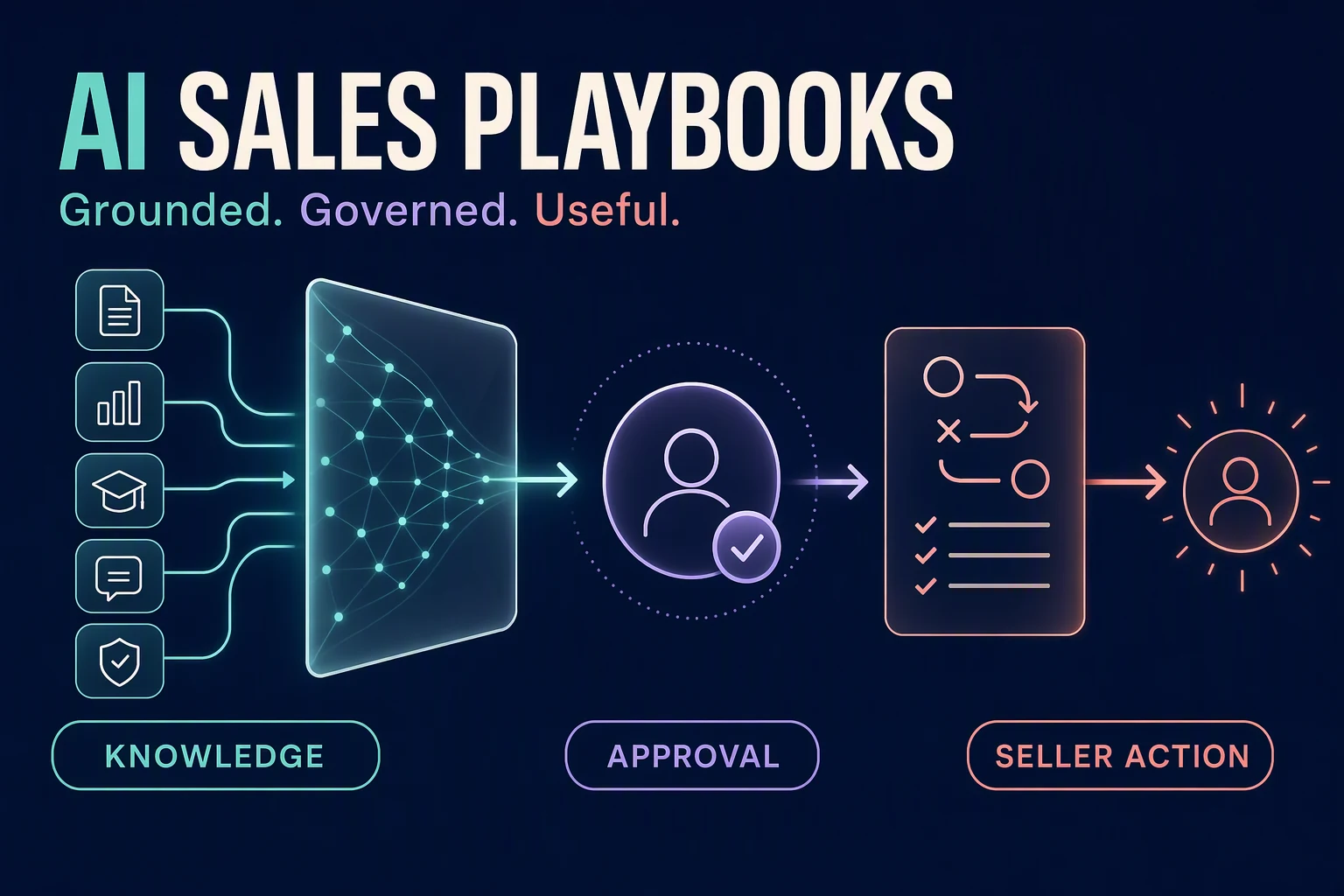
An AI sales playbook is a set of sales plays that AI drafts, updates and delivers from your approved company knowledge, with a named owner approving every change before sellers see it. Unlike a static PDF playbook, it stays linked to current content, CRM and call data, and it appears inside the tools sellers already use.
Below: what to ground it in and why, how approval works, how sellers use plays, an evaluation checklist and an overview of the main software approaches.
Last updated: 16 October 2026
What is an AI sales playbook?
A sales playbook documents how a team sells: target buyers, stages, messaging, discovery questions, objection handling and the content to use. A play is one repeatable unit inside it: a trigger (for example, “a named competitor appears in a late-stage deal”), the steps to take, what to say and what to send.
An AI sales playbook keeps that structure and changes three things:
- Authoring. AI drafts plays from a short outcome brief and from approved sources, instead of an enablement manager writing every page by hand.
- Upkeep. AI flags plays that new evidence contradicts, such as a pattern in lost deals, a product release or a competitor’s new packaging, and proposes edits for review.
- Delivery. Plays surface where selling happens (the CRM opportunity, chat, email, a buyer deal room), matched to the deal’s stage, persona, industry and competitor.
One thing does not change: the people who own the sales motion set the strategy and approve what goes live. “Generative”, “AI-powered” and “AI-generated” sales playbooks all describe the same idea. An “agentic” playbook goes further, with AI recommending or taking the next action. That is already common: in Allego’s 2026 AI in Revenue Enablement report (318 revenue enablement leaders, fielded by TrendCandy, published 11 June 2026), 56% said they use or pilot AI systems that recommend actions or execute tasks.
Anatomy of one AI play
- Trigger: the stage, persona, industry, competitor or signal that makes the play relevant.
- Understand: the two or three things the seller must know, such as the buyer’s likely problem, your angle and the main risk.
- Say: discovery questions, a short talk track and the top objections with approved responses.
- Send: the approved assets for this moment, by current version.
- Sources: a link from every claim to the approved document it came from.
- Control fields: owner, approver, version and next review date.
How is an AI sales playbook different from a traditional playbook?
A traditional playbook is a document. An AI playbook is a governed system that produces and maintains documents. The table summarises the practical differences.
| Dimension | Static playbook (PDF, slides or wiki) | AI sales playbook |
|---|---|---|
| Creation | Written by hand over weeks, released as one large document | Drafted play by play from an outcome brief and approved sources, then reviewed |
| Source of truth | Whatever the author knew on the day | Linked to approved content, CRM fields, call evidence and win/loss findings |
| Freshness | Revised once or twice a year | Change events trigger proposed edits; every play carries a review date |
| Delivery | A link sellers must remember to open | Surfaced in the CRM, chat, email and deal rooms by stage and persona |
| Personalisation | One version for everyone | Variants by role, industry and competitor, built from the same approved core |
| Governance | Informal; old copies keep circulating | Owners, approval routing, version history and retirement of old versions |
| Measurement | Downloads or page views | Which plays are used, in which deals, and what happened next |
| Main failure mode | Goes stale and gets ignored | Confident but wrong output, if it is not grounded and reviewed |
What data should an AI sales playbook be grounded in?
Grounding means the AI retrieves passages from a defined set of approved sources and writes from them, citing each one, instead of answering from whatever its model absorbed in training. The usual technique is retrieval-augmented generation. The paper that named it, Lewis et al. (arXiv, May 2020), argued that retrieval makes a model’s claims easier to trace and its knowledge easier to update. Both matter in a sales playbook.
Ground plays in these sources
- Approved messaging and positioning (one live version only).
- Product documentation and release notes, with ship dates.
- Pricing and packaging rules, including what sellers may not offer.
- Customer evidence cleared for external use, with consent on file.
- Competitive intelligence where each claim carries a date and a source.
- Win/loss interviews and win/loss analysis.
- Call transcripts, as evidence of what buyers ask, not as a source of product facts.
- CRM fields that select the play: stage, segment, industry, competitor, deal size.
- Legal and compliance guidance, including claims you must never make.
Keep out drafts, superseded versions, competitor marketing copy taken at face value, open-web results and personal notes. If a source would not survive a review by its owner, the AI should not read it.
Why ungrounded generation is a risk
The US National Institute of Standards and Technology lists “confabulation” among the risks that generative AI creates or worsens in its Generative AI Profile (NIST AI 600-1, 26 July 2024), defining it as confidently stated but erroneous or false content. In a sales playbook that looks like a feature that has not shipped, a certification you do not hold, a competitor weakness nobody verified or a discount the seller is not allowed to offer.
Companies answer for what their AI tells customers. In Moffatt v. Air Canada, decided by British Columbia’s Civil Resolution Tribunal on 14 February 2024, the airline’s website chatbot gave a customer wrong information about bereavement fares. The tribunal found the airline liable for negligent misrepresentation, rejected its argument that it was not responsible for the chatbot, and held that correct information elsewhere on the site did not excuse the error, as Torkin Manes summarised on 27 February 2024. A seller who pastes an AI-written claim into a proposal creates the same kind of exposure.
Grounding reduces errors but does not remove them. When Stanford RegLab and HAI researchers tested retrieval-based legal research tools (Stanford HAI, 23 May 2024, updated 30 May 2024), Lexis+ AI and Ask Practical Law AI produced incorrect information more than 17% of the time and Westlaw AI-Assisted Research hallucinated more than 34% of the time, against hallucination rates of 58% to 82% for general-purpose chatbots in the authors’ earlier study. These are legal tools, but the lesson carries over: retrieval narrows the error rate, and human review must catch the rest.
How to stop AI from making up product claims in sales content
- Keep a claims register. List each approved claim with its source, owner and expiry date, and allow the AI to state only claims in the register.
- Require a citation per section. A sentence with no source is flagged for review, not published.
- Prefer a gap to a guess. Instruct the system to write “no approved source” rather than fill the gap.
- Maintain a do-not-say list. Unreleased roadmap, certifications you do not hold, unverified competitor claims and pricing exceptions.
- Always route high-risk content to a person. Anything with a number, a customer name or a comparative claim needs a named reviewer.
- Expire claims automatically. When a source document is replaced, every play that cites it returns to review.
How to govern AI-generated sales messaging and content
Governance answers three questions for every play: who may change it, who must approve it, and when it stops being valid. If your team already practises sales content governance, extend the same owners and rules to AI drafts rather than creating a parallel process.
Who approves what
| Content in the play | Usual owner | Approver before publishing | Review trigger |
|---|---|---|---|
| Positioning and messaging | Product marketing | Product marketing lead | Launch, repositioning, competitor move |
| Product capability claims | Product marketing | Product manager for that area | Each release |
| Pricing, discounts and terms | Deal desk or RevOps | Finance or deal desk | Price-book change |
| Competitive claims and battlecards | Competitive intelligence or product marketing | Product marketing, plus legal for comparative claims | Competitor launch; scheduled quarterly check |
| Customer proof (logos, quotes, results) | Customer marketing | Customer marketing, with customer consent on file | Consent or contract change |
| Discovery and process guidance | Enablement and sales leadership | Sales leader for the segment | Methodology or territory change |
| Regulated or legal language | Legal or compliance | Legal | Policy or regulation change |
How to get human approval on AI sales content without slowing everything down
- Request. Someone files an outcome brief: audience, selling moment, desired outcome, competitor, constraints.
- Ground. The system pulls only from approved sources and shows which ones it used.
- Draft. AI writes the play with a citation per section.
- Review by section. Each section routes to its owner, so the deal desk sees only the pricing paragraph and the product manager sees only capability claims. Uncited claims block publication.
- Publish once. The approved version goes live in every channel at the same time, and the previous version is retired rather than left in shared drives.
- Monitor. Usage, seller feedback and new evidence trigger the next review.
Keep an audit trail of who approved which version, when, and from which sources. NIST AI 600-1 recommends reviewing and verifying the sources and citations in generative AI output both before deployment and during ongoing monitoring (action MS-2.5-003), which is the same discipline applied to plays.
How to build an AI sales playbook: a worked example
The example below uses a fictional company and competitor. It shows the order of work, which matters more than the tool.
Step 1: Write the outcome brief
- Audience: account executives selling to mid-market manufacturers.
- Selling moment: evaluation stage, when the buyer’s CFO joins and compares your price with the incumbent tool.
- Desired outcome: the CFO agrees to a joint business-case review.
- Competitor: “Competitor A”, the incumbent.
- Constraints: no discount language; use only the approved business-case method.
Step 2: Choose the sources
The current pricing and packaging guide, the approved business-case method, two customer stories cleared for external use, the competitive brief on Competitor A dated this quarter, and the last two quarters of win/loss notes where price was cited as a reason.
Step 3: Generate the draft with a constrained prompt
Using only the attached sources, draft a sales play for the selling moment below.
Cite the source document and version after each section.
If a statement has no source, write NO APPROVED SOURCE instead of the statement.
Do not mention pricing exceptions, roadmap items, or claims about Competitor A
that are not in the competitive brief.

Selling moment: evaluation stage; the CFO compares our price with Competitor A.
Sections: trigger; what the seller should understand; two discovery questions
for the CFO; a 60-second talk track; the top two objections with approved
responses; assets to send; the next step to propose.
Steps 4 to 6: Review, publish, revise
Product marketing checks the talk track, the deal desk checks anything touching price, and the competitive owner checks every statement about Competitor A; each NO APPROVED SOURCE line is sourced or deleted. Attach the approved play to opportunities in evaluation where Competitor A is recorded and a finance contact is on the buying committee. After a quarter, compare deals where the play was opened with similar deals where it was not, review the call moments where the CFO pushed back, and send proposed changes back through review.
How do sellers use AI plays in the flow of work?
A playbook only helps if sellers can apply it in the conversation. In Highspot’s GTM Performance Gap Report 2026 (450 go-to-market leaders; page modified 19 August 2026), 36% said sellers struggle to apply messaging live, and 76% said AI adoption is moving faster than their organisation can support. Design delivery as carefully as content.
- On the CRM opportunity: the play that matches the stage, persona and competitor appears on the record.
- Before a meeting: a short brief pulls the play, the account history and the right assets together.
- In chat or an AI assistant: a seller asks how to answer a pricing objection in Slack, Teams or an assistant connected through MCP, and gets the approved answer with its source.
- In the buyer deal room: the play’s approved assets are shared with the stakeholder they were written for.
- In practice sessions: the play becomes a role-play or quiz before the real call. Our guide to turning sales playbooks into AI role-plays, quizzes and coaching covers that conversion step by step; this guide stays with authoring, grounding and governance.
How to roll out AI playbooks to sales reps
- Start with one motion that hurts, such as a competitor that keeps winning or a new product line.
- Publish three to five plays, not a full library.
- Ask managers to open the plays in deal reviews, so reps see them used.
- Give sellers a one-click “this is wrong or missing” button that routes to the play’s owner.
- Expand only when the first plays are used and trusted.
How do AI playbooks stay accurate?
Can AI keep sales playbooks up to date? It can detect when a play is out of date and draft the fix, but publishing should still go through the play’s owner. Accuracy is a maintenance loop, with a defined path back into the playbook for each type of new evidence.
- Win/loss data. When an objection keeps appearing in lost deals, the system proposes a revised response. Automate the detection and the draft, not the publishing.
- Call recordings. Transcripts show new buyer language and objections. Use them to decide what to change; take the facts in the answer from approved sources.
- Product releases. Release notes re-ground every play that mentions the changed capability.
- Competitor launches. The competitive owner updates the brief first, and every battlecard and play that cites it returns to review.
- Review dates. An expired play is hidden or clearly labelled until someone re-approves it.
- Usage and feedback. Plays nobody opens, or that sellers flag as wrong, are revised or retired.
How to evaluate AI sales playbook tools: a checklist
Use these questions in demos. Ask the vendor to show each answer live, on your own content if possible, rather than on slides.
| Criterion | Ask the vendor | A good answer |
|---|---|---|
| Grounding scope | Which sources can the AI draft from, and can we restrict it to approved ones? | An admin-defined source list; no open-web generation unless you switch it on |
| Citations | Does each section link to the passage and version it came from? | Click-through to the source; uncited statements are flagged |
| Approval routing | Can different sections route to different owners? | Section-level routing, with publishing blocked until approval |
| Versioning and retirement | What happens to old versions and shared links when a play changes? | One live version; old links update or are retired |
| Permissions | Does the AI respect content permissions by team, region or partner? | Answers draw only on what that user is allowed to see |
| Delivery and triggers | Where will sellers see plays, and what decides which play appears? | CRM record, email, chat, AI assistants and deal rooms, matched on CRM fields such as stage and competitor |
| Update loop | How do win/loss findings, calls and releases reach the playbook? | Proposed edits routed for review, never silent rewrites |
| Practice | Can a play become a role-play or quiz? | Linked practice that updates when the play changes |
| Analytics | What can we measure? | Play use by deal and stage, seller feedback, review cycle time, outcomes against a comparison group |
| Data and AI governance | Is our data used to train models? Which security and AI-management certifications apply, and to which entity? | A written policy, with certifications you can verify for the vendor itself rather than only its hosting provider |
Red flags: a demo that only shows open-ended prompting, no way to see where a sentence came from, “fully autonomous” publishing to sellers, and no audit trail of approvals.
What is the best AI sales playbook software? A short category overview
Disclosure: Revspire publishes this guide and sells an AI playbook product. Vendors are listed alphabetically, Revspire appears once, and each description comes from the vendor’s own pages, checked on 16 October 2026. There is no single best tool; the right one depends on where your playbook, content and call data live today. If you already own an enablement suite or a conversation intelligence tool, check its playbook features before buying another.
| Vendor | Approach | What the AI works from (vendor’s description) | Where sellers meet it |
|---|---|---|---|
| Gong (Gong Enable) | Conversation-led enablement | Real customer conversations | Inside Gong: practice, coaching inbox, call reviews |
| Highspot by Seismic | Enterprise enablement suite | Plays built from templates with AI-recommended content; Seismic’s Aura Chat grounded in trusted Seismic content | Plays and content surfaced in the CRM by persona, industry and stage |
| Klue | Competitive enablement | Public web, sales calls, win/loss interviews, internal documents | Email deal insights and answers in Slack |
| Revspire | AI playbook engine within an enablement platform | Approved revenue knowledge: CRM data, calls and approved content | Seller workspace, CRM opportunities and buyer deal rooms |
| Spekit | In-the-flow knowledge and guidance | The customer’s governed go-to-market knowledge | Chrome extension, Slack, Outlook and Salesforce |
Gong (Gong Enable)
- Notable: AI Trainer turns past calls into role-play scenarios, and Initiative Tracking measures whether talk tracks show up in the field (Gong Enable).
- Limitation: the Enable page does not mention playbook authoring or human review of AI-generated scenarios and scores.
- Choose it instead when: calls are already recorded in Gong and the main question is whether reps use the talk tracks.
Highspot by Seismic
- Notable: plays combine role guidance, actions and AI-recommended content, with play-usage scorecards, and surface in Salesforce and Microsoft Dynamics 365 (Highspot, modified 1 June 2026). Seismic cites ISO 42001 certification for AI management (Seismic, 21 October 2025).
- Limitation: Highspot is now part of Seismic, so confirm which product line and roadmap a quote covers; neither page describes section-level approval of AI drafts.
- Choose it instead when: you want a large-enterprise suite for content, plays and learning from one established vendor.
Klue
- Notable: Compete Agent keeps competitor profiles current and answers competitive questions in Slack, and Klue says every output has human oversight (Klue, 10 June 2025).
- Limitation: its scope is competitive intelligence and win/loss, not the whole playbook (discovery, process, onboarding).
- Choose it instead when: competitive deals are your main problem and you have a competitive intelligence owner.
Revspire AI Playbook Engine
- Notable: the Revspire AI Playbook Engine drafts battlecards, objection plays, win/loss insights and role-specific messaging, routes each draft to its reviewers before sellers see it, and shows which plays sellers open and use.
- Limitation: none of the three plans on Revspire’s pricing page (Launch, Elevate and Spark) lists the Playbook Engine, so scope and price come through a demo; no free plan or trial is listed.
- Choose it when: you want plays connected to governed content, seller practice and deal rooms in one workflow.
Spekit
- Notable: AI Sidekick gives in-the-moment guidance, and the platform lists decay detection and freshness monitoring for its knowledge base (Spekit).
- Limitation: the homepage does not describe a sales play or playbook feature by name, or an expert approval workflow.
- Choose it instead when: the main problem is reps not finding answers inside the tools they already use.
How to measure AI playbook ROI
Measure in two layers, and be honest about which one proves what.
- Leading indicators: coverage (share of active deals with a matching play), play use by stage, seller feedback, time from a change (launch, competitor move) to a live approved play, review cycle time, and uncited claims caught before publishing.
- Outcome indicators: stage conversion and win rate in deals where the play was used, against comparable deals where it was not, and ramp time for new hires on that motion.
- Method: compare like with like (segment, deal size, quarter). Treat the result as correlation unless you staggered the rollout by team, which gives you a fairer comparison group.
Frequently asked questions
What is the best AI sales playbook software?
There is no single best tool. Enablement suites suit teams that want plays, content and delivery from one platform; in-the-flow tools such as Spekit suit quick answers inside existing apps; Gong suits teams centred on call data; Klue suits competitive programmes. Use the checklist above and test each tool on your own approved content.
Can AI generate playbooks from CRM data?
Partly. CRM data tells the AI which segments, stages and competitors matter and where deals stall, and it decides which play to show. It does not contain your approved messaging or product facts, so combine it with approved content and win/loss evidence, and have the motion’s owner approve the result.
What are the risks of AI-generated battlecards?
The main risks are invented or outdated competitor weaknesses, wrong pricing comparisons and comparative claims that create legal exposure. Ground battlecards in dated, sourced competitive intelligence, require the competitive owner’s approval, and send comparative claims to legal. A battlecard nobody can trace to a source should not reach a seller.
Will AI replace sales enablement?
Nothing we reviewed shows that. AI shifts enablement work from writing and distributing documents to curating sources, approving output, designing practice and coaching. When 76% of leaders in Highspot’s 2026 report say AI adoption is outpacing what their organisation can support, that work looks more necessary, not less.
See how grounded drafting, approval routing and publishing work on your own content: book a Revspire demo.
Sources
All pages were accessed on 16 October 2026. Publication or modification dates are shown where the page gives one.
- AI drives revenue growth: 2026 AI in Revenue Enablement report, Allego, 11 June 2026
- Retrieval-Augmented Generation for Knowledge-Intensive NLP Tasks, Lewis et al., arXiv, 22 May 2020 (v4, 12 April 2021)
- Artificial Intelligence Risk Management Framework: Generative Artificial Intelligence Profile (NIST AI 600-1), NIST, 26 July 2024
- BC Tribunal confirms companies remain liable for AI chatbot-created information, Torkin Manes LLP, 27 February 2024
- AI on Trial: Legal Models Hallucinate in 1 out of 6 (or More) Benchmarking Queries, Stanford HAI, 23 May 2024 (updated 30 May 2024)
- GTM Performance Gap Report 2026, Highspot, modified 19 August 2026
- Gong Enable, Gong, undated product page
- Sales playbook software, Highspot by Seismic, modified 1 June 2026
- Seismic launches Aura AI agents, Seismic, 21 October 2025
- Klue launches Compete Agent, Klue, 10 June 2025 (modified 30 July 2025)
- Spekit homepage, Spekit, undated
- AI Playbook Engine, Revspire
- Pricing, Revspire
Leave a Reply