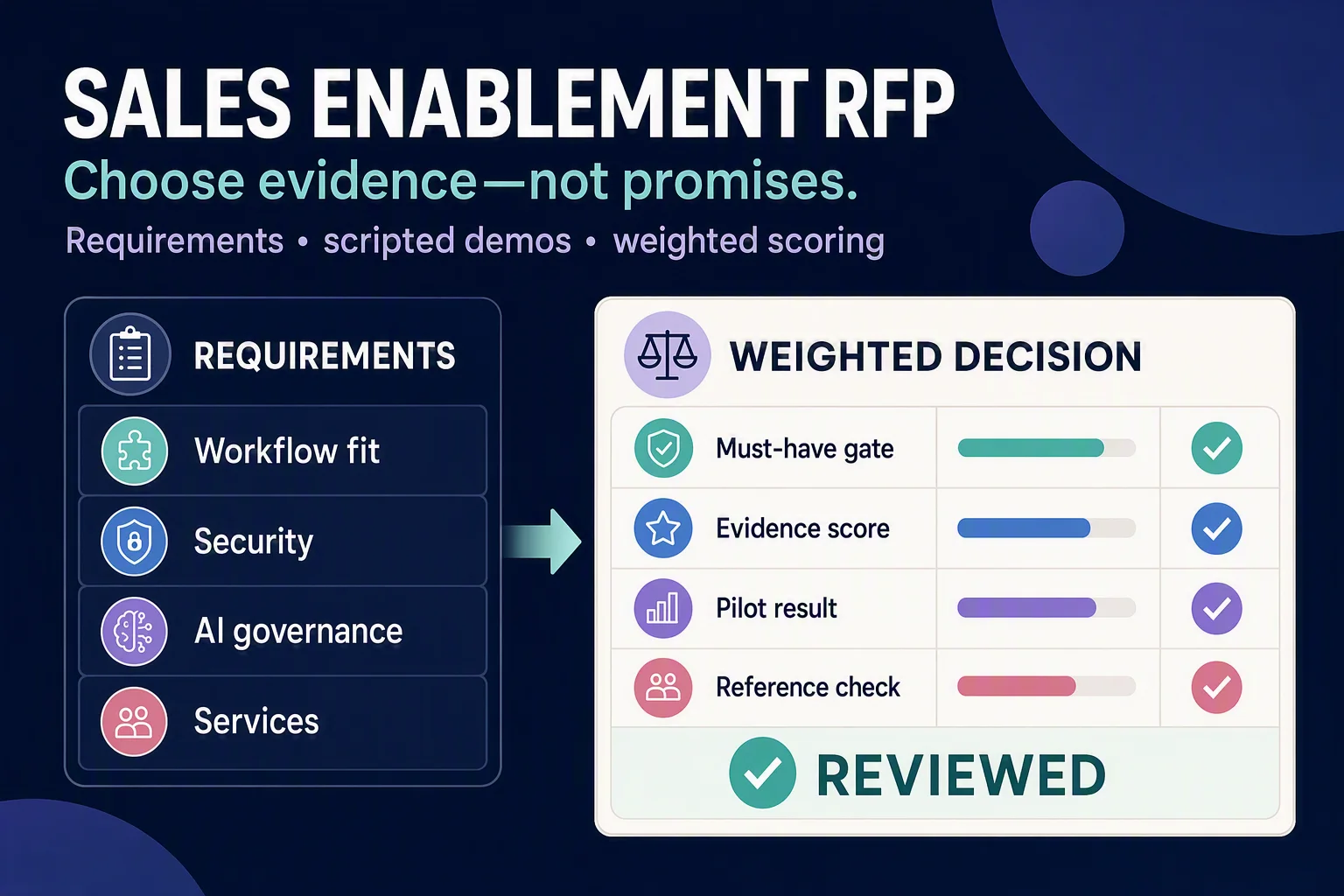
To evaluate sales enablement tools, write a one-page decision brief, turn must-haves into pass/fail gates, score everything else on a weighted 0-4 scale fixed before proposals arrive, give every finalist the same scripted demo on your own content, and pilot the riskiest assumption with real sellers before you sign.
This guide gives you each piece ready to copy: 18 testable requirements, security and AI questions, a weighted scorecard with a worked example, a demo script, a 30-day pilot plan and an RFP outline. For the vendors themselves, see our list of the best sales enablement tools for B2B teams.
Last updated: 16 October 2026
Disclosure: Revspire sells a sales enablement platform. The method below is vendor-neutral, and you can use it to evaluate Revspire too.
Why evaluating sales enablement software needs a method
Technology purchases often disappoint. In a Gartner survey published 12 July 2022, 56% of organisations reported a high degree of regret about their largest technology purchase of the previous two years (1,120 respondents, surveyed late 2021). Enablement buys carry the same risk: every vendor claims content, coaching, AI and analytics, and demos show the vendor’s best path, not your workflow.
Public procurement offers a useful discipline. The US Federal Acquisition Regulation requires solicitations to state every evaluation factor and its relative importance (FAR 15.304, accessed 16 October 2026). Publishing your criteria and weights before responses arrive makes the decision consistent, auditable and harder to sway with a good demo.
How do I evaluate sales enablement vendors? The seven steps
| Step | What you produce | Owner | Suggested timing |
|---|---|---|---|
| 1. Write the decision brief | One page: workflow, users, success evidence, risk boundary | Enablement lead with the executive sponsor | Week 1 |
| 2. Write gates and requirements | Pass/fail gates plus scored requirements | Enablement, RevOps, IT security | Weeks 1-2 |
| 3. Lock weights and rating anchors | Scorecard version 1, dated | Evaluation committee | Before the RFP goes out |
| 4. Issue the RFP | RFP pack and response template | Procurement | Weeks 2-4 |
| 5. Review gates and score responses | Shortlist of two or three finalists | Evaluation committee | Week 5 |
| 6. Run scripted demos | Scored demo sheets with evidence | Committee plus three to five sellers and managers | Week 6 |
| 7. Pilot, then negotiate | Pilot readout; contract with acceptance tests and exit terms | Sponsor, procurement, legal | Weeks 7-11 |
Start with a one-page decision brief
Write the brief before anyone opens a feature grid. It stops the evaluation drifting into “which tool has more features”.
- Target workflow: the one job that must get better first.
- Users and roles: sellers, managers, enablement admins, content owners, partners, buyers.
- Current friction: what fails today and the workarounds people use.
- Success evidence: the adoption, quality and outcome signals you will accept.
- Risk boundary: data, permissions, claims and AI actions that must stay controlled.
- Operating owner: who runs the platform after go-live.
- Budget range, term and decision date.
Worked example (illustrative): a 500-rep B2B SaaS company. Target workflow: account executives in three segments cannot find the current approved deck, battlecard and pricing sheet for a deal stage, so they rebuild slides or send outdated versions. Users: 500 reps, 60 managers, 4 enablement admins, 25 content owners in product marketing. Success evidence: reps find the approved asset in a timed test; shared assets are current versions; managers review practice within a week. Risk boundary: pricing and security answers come only from approved sources; buyer rooms expire. Owner: Director of Revenue Enablement. Term: up to two years.
How do enablement tools compare? Know which type you are buying
Gartner Peer Insights lists five mandatory capabilities for revenue enablement platforms: embedded playbooks and guidance, learning and coaching, a governed content repository with AI search, usage reporting, and integration with systems of record (Gartner Peer Insights, accessed 16 October 2026). Use them as the baseline every vendor must meet. Above that baseline, products differ in where they start:
| Type | Strongest at | Test hardest | Examples |
|---|---|---|---|
| Broad enterprise suite | Governed content at scale, training, buyer rooms in one contract | Admin effort, implementation time, which tier includes what | Seismic, Showpad, Allego |
| Readiness-led platform | Skills, AI role play, coaching, certification | Content governance depth and buyer-facing sharing | Mindtickle, SalesHood |
| In-workflow enablement | Answers and guidance inside CRM, browser and inbox | Source governance and reporting beyond usage | Spekit, GTM Buddy |
| Field-sales content app | Branded, offline presenting for in-person selling | Coaching depth and CRM analytics | Showell, Showpad |
| Content plus deal rooms | Connecting governed content to buyer rooms and mutual action plans | Which modules each tier includes | Revspire |
Sales enablement software requirements: gates, scored items and questions
Sort every line of the RFP into one of three classes before you send it:
- Gates are pass, conditional pass or fail. A failed gate removes the vendor; it is never averaged into a score. Typical gates: SSO and provisioning, data export and deletion, AI source control, regional data handling.
- Scored requirements differ by degree, usability or effort, and are rated against published anchors.
- Discovery questions surface cost, risk or implementation unknowns. They can become gates or scored items once you understand the answers.
Write each requirement as an observable test: who does what, under which condition, with what result, and what proof you will accept. “Has AI search” is not testable; the row CON-01 below is.
| ID | Requirement, written as a test | Class | Proof to request |
|---|---|---|---|
| CON-01 | A seller finds the current approved asset for a named account, stage and persona within your time limit, with owner, version and expiry visible. | Scored | Timed test on your content |
| CON-02 | Recommended content appears in the CRM opportunity and the email client, filtered by stage. | Scored | Live demo in your sandbox |
| GOV-01 | An owner approves, replaces and retires an asset; retired versions stop resolving in seller search and in links already shared. | Gate | Demo plus admin documentation |
| GOV-02 | Permissions by region, segment and partner, with an audit log of every change. | Gate if regulated | Audit log export |
| PLY-01 | A playbook or battlecard update reaches sellers in their workflow with a change notice and a visible source. | Scored | Demo |
| RDY-01 | A manager assigns a role play built from a real deal scenario, reviews the AI score and overrides it with a comment. | Scored | Pilot evidence |
| RDY-02 | Readiness evidence (completion, scores, certification) reports by role, team and skill. | Scored | Sample report |
| BUY-01 | A seller creates an account-specific buyer room with a mutual action plan, then revokes access. | Scored | Demo |
| BUY-02 | Buyer engagement is visible by stakeholder and asset, and syncs to the opportunity. | Scored | CRM field mapping |
| ANA-01 | Reports separate eligible users, first use, repeat use and outcome signals; raw events can be exported. | Scored | Sample export |
| ANA-02 | Content and room engagement can be joined to opportunity outcomes in the CRM or warehouse. | Scored | Data model documentation |
| AI-01 | Every AI answer cites approved sources, abstains when none exist, and can be corrected by an admin. | Gate for buyer-facing output | Test set of 20 of your questions |
| AI-02 | Customer data is not used to train shared models without written opt-in, and model-provider changes are notified. | Gate | Contract clause |
| INT-01 | The CRM integration uses documented objects and fields, logs sync errors and documents failure behaviour. | Gate | Integration guide, error log |
| IAM-01 | SAML or OIDC single sign-on, SCIM provisioning and deprovisioning, and role-based access. | Gate | Identity configuration guide |
| SEC-01 | A current independent assurance report or certificate covers the vendor’s own service, with a subprocessor list. | Gate | SOC 2 report or ISO certificate |
| ACC-01 | Seller, admin and buyer-facing experiences are tested against WCAG 2.2 level AA. | Scored (gate in public sector) | Accessibility conformance report |
| EXT-01 | Content, metadata, analytics and room history export in documented formats, with verified deletion at exit. | Gate | Export sample, deletion procedure |
What security questions should you ask a sales enablement vendor?
- Whose attestation is it? Ask for the vendor’s own SOC 2 report or ISO/IEC 27001 certificate, and check its scope. SOC 2 examinations report on controls relevant to security, availability, processing integrity, confidentiality or privacy (AICPA, accessed 16 October 2026). ISO/IEC 27001, third edition October 2022, specifies requirements for an information security management system (ISO). Some vendors rely on their cloud provider’s attestations: Revspire’s Trust Center, for example, describes its SOC 2 and ISO 27001 materials as cloud-provider assurance for its Microsoft Azure infrastructure.
- How is AI governed? ISO/IEC 42001, published December 2023, sets requirements for an AI management system (ISO). Ask whether the vendor is certified or only aligned, which model providers it uses, whether prompts and outputs are retained, and how you are told about model changes.
- Which generative AI risks are tested? NIST’s Generative AI Profile (NIST AI 600-1, 26 July 2024) names twelve risks, including confabulation, data privacy, information security and intellectual property (NIST). Ask for test results on your own questions, not a general accuracy claim.
- How do identities start and stop? Require SSO and SCIM, the provisioning protocol defined in RFC 7644 (September 2015) (IETF), and ask how quickly a leaver loses access to content and buyer rooms.
- Who holds the keys? Some enterprise packages offer customer-managed encryption keys; Highspot lists them among its enterprise capabilities (page modified 7 August 2026). Ask whether the feature is in your tier.
- Where does data live, and for how long? Region, subprocessors, retention for content, recordings and AI logs, and the deletion certificate at exit.
- Is it accessible? WCAG 2.2 is the current W3C Recommendation, dated 12 December 2024 (W3C). Ask for an accessibility conformance report built on ITI’s VPAT, whose latest version is 2.5Rev, April 2025 (ITI), covering buyer-facing rooms as well as the seller app.
What integrations should a sales enablement platform have?
Integration with systems of record is one of Gartner’s mandatory capabilities, so test depth, not logos. Ask for each integration: which objects and fields sync, in which direction, how often, what happens on failure, and which pricing tier includes it.
- CRM: content in the opportunity view, engagement written back to opportunities and contacts.
- Content sources: SharePoint, Google Drive, Box or your DAM, with version sync rather than copies.
- Email, calendar and chat: Outlook, Gmail, Slack or Teams, where sellers actually ask for content.
- Identity: SSO and SCIM (see the gates above).
- Conversation intelligence: call data for coaching and win/loss, if you run a call recorder.
- Data export: BI or warehouse access for your own attribution analysis.
- AI assistants: the Model Context Protocol (MCP) is “an open-source standard for connecting AI applications to external systems” (MCP documentation). Some vendors now offer MCP servers, sometimes only in top tiers: Highspot lists one in its Best package and Showpad in its Expert plan (both checked 16 October 2026).
How to score sales enablement vendors: a weighted scorecard
Rate each dimension from 0 to 4 against these anchors, and record the evidence (proposal page, demo timestamp, test result or contract clause) behind every rating:
- 0 absent or contradicted by evidence
- 1 claimed but unproven, or needs a major workaround
- 2 demonstrated with acceptable limits
- 3 demonstrated on your workflow and content
- 4 demonstrated with clearly stronger administration, evidence or resilience
Weighted score per dimension = weight x rating / 4. Totals run from 0 to 100. Choose the weight profile that matches your decision brief, then lock it before the RFP goes out.
| Dimension | Balanced | Content-led | Readiness-led | Deal-room-led |
|---|---|---|---|---|
| Seller workflow fit (find, use, share) | 20 | 20 | 15 | 15 |
| Content governance and administration | 15 | 20 | 10 | 10 |
| Readiness, practice and coaching | 10 | 5 | 25 | 5 |
| Buyer engagement and digital sales rooms | 10 | 5 | 5 | 25 |
| Security, privacy and accessibility (beyond gates) | 10 | 10 | 10 | 10 |
| AI quality and control | 10 | 10 | 10 | 10 |
| Integrations and data | 10 | 10 | 10 | 10 |
| Analytics and revenue attribution | 10 | 15 | 10 | 10 |
| Implementation, support and commercial terms | 5 | 5 | 5 | 5 |
| Total | 100 | 100 | 100 | 100 |
Worked example: two finalists, two weight profiles
Two hypothetical finalists both pass every gate. Vendor A is stronger on governance; Vendor B on seller experience and coaching.
| Dimension | Vendor A rating | Vendor B rating | A (balanced) | B (balanced) | A (content-led) | B (content-led) |
|---|---|---|---|---|---|---|
| Seller workflow fit | 3 | 4 | 15 | 20 | 15 | 20 |
| Content governance | 4 | 2 | 15 | 7.5 | 20 | 10 |
| Readiness and coaching | 2 | 4 | 5 | 10 | 2.5 | 5 |
| Buyer rooms | 2 | 3 | 5 | 7.5 | 2.5 | 3.75 |
| Security beyond gates | 3 | 3 | 7.5 | 7.5 | 7.5 | 7.5 |
| AI quality and control | 3 | 2 | 7.5 | 5 | 7.5 | 5 |
| Integrations and data | 3 | 2 | 7.5 | 5 | 7.5 | 5 |
| Analytics and attribution | 2 | 3 | 5 | 7.5 | 7.5 | 11.25 |
| Implementation and commercial | 3 | 2 | 3.75 | 2.5 | 3.75 | 2.5 |
| Total | 71.25 | 72.5 | 73.75 | 70 |
Read the result carefully. A lead of one or two points is within reviewer noise; decide on the gates, the highest-weighted dimension and the pilot evidence. Resolve rating disagreements in discussion before averaging, and keep the original scorecard if you change weights later.
What questions should you ask sales enablement vendors in a demo?
Send every finalist the same script, the same sanitised content and the same deal one week ahead. Score each scene live.
- Find: a seller locates the approved asset for a named account and stage.
- Use: the seller applies a battlecard or play in their normal workflow.
- Govern: an admin replaces a source and retires the old version; check a link shared yesterday.
- Coach: a manager reviews a role play, overrides an AI score and assigns a next step.
- Share: the seller opens a buyer room with a mutual action plan and invites two stakeholders.
- Integrate: trigger a CRM sync, including one deliberate failure, and show the error.
- Report: show adoption and engagement for the scenes above, and export the raw events.
- Exit: export the room history and content metadata, and walk through deletion.
Then ask: Which of today’s scenes need a higher tier, an add-on or professional services? What AI usage, storage, external-user or API limits apply per plan? Which named customers of our size and motion can we call? What will change in your product in the next 12 months, and will you put it in the contract?
How to run a sales enablement platform pilot
A pilot exists to disprove your preferred choice cheaply. Run one workflow, two or three teams, for about 30 days, with a baseline measured first. In 30 days, measure leading indicators, not revenue:
- Time to find the approved asset in a repeated timed test.
- Weekly active sellers as a share of eligible pilot sellers.
- Share of shared assets that are the current approved version.
- Practice completion and manager review turnaround.
- Buyer room opens and stakeholders engaged per pilot opportunity.
- Admin hours spent maintaining content, plays and permissions.
- AI answers that cited an approved source, from your test set.
Agree the pass thresholds in writing before the pilot starts. Revenue effects take longer than a pilot, so treat them as a post-launch measure; our 90-day sales enablement implementation plan shows how to carry pilot metrics into rollout.
Sales enablement RFP template: copy-and-paste outline
- Purpose and decision brief: the one-page brief above.
- Company and current environment: users by role, CRM, content sources, identity provider, current tools and renewal dates.
- Scope and phases: what is in phase 1, what is optional, which teams and regions.
- Response instructions and timeline: format, deadline, question window, demo dates.
- Evaluation method: the gates, the dimensions and their weights, stated up front.
- Mandatory gates: one row each, answered pass, conditional or fail, with evidence.
- Scored requirements: the requirements table, with a proof column vendors must fill.
- Security, privacy, AI and accessibility questionnaire.
- Scripted demo and pilot plan: scenes, data provided and pilot success criteria.
- Implementation, services and support: customer prerequisites, roles, effort, what services are included.
- Pricing response form: list and discounted price at expected and 1.5x user counts, with AI usage, storage, external users and add-ons itemised.
- Contract, renewal and exit terms: term, renewal cap, auto-renewal notice, export formats, deletion and transition help.
Invite three to five vendors to the RFP and take two or three to scripted demos; more than that rarely improves the decision and slows scoring.
What are red flags when buying sales enablement software?
- “AI included” with no source citations. If answers cannot show which approved document they came from, they cannot be governed.
- Usage limits hidden in the tier. Allowances vary by plan; SalesHood’s pricing page (modified 4 September 2026), for example, lists 10 AI role-play submissions per license on Essential and 80 on Pro. Price at your expected usage.
- Long terms and silent renewals. Terms differ widely: Allego describes a typical three-year term, and Showell requires 12 months with automatic renewal (both checked 16 October 2026). Negotiate notice periods and renewal caps.
- Roadmap promises outside the contract. After Seismic’s merger with Highspot, its merger page (modified 9 October 2026) says changes will be shared as decisions are finalized. Any vendor’s future feature belongs in the contract or not in your scoring.
- Analytics that stop at views and downloads, with no way to join engagement to opportunities.
- A demo on the vendor’s content only, or references from a different segment and motion.
- No documented export path for content metadata, analytics and buyer room history.
Build, buy or consolidate?
Can you build sales enablement with ChatGPT or Claude? You can prototype: with MCP, an AI assistant can search your content repositories and answer seller questions. What a prototype lacks is the operating layer: approval and retirement of content, permissions by role and region, buyer rooms with access control, practice scoring, analytics joined to the CRM, and an audit trail. Price that work honestly against a platform; our AI revenue enablement build vs buy framework sets out the trade-offs.
How to consolidate sales enablement tools: list every tool that stores content, delivers training, hosts buyer pages or reports on usage, with owner, users, cost and renewal date. Assign one system of record per job, then time the evaluation to the earliest large renewal. Consolidation is also happening on the vendor side: Seismic and Highspot are one company, Showpad has been combined with Bigtincan under the Showpad brand (October 2025), and some rivals offer to help cover remaining contracts, such as Allego’s Buyout Program (modified 1 October 2026). Treat switching offers as a commercial term to score, not a reason to skip the gates.
Frequently asked questions
How do I evaluate sales enablement vendors?
Write a one-page decision brief, separate pass/fail gates from scored requirements, and publish weighted criteria before proposals arrive. Shortlist two or three vendors, run the same scripted demo on your content, and pilot the riskiest assumption for about 30 days before negotiating.
How do enablement tools compare?
Most meet the same baseline (content, learning and coaching, guidance, reporting, CRM integration) but start from different strengths: broad suites, readiness-led platforms, in-workflow tools, field-sales apps and content-plus-deal-room platforms. Compare them on your workflow with one scorecard, not feature counts. Our sales enablement platform comparisons cover specific pairs.
What should be in a sales enablement RFP?
A decision brief, your current environment, scope, response rules, the evaluation method with weights, mandatory gates, scored requirements with proof, a security and AI questionnaire, a scripted demo and pilot plan, implementation and services, a pricing form, and contract and exit terms.
How long does it take to implement a sales enablement platform?
There is no independent benchmark; timelines depend on content volume, CRM and identity integration, and how many teams launch at once. Ask two reference customers of your size for their actual timeline, write milestones and acceptance tests into the contract, and plan a phased rollout of about 90 days for the first workflow.
How do I get budget for a sales enablement platform?
Tie the request to one measurable workflow from your brief, show what the workaround costs today, and propose pilot metrics with pass thresholds. Use cited evidence, not vendor averages; our sales enablement ROI statistics page labels which studies are independent and which are vendor-sponsored.
Bring your decision brief and demo script, and we will run it on your content: request a Revspire demo.
Sources
All pages were accessed on 16 October 2026. Publication or modification dates are shown where the page gives one.
- Gartner Finds That Majority of Technology Purchases Come With High Degree of Regret, Gartner (12 Jul 2022)
- FAR 15.304 Evaluation factors and significant subfactors, Acquisition.gov (undated)
- Revenue Enablement Platforms market, Gartner Peer Insights (undated)
- System and Organization Controls: SOC suite of services, AICPA and CIMA (undated)
- ISO/IEC 27001:2022 Information security management systems: Requirements, ISO (Oct 2022)
- ISO/IEC 42001:2023 Artificial intelligence: Management system, ISO (Dec 2023)
- NIST AI 600-1: AI Risk Management Framework, Generative AI Profile, NIST (26 Jul 2024)
- RFC 7644: System for Cross-domain Identity Management: Protocol, IETF (Sep 2015)
- Web Content Accessibility Guidelines (WCAG) 2.2, W3C (12 Dec 2024)
- Voluntary Product Accessibility Template (VPAT), Information Technology Industry Council (VPAT 2.5Rev, Apr 2025)
- What is the Model Context Protocol (MCP)?, Model Context Protocol (undated)
- Highspot pricing, Highspot, now part of Seismic (modified 7 Aug 2026)
- Showpad pricing, Showpad (undated)
- SalesHood pricing, SalesHood (modified 4 Sep 2026)
- Allego pricing, Allego (modified 7 Jun 2026)
- Showell pricing, Showell (undated)
- Seismic merger page, Highspot (modified 9 Oct 2026)
- Buyout Program, Allego (modified 1 Oct 2026)
- Vector Capital Completes Acquisition of Showpad, Bigtincan (30 Oct 2025)
Leave a Reply