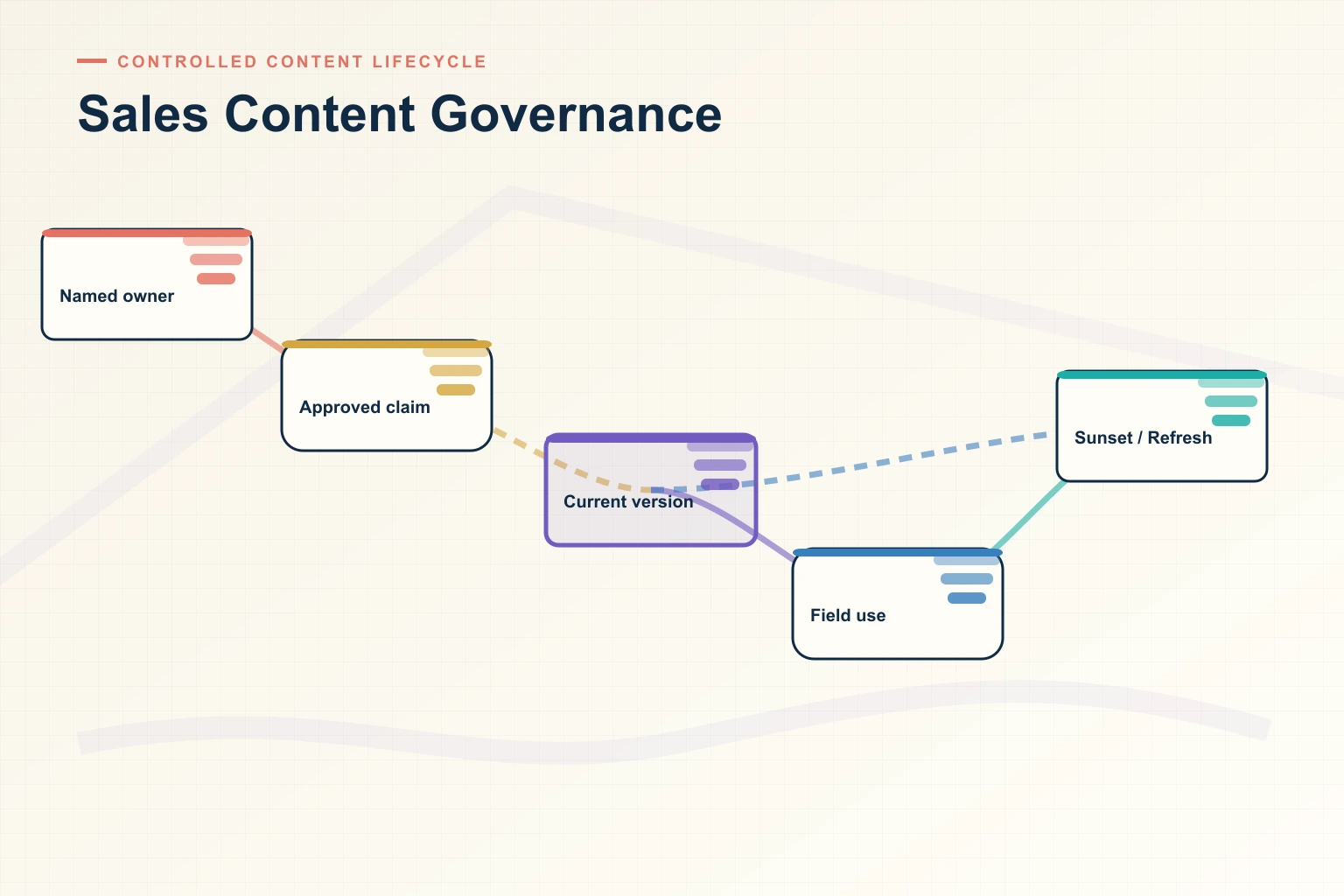
Governance is a decision system, not a cleaner folder
Sales content governance determines who may create, approve, change, distribute, and retire material used in revenue work. It is not achieved by moving files into one library or adding an approved tag. A governed system can answer which object is authoritative, which audience may use it, which evidence supports its claims, when it becomes effective, what replaced it, and who is accountable when it is wrong.
The framework matters because sales content changes under different clocks. Pricing can change immediately. A security answer may change after a control review. A competitive claim may need evidence and a short review interval. A customer story may have a contractual usage limit. A generic discovery guide may remain useful for longer. One universal approval path either slows low-risk work or leaves high-risk material under-reviewed.
This article defines an operating model built around content objects, lifecycle states, a RACI, version rules, risk-based approvals, and explicit sunset decisions. It is a starting point, not legal or records-management advice. Adapt it to your contracts, regulatory obligations, internal policies, and sales motion. Revspire’s Content Hub and sales playbooks are relevant internal workflow surfaces, but the accountability model must be defined by the organization.
Set the scope before assigning owners
Start with content used to influence or support a buyer decision: pitch decks, one-pagers, proposals, case studies, pricing guidance, battle cards, security answers, implementation plans, ROI tools, demo scripts, email templates, and training examples. Include reusable claims stored outside obvious files, such as snippets in a sales engagement tool or answers returned by an AI assistant.
Classify objects by use and risk rather than file format. The same product statement might appear in a deck, playbook, chatbot answer, and proposal template. Governance should connect those expressions to one approved claim or source so a correction can propagate.
| Content class | Typical risk | Minimum authority | Review trigger |
|---|---|---|---|
| Internal coaching guidance | Outdated process or inconsistent methodology | Enablement owner and relevant sales leader | Process, role, or methodology change |
| Customer-shareable product content | Incorrect capability, availability, or positioning | Product marketing plus product owner for material claims | Release, deprecation, packaging, or roadmap change |
| Pricing and commercial guidance | Margin leakage or unauthorized commitment | Finance or deal-desk authority | Price book, discount policy, currency, or approval change |
| Security, privacy, and legal response | False assurance or contractual exposure | Named security, privacy, or legal reviewer | Control, subprocessor, regulation, or contract-language change |
| Customer evidence | Expired permission, inaccurate attribution, or confidential detail | Customer owner, marketing, and legal as required | Consent expiry, relationship change, correction, or new usage context |
| Competitive claim | Unsupported comparison or stale market information | Competitive-intelligence owner with cited evidence | Evidence date, competitor release, or challenge from the field |
Give every content object a minimum contract
A governance contract is the metadata and evidence required before an object can move to an approved state. The Dublin Core Metadata Initiative publishes terms including modified, valid, isVersionOf, replaces, and isReplacedBy. The official DCMI Metadata Terms are useful reference vocabulary even if your system uses different field names.
| Field | Purpose | Control question |
|---|---|---|
| Canonical ID | Stable identity across titles, formats, and locations | Can events and citations still resolve after a rename? |
| Owner | Person accountable for accuracy and review | Is there a named role and backup, not only a department? |
| Content class and risk tier | Selects the approval path and review interval | Can an author lower the tier without review? |
| Audience and purpose | Defines who may use the object and for which job | Is internal-only material prevented from customer sharing? |
| Source and evidence | Supports material claims | Can a reviewer open the current authoritative source? |
| Version and relationships | Connects revisions, variants, translations, and replacements | Which version wins when several copies exist? |
| Approvers and decisions | Records who approved what and when | Does approval cover this audience, region, and channel? |
| Effective, review, and expiry dates | Separates publication from validity | What happens automatically when a date arrives? |
| Dependencies | Identifies downstream playbooks, rooms, templates, and agents | Can the owner find every active use after a correction? |
| Disposition | Defines archive, retention, deletion, or preservation | Is retirement different from destroying a required record? |
Do not make a modified timestamp stand in for approval. A file can be moved, reformatted, or translated without changing a claim. Conversely, a significant claim can change inside a file whose title remains the same. Store the approved version and its evidence explicitly.
Use a lifecycle with controlled transitions
| State | Entry evidence | Permitted use | Exit condition |
|---|---|---|---|
| Requested | Named audience, job, owner, urgency, and desired outcome | Planning only | Request accepted, combined, deferred, or rejected |
| Draft | Author, sources, content class, and initial risk tier | Restricted collaboration | Required facts and evidence are complete |
| In review | Frozen candidate version and reviewer list | Reviewer access only | Comments resolved or candidate rejected |
| Approved | Recorded decisions, scope, effective date, and expiry rule | Not yet distributed if effective date is future | Publication check succeeds |
| Published | Authoritative location, permissions, discoverability, and notification | Approved audience and purpose | Review, correction, expiry, or replacement event |
| Under review | Scheduled or event-triggered reassessment | Continue, restrict, or pause according to risk | Reapproved, revised, or retired |
| Superseded | Replacement ID and effective date | Historical reference under controlled access | Retention or archive rule executes |
| Retired | Reason, owner, downstream cleanup, and disposition | No new sales use | Archive, preserve, or delete according to policy |
Transitions should be events, not labels someone can edit freely. Record the prior state, new state, actor, timestamp, reason, and policy result. If an urgent correction bypasses the ordinary sequence, create an exception record with a deadline for retrospective review.
Assign a RACI at the decision level
A single content owner cannot be expert in product, finance, security, law, accessibility, localization, and field execution. A RACI is useful only when it is attached to specific decisions. Responsible performs the work, Accountable owns the final outcome, Consulted contributes before the decision, and Informed receives the result.
| Decision | Responsible | Accountable | Consulted | Informed |
|---|---|---|---|---|
| Accept the request | Enablement operations | Content portfolio owner | Field leader, requester | Author |
| Verify product claim | Product marketing | Named product owner | Solutions, support | Enablement |
| Approve commercial language | Deal desk or finance | Commercial-policy owner | Legal, sales leadership | Authors and sellers |
| Approve security or privacy statement | Security or privacy specialist | Control owner | Legal, customer assurance | Sales and solutions teams |
| Publish and target | Content operations | Enablement owner | Systems, localization, accessibility | Intended audience |
| Retire or preserve | Content operations | Content owner | Legal, records, product owner | Users and downstream owners |
Each row needs a service expectation and an escalation path. Do not make everyone accountable. When a reviewer is unavailable, the fallback should be an authorized delegate or a delayed release, not silent self-approval by the requester.
Version the meaning, not just the file
Use a major version when approved meaning, audience, risk, or obligation changes. Use a minor version for a compatible clarification or evidence update. Use a presentation revision for layout or formatting that does not change meaning. Your nomenclature may differ; the important point is that the change class drives review.
- Major: new price, capability, legal term, security assertion, market comparison, or required process.
- Minor: clearer explanation, refreshed screenshot, additional approved example, or corrected source citation.
- Presentation: typography, spacing, accessible alt text correction, or format conversion with meaning preserved.
- Variant: region, segment, role, or language adaptation linked to the parent and reviewed for its own claims.
The configuration-management controls in NIST SP 800-53 Revision 5 describe ideas such as baseline configuration and configuration change control. Sales content is not an information system baseline, but the control logic is useful: identify the approved state, authorize changes, record decisions, and detect unauthorized variation.
Never overwrite a published object in a way that destroys the decision trail. The active experience should route users to the current version, while authorized reviewers can reconstruct what a seller or buyer saw at a past date.
Make approvals proportional to claim risk
| Tier | Example | Approval pattern | Default review rule |
|---|---|---|---|
| Low | Internal facilitation guide with no customer claims | Enablement peer review | Scheduled review or process change |
| Moderate | Public product overview using approved claims | Product marketing and content owner | Release or packaging trigger plus scheduled review |
| High | Pricing, security, legal, regulated, or comparative material | Relevant domain authority and recorded evidence | Shorter interval and event-driven review |
| Emergency | Correction of a material false or unsafe statement | Authorized fast path, immediate distribution block, retrospective review | Incident closure and control improvement |
Approval should state its scope. A reviewer may approve a security description for a questionnaire but not for contract language. A customer logo may be approved for one region and campaign but not an unrestricted global template. Capture those boundaries in the object contract.
Accessibility belongs in the definition of publishable. The W3C Web Content Accessibility Guidelines 2.2 provide testable success criteria for web content. Select the standards and conformance expectations that apply to your delivery surfaces, and include captions, reading order, contrast, keyboard use, link purpose, and document accessibility in the release check.
Define sunset rules before publication
A review date asks someone to look. A sunset rule states what happens if evidence is absent. For high-risk content, expiry should remove the object from recommendation, search, templates, and AI retrieval until it is reapproved. For lower-risk material, expiry may retain internal access while displaying a warning and blocking external sharing.
Use both scheduled and event-driven triggers:
- Product release, packaging change, deprecation, or roadmap decision.
- Price book, discount authority, or commercial-policy change.
- New or retired control, subprocessor, certification, or privacy practice.
- Customer permission expiry or request to stop use.
- Competitor release or evidence challenge.
- Repeated field feedback, buyer confusion, or accessibility defect.
- Owner departure, organizational change, or source system retirement.
- Low justified use combined with ongoing maintenance cost.
Retirement is not deletion. The U.S. National Archives explains that records schedules provide instructions for disposition in its official records scheduling guidance. Your sales assets may fall under different laws and policies, but the distinction is valuable: stop new use, preserve what must remain for evidence, and delete only under an approved retention decision.
Measure whether the governance system works
Count decisions and defects, not just assets. Useful measures include owner coverage, percentage of high-risk objects with current evidence, review completed before expiry, time to block a material error, downstream replacements completed, failed attempts to share restricted content, exception age, duplicate claims, and field-reported defects resolved. Segment by content class and risk so a large library of low-risk material does not hide a small set of uncontrolled claims.
Audit a sample from both directions. Start with a published claim and trace it to source, approval, version, and dependencies. Then start with a changed source and find every published object that should be reviewed. Both paths must work.
Sales content governance checklist
- The governed scope includes files, snippets, templates, AI answers, and embedded claims.
- Every object has a canonical ID, owner, class, risk tier, audience, purpose, and source.
- Lifecycle transitions record actor, time, decision, reason, and prior state.
- RACI roles attach to decisions, with delegates and escalation paths.
- Major, minor, presentation, and variant changes have explicit review rules.
- Approval scope records audience, region, channel, and intended use.
- High-risk content cannot publish or remain discoverable after required evidence expires.
- Accessibility and localization checks are part of release, not post-publication cleanup.
- Emergency corrections can block distribution and trigger downstream replacement.
- Superseded links, room content, playbooks, templates, and retrieval indexes are updated.
- Retirement, preservation, retention, and deletion are separate decisions.
- Metrics test owner coverage, evidence freshness, exceptions, defects, and correction speed.
Govern the claim wherever it travels
A durable framework treats content as a controlled claim system rather than a collection of finished files. Ownership establishes accountability. Versioning preserves meaning and history. Risk-based approvals put the right authority at the decision. Sunset rules prevent yesterday’s truth from remaining today’s recommendation.
To evaluate how Revspire can support governed content and playbook delivery across revenue workflows, request a Revspire demo. Bring one high-risk asset and map its current path from source through approval, publication, update, and retirement.
Leave a Reply