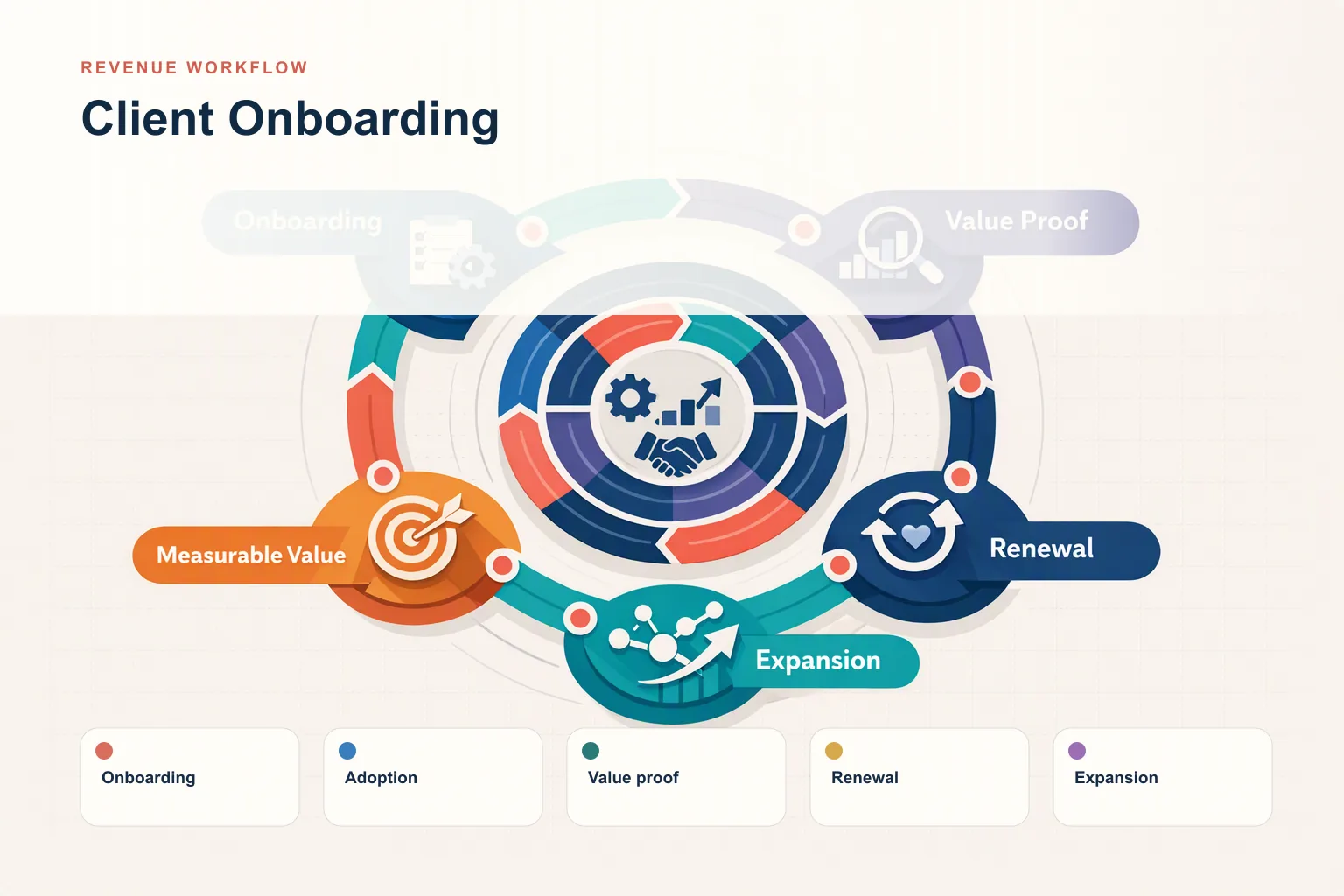
B2B customer onboarding is the work between a signed contract and the customer’s first measurable business outcome, and it is a revenue driver because it shapes whether the account renews and expands. Run it as a continuation of the sale: carry the deal’s goals, stakeholders and mutual action plan into a dated 30/60/90-day plan.
This guide covers the sales-to-customer-success handoff (with a checklist), time to first value, onboarding milestones, stakeholder engagement breadth, onboarding metrics with formulas, and what published research says about the link to retention and expansion. If you are choosing tools, see our separate list of the best customer onboarding software for 2026.
Last updated: 16 October 2026
Why is customer onboarding a revenue driver?
In B2B software, a growing share of revenue comes from customers you already have, and onboarding is where that revenue is first put at risk or secured. The evidence:
- Expansion carries growth at scale. High Alpha’s 2025 SaaS Benchmarks Report (800+ respondents) says that for companies above $50 million ARR, existing customers now account for roughly 60% of new ARR.
- Retention separates valuations. McKinsey’s net revenue retention analysis (19 November 2025) of more than 100 B2B SaaS companies from 2019 to 2024 found the top valuation quartile had net revenue retention (NRR) of 113%, against 98% in the bottom quartile.
- Value realisation goes with higher NRR. In the same McKinsey article (19 November 2025), a survey of leaders at 98 US B2B SaaS companies found those with the most sophisticated value realisation and adoption journeys had NRR about seven percentage points higher than peers with basic practices. Only 18% of respondents were in that group.
- Sales leaders are moving their focus. A Gartner survey of 243 chief sales officers and senior sales leaders, announced on 20 May 2025, found 73% prioritising growth from existing customers in 2025. Gartner describes the path to customer value as starting with onboarding programmes.
The link between retention and profit predates SaaS. Fred Reichheld’s Bain & Company brief Prescription for cutting costs (25 October 2001) gives the example that, in financial services, “a 5% increase in customer retention produces more than a 25% increase in profit” (full brief, PDF). It is an example from one industry; the wider range often quoted alongside it does not appear in the brief, so we do not repeat it.
Vendor research points the same way, with the usual caveat about who ran it. OnRamp, which sells onboarding software, surveyed 161 onboarding and customer success leaders for The State of Onboarding 2026: 57% of companies that cut onboarding investment saw churn rise, and 62% of CS leaders said they lack real-time visibility into customer progress. The report does not describe its methodology.
Customer onboarding, implementation and adoption
- Implementation is the technical work: provisioning, integrations, data migration and security review.
- Onboarding is the wider programme: implementation plus the people, plan and milestones that get the customer to first value.
- Adoption is what you keep measuring after onboarding ends: the right people using the product for the use cases they bought it for.
A plan that tracks only implementation tasks can finish on time with no business result. The rest of this guide is about closing that gap.
What should a sales-to-customer-success handoff include?
The handoff is where deal context is easiest to lose: the customer repeats discovery, promises made during the deal surprise the CS team, and the champion meets a stranger. Prevent it with a written handoff the account executive (AE) completes before signature, an internal handoff meeting and a customer kickoff where the AE introduces the customer success manager (CSM).
| Handoff item | What to capture | Where it comes from |
|---|---|---|
| Business outcomes and success criteria | The customer’s goals in their own words, with the metric and target date they agreed | Discovery notes, business case, mutual action plan |
| First-value milestone | The first outcome that will prove the purchase was right, and the date both sides agreed | Mutual action plan, proposal |
| Buying committee and roles | Executive sponsor, champion, admin, user team leads, IT and security, procurement; who supported the purchase and who resisted | Stakeholder map, CRM contact roles |
| Why they bought | The problem, alternatives considered, any competitor displaced and the decision criteria | Opportunity record, win notes |
| Commitments made | Anything promised: timelines, integrations, roadmap items, services, non-standard terms | Proposal, order form, the AE |
| Scope and technical context | Modules, seats, integrations, data sources, security requirements, systems being replaced | Order form, technical evaluation notes |
| Commercial context | Contract start and renewal dates, tier, expansion options discussed, budget owner | Order form, CRM |
| Risks and open objections | Late concerns, stakeholders not yet won over, internal politics | The AE, deal review notes |
| Open plan items | Post-signature tasks already agreed, with owners and dates | Mutual action plan |
| Communication preferences | Meeting cadence, channels, who wants executive summaries | The AE, the champion |
Run the handoff in three steps
- Before signature. Introduce the CSM or onboarding lead in the final sales stage, so the customer meets them before the contract is signed. McKinsey’s article describes a company that engages its customer experience function early in the sales cycle, supported by a customer dashboard and regular health checks.
- Internal handoff meeting. The AE, sales engineer and CSM walk through the checklist. The CSM confirms each item is complete or flags it.
- Customer kickoff. The AE opens, restates the outcomes the customer bought for and hands over to the CSM. Agree the first-value milestone and the 30/60/90-day plan in the meeting. The AE stays on the account until first value.
Measure handoff completeness for every new customer, and review incomplete handoffs with the sales manager as well as the CS team, because the gap starts in the deal.
What is time to first value?
Time to first value (TTFV) is the number of days from contract signature to the first outcome the customer recognises as valuable. McKinsey (19 November 2025) describes time to value as a measure of how quickly a customer starts getting value from a new product or service, and gives “time to activate the first 100 users” as an example of an onboarding goal that leading companies agree with customers at the outset.
Formula: TTFV = date the first-value milestone is achieved − contract signature date. Report the median for each cohort of new customers, by segment. One stalled enterprise rollout can distort an average.
How to define first value
- It is a customer outcome, not your activity: “the first 50 reps sharing approved content from the new system”, not “training session delivered”.
- It is agreed before signature and written into the mutual action plan.
- It can be seen in product data or is confirmed by the executive sponsor.
- Large implementations can split it into a technical first value (data flowing) and a business first value (the first team working the new way).
How to shorten time to first value
- Start prerequisites such as security review, single sign-on and data access during the late sales stages, as items on the mutual action plan.
- Get one pilot team to value before rolling out to everyone.
- Book the kickoff before signature so there is no idle gap after the contract.
- Pre-build configuration from what the deal already captured, so the customer is not interviewed twice.
- Give every task a customer-side owner and a date, and review overdue items weekly.
Onboarding milestones: a 30/60/90-day plan
Write milestones as outcomes with evidence, not as tasks. Stretch the windows for complex implementations; the structure matters more than the exact day counts.
| Window | Milestone | Evidence it is done | Lead owner |
|---|---|---|---|
| Before signature | Success criteria, first-value milestone and kickoff date agreed; CSM introduced | Mutual action plan with a signed-off post-signature section | AE |
| Days 0 to 7 | Kickoff held with the executive sponsor; handoff checklist complete; onboarding plan shared | Kickoff notes; plan with owners and dates | CSM |
| Days 8 to 30 | Technical setup complete; pilot group live; first-value milestone reached or on track | Integrations or sign-on live; pilot usage data; sponsor confirmation | CSM and implementation lead |
| Days 31 to 60 | Rollout to the target teams; usage by role; first sponsor check-in on success criteria | Activation rate on licensed seats; stakeholder engagement by role | CSM |
| Days 61 to 90 | Value review against the success criteria; adoption gaps addressed; renewal and expansion path documented | Value review summary agreed with the sponsor; updated account plan | CSM with the AE or account manager |
Stakeholder engagement breadth: avoid single-threaded onboarding
Stakeholder engagement breadth is the number of customer stakeholders actively involved in onboarding, compared with the roles you need. If only the champion is engaged, one job change or reorganisation leaves nobody inside the account who has seen the value, and the renewal turns into a new sale.
The same pattern shows up before signature. Gong’s analysis of more than 10 million sales conversations and 500,000 sales emails, published on 30 October 2019, found winning deals reached about eight buyer-side contacts by email, against three in losing deals. Onboarding should keep that breadth rather than narrow the relationship to one admin.
- Carry the stakeholder map from the deal into onboarding, with each person’s role and what they care about.
- Give each role an onboarding moment: the executive sponsor attends kickoff and the 90-day value review, admins own setup, team leads own rollout, and end users get role-specific training.
- Measure breadth at day 30 as engaged stakeholders divided by mapped roles, where “engaged” means attended a session, completed a task or used the product in the period.
- Flag accounts where everything depends on one person, and ask the champion for introductions early.
Our glossary explains stakeholder mapping for buying committees; the same map serves onboarding.
Customer onboarding metrics and formulas
Track a few leading metrics during onboarding and two lagging ones after it. Calculate them for each cohort of customers that signed in the same month or quarter.
| Metric | Formula | What it tells you |
|---|---|---|
| Time to kickoff | Kickoff date − signature date | Whether momentum from the deal is kept |
| Handoff completeness | Handoff items complete ÷ handoff items required | Whether CS starts with the full deal context |
| Time to first value (TTFV) | First-value milestone date − signature date (median per cohort) | How fast customers reach their first outcome |
| Milestone on-time rate | Milestones completed by their due date ÷ milestones due | Whether the plan is realistic and owned |
| Activation rate | Licensed users active in the period ÷ licensed users | Whether the purchase is being used |
| Stakeholder engagement breadth | Engaged stakeholders at day 30 ÷ mapped stakeholder roles | Single-threading risk |
| Early expansion rate | Customers that add seats, modules or services within 90 days ÷ new customers in the cohort | Whether onboarding is uncovering more value |
| Gross revenue retention (GRR) | (Starting ARR − churned ARR − contraction) ÷ starting ARR, over 12 months | Revenue kept, before expansion |
| Net revenue retention (NRR) | (Starting ARR − churned ARR − contraction + expansion) ÷ starting ARR, over 12 months | Revenue kept plus grown |
Worked example (illustrative numbers)
A cohort of 20 customers signs in the first quarter. Median time to kickoff is 9 days and median TTFV is 41 days. At day 30 the average account has 4 of its 7 mapped roles engaged, a breadth of 57%. Three customers add seats within 90 days, an early expansion rate of 3 ÷ 20 = 15%. Twelve months later the cohort, which started at $1.0M ARR, has lost $60k to churn and $20k to downgrades and added $180k of expansion. GRR is (1,000 − 60 − 20) ÷ 1,000 = 92%; NRR is (1,000 − 60 − 20 + 180) ÷ 1,000 = 110%.
The useful step is the comparison: if customers who reached first value within 60 days renewed and expanded more than those who took longer, you have your own evidence for where to invest. Our net revenue retention guide covers NRR in more depth.
How to use a mutual action plan for customer onboarding
A mutual action plan (MAP) is the shared, dated plan buyer and seller follow to reach a decision. The strongest onboarding plans start life as its final section.
- Before signature, add post-signature milestones to the MAP: kickoff, technical setup, pilot, first value and the 90-day value review.
- Keep the same buyer-side owners and add CS owners on your side, so the customer sees continuity rather than a new project plan.
- Keep the plan where the buyer already worked during the deal, next to the content they used: the business case, security documents and implementation guide.
- Review slippage weekly, as you did in the deal. A buyer-owned task past due is an early risk signal.
- Close the loop at day 90 by comparing the outcomes achieved with the success criteria in the original plan.
How onboarding sets up expansion
Expansion conversations go better when they come out of a value review than out of a quota push. During onboarding, log the signals as they appear:
- Questions about use cases or teams outside the original scope.
- Pilot users or teams adopting faster than the plan.
- Requests for features in a higher tier or another module.
- New stakeholders asking to join sessions.
- The executive sponsor citing a result in their own internal reporting.
Record each signal against the account in the CRM and bring it to the 90-day value review with the AE or account manager. Our customer expansion strategy guide covers what to do next.
Onboarding mistakes that cost renewals
| Mistake | What it looks like | Fix |
|---|---|---|
| Treating onboarding as a finished project | The plan closes at go-live and nobody owns adoption after day 30 | Run milestones through the 90-day value review and name an adoption owner |
| Counting tasks, not outcomes | Every checklist item done, no business result | Track TTFV and the success criteria, not task completion |
| Single-threading | Only the champion attends; the sponsor disappears after kickoff | Measure breadth at day 30; give each role an onboarding moment |
| Making the customer repeat discovery | The first CS call asks why they bought | Complete the handoff checklist before kickoff |
| Hidden promises | Commitments from the deal surface in week three | Capture commitments in the handoff; the AE attends kickoff |
| Not learning from churn | Churned accounts are never reviewed against their onboarding | Review each churned or contracted account’s onboarding record and update the plan template |
Where Revspire fits
Revspire is an AI sales enablement platform. The module relevant here is Digital Sales Rooms: a branded room where buyers and sellers collaborate, with mutual action plans that carry owners and due dates, buying-committee stakeholder mapping, secure content sharing and real-time buyer engagement analytics. Those are inputs the handoff checklist asks for, so a team that runs its deals in a room has the plan, the stakeholders and the engagement history in one place when the CSM takes over.
Revspire is not an implementation project tool or an in-app digital adoption platform. If you need guided product tours, implementation project management or a services client portal, compare dedicated tools in our customer onboarding software list.
Frequently asked questions
What is B2B customer onboarding?
B2B customer onboarding is the programme that takes a new business customer from signed contract to its first measurable outcome. It covers the sales-to-CS handoff, kickoff, technical implementation, user rollout and an early value review, run against a dated plan with owners on both sides.
Why is customer onboarding a revenue driver?
Because renewals and expansion depend on customers reaching value early. McKinsey (19 November 2025) found the top valuation quartile of B2B SaaS companies had NRR of 113% against 98% in the bottom quartile, and that companies with sophisticated value realisation and adoption journeys had NRR about seven points higher than peers with basic practices.
What should a sales-to-customer-success handoff include?
At minimum: the customer’s success criteria in their words, the agreed first-value milestone, the buying committee and each person’s role, why they bought, every commitment made in the deal, technical scope, renewal and expansion context, open risks and the open items on the mutual action plan. The AE should complete it before signature and attend the kickoff.
What is time to first value?
Time to first value is the number of days from contract signature to the first outcome the customer recognises as valuable, such as a pilot team working in the new system. Define the milestone with the customer before signature, and report the median across each cohort of new customers.
What are the most useful customer onboarding metrics?
During onboarding: time to kickoff, handoff completeness, time to first value, milestone on-time rate, activation rate and stakeholder engagement breadth. After it: early expansion rate, gross revenue retention and net revenue retention, compared by cohort.
How long should B2B customer onboarding take?
There is no standard length; it depends on implementation complexity and on how first value is defined. A 30/60/90-day structure works for many B2B software products, with complex enterprise rollouts stretching the windows. Set the target from your own cohorts’ median TTFV rather than an outside benchmark.
Start with the plan: download our free mutual action plan template and add a post-signature section for kickoff, first value and the 90-day value review.
Sources
All pages were accessed on 16 October 2026. Publication dates are shown where the page gives one.
- The net revenue retention advantage: Driving success in B2B tech, McKinsey & Company (Alfonso Pulido, Begum Erdogan, Jake Berliner), 19 November 2025. Accessed 16 October 2026.
- 2025 SaaS Benchmarks Report, High Alpha, 2025. Accessed 16 October 2026.
- Gartner Survey Finds 73% of CSOs Are Prioritizing Growth from Existing Customers for 2025, Gartner via Business Wire, 20 May 2025. Accessed 16 October 2026.
- Prescription for Cutting Costs, Bain & Company (Fred Reichheld), 25 October 2001, and the full brief (PDF). Accessed 16 October 2026.
- The State of Onboarding 2026, OnRamp, undated (2025 footer). Accessed 16 October 2026.
- Building an army of champions: why it’s essential to closing more deals, Gong (Devin Reed), 30 October 2019, updated 6 March 2026. Accessed 16 October 2026.