A sales enablement software business case should connect a specific revenue problem to a measurable workflow change—not begin with a feature list. Leadership needs to see the current constraint, who owns it, what evidence supports it, what the proposed platform must change, how risk will be controlled, and which result will justify expansion.
Salesforce describes sales enablement as using content, coaching, training, and technology to help representatives onboard, improve their skills, and sell.[1] That definition is useful, but it is still broad. A fundable proposal narrows the scope to a small number of observable moments such as finding approved content, preparing for a buyer meeting, practising a critical conversation, coordinating a mutual plan, or measuring buyer engagement.
Disclosure: Revspire publishes this guide and provides sales enablement software. The framework below is intentionally vendor-neutral. Verify every product claim in current documentation, test the workflow with your own users and data, and keep the decision criteria visible to all vendors.
What a sales enablement software business case must prove
A credible case answers six questions before asking for budget. If one answer is missing, treat it as discovery work rather than filling the gap with an industry benchmark that may not apply to your team.
| Decision question | Evidence to bring | Accountable owner |
|---|---|---|
| Which revenue workflow is constrained? | Examples from live deals, seller interviews, process data, and buyer feedback | Revenue or sales leader |
| What is the current baseline? | Defined measures, time period, data source, exclusions, and known gaps | Revenue operations |
| Which users and systems are affected? | Roles, permissions, handoffs, content sources, CRM objects, and integration map | Enablement and IT |
| What must the platform demonstrate? | Weighted requirements and realistic acceptance scenarios | Cross-functional evaluation team |
| How will risk be governed? | Security, privacy, AI, accessibility, retention, and change-control review | Security, privacy, legal, and procurement |
| What earns expansion? | Pilot threshold, adoption evidence, business measure, decision date, and stop condition | Executive sponsor |
1. Diagnose the revenue workflow before choosing software
Start with the operating problem. Interview a small, representative set of sellers, managers, marketing owners, revenue operations, customer success, and—where possible—buyers. Ask them to show the work rather than describe an ideal process. A screen recording of a seller searching across five repositories or a deal review with an unowned next step is more useful than a general complaint that “content is hard to find.”
Separate seller-readiness problems from cross-functional lifecycle problems. The distinction between revenue enablement and sales enablement helps define whether the first release should focus on sellers or include marketing, customer success, and revenue operations.
- Content workflow: Can the seller find the current, approved asset for the buyer, stage, product, and region?
- Readiness workflow: Can a manager see whether a seller can apply guidance in a realistic conversation?
- Deal workflow: Can the team coordinate buyer actions, stakeholders, content, proposals, and next steps?
- Measurement workflow: Can the organization connect enablement activity to observable seller and buyer behavior without claiming unsupported causation?
Write one problem statement in plain language: For [user], [current workflow] creates [observable friction], which affects [business outcome]. We will know it improved when [measure] changes under [defined conditions].
2. Establish a defensible baseline
A baseline makes the proposal testable. Use measures you can reproduce from named systems, and document where instrumentation is incomplete. Do not promise a percentage lift borrowed from another company. Your leadership team needs a local starting point and an honest measurement plan.
| Workflow | Possible baseline | Evidence source |
|---|---|---|
| Content discovery | Median time to locate an approved asset; failed searches; stale-content incidents | Search logs, content audit, seller observation |
| Onboarding and readiness | Time to required certification; retry rate; rubric dimensions needing coaching | Learning and practice records |
| Buyer collaboration | Mutual-plan completion; stakeholder participation; agreed next actions | CRM and buyer-workspace records |
| Deal execution | Stage age; close-date changes; next-step quality; required evidence gaps | CRM and pipeline review |
| Governance | Assets without owners, review dates, permissions, or approved claims | Content inventory and policy review |
For the financial layer, use the formulas and attribution cautions in the sales enablement ROI guide.
3. Build a sponsorship coalition with clear decision rights
Sales enablement software changes work across teams. A sponsor can approve funding, but adoption also depends on the people who own content, CRM data, coaching, security, procurement, and the buyer experience. Kotter’s change framework emphasizes a guiding coalition, a clear vision, barrier removal, and short-term wins.[2] Translate those ideas into named responsibilities rather than a large steering committee with no decisions to make.
Use the sales enablement team-structure guide to clarify operating roles before the platform decision.
- Executive sponsor: owns the business outcome, trade-offs, and expansion decision.
- Enablement owner: owns use cases, approved guidance, adoption, and manager routines.
- Revenue operations: owns CRM design, baseline integrity, instrumentation, and reporting definitions.
- Marketing or content operations: owns content lifecycle, metadata, approvals, and archival rules.
- IT, security, privacy, and legal: own architecture, access, data handling, vendor risk, and contractual controls.
- Seller and manager representatives: test the real workflow and document friction.
Use a simple RACI for requirements, pilot approval, source-content changes, integrations, reporting, and go-live. The business case should name who can stop the project if evidence or controls are missing.
4. Turn needs into weighted evaluation criteria
A requirements list becomes useful when every item maps to a real task and a test. Compare a platform against the smallest coherent first release, then consider expansion capabilities separately. The sales enablement RFP template turns those needs into structured requirements, vendor questions, evidence fields, and a weighted comparison scorecard. The revenue enablement build-versus-buy framework can help teams decide what belongs in a platform, an integration, or an internal service.
When you are ready to compare categories, use the companion guide to seven sales enablement tools for B2B teams.
Workflow and adoption criteria
- Find an approved asset using a realistic seller query and explain why it is current.
- Adapt content without breaking required claims, permissions, or brand controls.
- Move from playbook guidance to practice, coaching, and a live deal action.
- Create a buyer-facing workspace, invite stakeholders, and record mutually agreed actions.
- Complete the core task from the CRM or another system where the seller already works.
Governance, security, privacy, and AI criteria
Review data flows, access controls, retention, subprocessors, regional requirements, model behavior, auditability, and human oversight. NIST’s AI Risk Management Framework is voluntary guidance for incorporating trustworthiness considerations into the design, development, use, and evaluation of AI systems.[3] Use it to structure questions about ownership, intended use, measurement, monitoring, and failure handling rather than treating “uses AI” as a requirement.
If the workflow is likely to create a high risk to people’s rights and freedoms, the UK Information Commissioner’s Office describes a data protection impact assessment as a process for identifying and minimizing that risk.[4] Confirm the applicable legal requirements with your privacy and legal teams. Review available security materials through the vendor’s trust process; for Revspire, start with the Revspire Trust Center.
Measurement and integration criteria
- Name the system of record for accounts, opportunities, users, content, and outcomes.
- Define the exact records and permissions exchanged in each integration direction.
- Verify whether reports expose raw evidence, definitions, timestamps, and export options.
- Test identity, role changes, deletion, error handling, and reconciliation—not only the happy path.
5. Use a scorecard that reflects the decision
The example weights below total 100 and are intentionally editable. Agree the weights before demonstrations so a polished presentation cannot silently change the decision.
| Criterion | Example weight | Acceptance evidence |
|---|---|---|
| Priority workflow fit | 25 | Users complete two realistic scenarios with defined evidence |
| Adoption and administration | 15 | Representative users complete tasks; owners can configure and maintain them |
| Content governance | 15 | Ownership, approval, versioning, permissions, expiry, and retrieval are demonstrated |
| Integration and data quality | 15 | Required records, permissions, failure handling, and reporting reconcile |
| Security, privacy, and AI governance | 15 | Control owners approve documented risks and mitigations |
| Measurement | 10 | Baseline, event definitions, attribution limits, and evidence can be inspected |
| Total cost and commercial fit | 5 | Licensing, implementation, integration, administration, and exit costs are visible |
Score each criterion on an anchored scale—for example, 0 for absent, 1 for substantial workaround, 2 for adequate, and 3 for strong. Keep non-negotiable controls as pass/fail gates so a security or data-handling failure cannot be offset by presentation quality.
6. Run a decision-grade pilot
A pilot should test the riskiest assumptions with representative people, data, content, and integrations. Avoid a broad launch disguised as a pilot. Select one role, one region or segment, one governed content set, and one or two high-value workflows.
Before launch, review the common sales technology adoption mistakes that can undermine otherwise sound product choices.
- Freeze the hypothesis: state the user, workflow, baseline, expected direction, evidence source, and decision date.
- Prepare realistic scenarios: include normal work, exceptions, permission boundaries, stale content, and integration failures.
- Train managers and users: explain the workflow, support route, and what evidence will be collected.
- Observe the work: combine product telemetry with user observation, manager review, and data-quality checks.
- Review unintended effects: watch for duplicate entry, notification overload, shadow content, unsafe AI output, or metrics that reward activity rather than buyer progress.
- Make the decision: expand, revise, pause, or stop against the agreed gates.
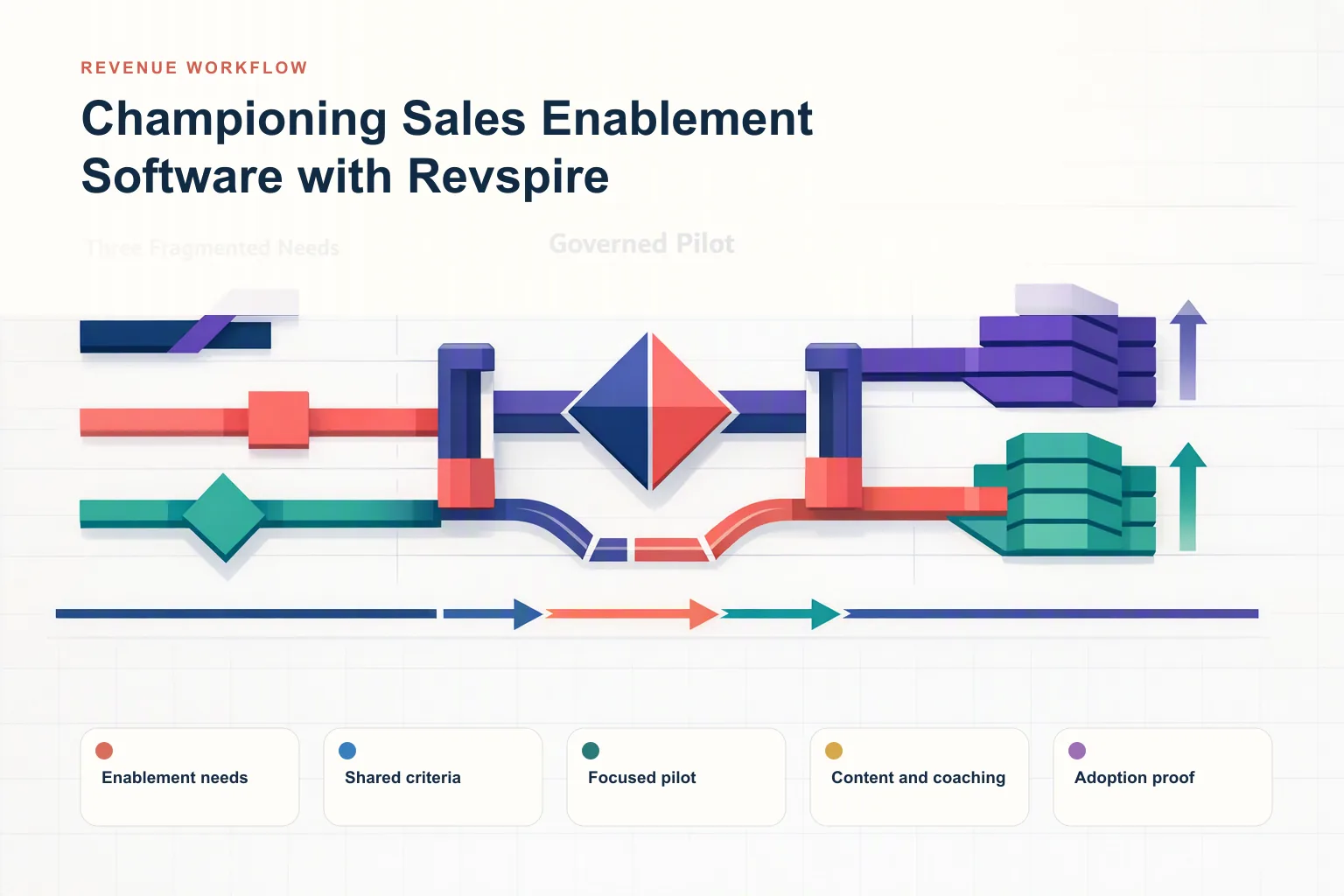
Use the existing explainer below to frame three practical decisions: build the leadership case, prove the workflow, and earn the scale decision.
7. Calculate ROI without overclaiming
Separate direct financial effects from leading indicators. A simple model is:
ROI = (verified financial benefit − total program cost) ÷ total program cost × 100
Total program cost should include licenses, implementation, integrations, migration, administration, training, support, internal labor, and the cost of retiring or operating overlapping tools. Verified benefit may include accepted labor savings or revenue effects only when the measurement design supports the attribution. Content use, certification scores, engagement, and stage movement can guide decisions, but they are not automatically revenue.
Publish the calculation period, population, source systems, exclusions, confidence limits, and owner. If the baseline or event tracking is incomplete, state that before the pilot rather than retrofitting an attractive result.
A practical 90-day rollout plan
- Days 1–30—design: confirm the workflow, owners, baseline, sources, controls, requirements, and stop conditions.
- Days 31–60—pilot: configure the smallest viable workflow, test integrations and permissions, train the cohort, and collect evidence.
- Days 61–75—evaluate: reconcile data, interview users and managers, review risks, calculate costs, and score the decision.
- Days 76–90—decide and govern: approve expansion, remediation, or exit; publish ownership, content-review cadence, support, reporting definitions, and the next checkpoint.
For a detailed operating sequence, use the 90-day sales enablement implementation plan to assign owners, launch a bounded pilot, build adoption, and connect rollout evidence to measurable ROI.
How Revspire can fit the business case
Revspire is designed to connect several enablement workflows: governed content in the Content Hub, repeatable guidance in Playbooks, practice and feedback in Sales Training, and buyer-facing collaboration in Digital Deal Rooms. That connected scope can be relevant when the business problem crosses content, readiness, and live deal execution.
It may be more platform than a team needs if the requirement is a single narrow utility with no connected workflow. Use the scorecard above, verify integrations and controls, and compare the total operating model—not only the demo. Teams with a defined use case can request a Revspire working session using their own scenario and acceptance criteria.
Copyable executive business-case template
Keep the leadership version to one page and place supporting calculations, controls, and pilot evidence in an appendix. Replace every bracketed prompt with a named fact, source, owner, or decision.
- Decision requested: Approve [pilot, purchase, expansion, or stop decision] by [date], owned by [name or role].
- Business constraint: [User group] cannot reliably [workflow], evidenced by [baseline and source] during [period].
- Proposed change: Test [bounded workflow] with [cohort, systems, content, and controls].
- Expected evidence: Measure [adoption], [workflow result], [data quality], and [business outcome], with definitions and attribution limits.
- Cost: Include [licenses, implementation, integration, migration, administration, training, support, internal labor, and exit costs].
- Risks and controls: Record [security, privacy, AI, accessibility, integration, adoption, and change-management risks], each with an owner.
- Decision gates: Expand if [thresholds]; revise if [conditions]; stop if [control failure or insufficient evidence].
Frequently asked questions
Who should own a sales enablement software business case?
A revenue or enablement leader should own the business outcome, with revenue operations owning measurement and IT, security, privacy, legal, procurement, marketing, managers, and sellers owning their respective requirements and controls.
How long should a sales enablement software pilot run?
Long enough to observe the defined workflow more than once, but short enough to preserve a real decision. Set the duration from the sales motion and evidence needed rather than using a universal number.
Which sales enablement metric matters most?
There is no universal metric. Choose one tied to the constrained workflow, pair it with adoption and data-quality evidence, and distinguish leading indicators from financial outcomes.
Should the business case specify a vendor?
The problem, baseline, requirements, controls, pilot, and decision gates should be vendor-neutral. A recommended vendor can follow once comparable evidence is available.