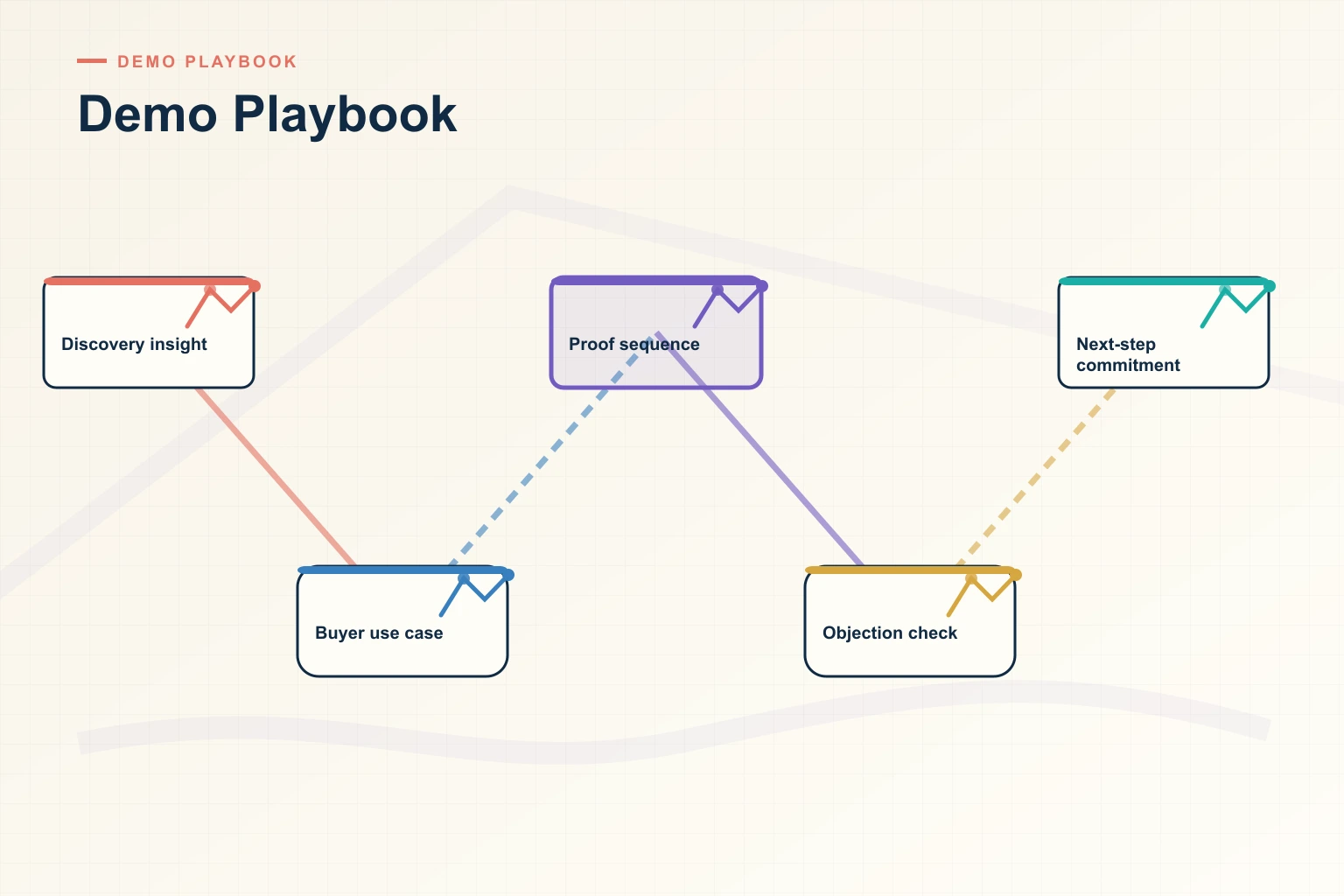
A demo playbook should guide a buyer decision—not a feature tour
A demo playbook defines how a team prepares, tailors, delivers, and follows up on a product demonstration. It should connect discovery evidence to a buyer decision, assign roles, state what must be validated, and capture the next step.
The most expensive mistakes happen when the demo becomes a presentation milestone instead of a decision workflow. The five problems below are specific to demo preparation and delivery; the broader enterprise sales playbook should govern the stages around it.
Five demo playbook mistakes and their fixes
| Mistake | What it creates | Corrective control |
|---|---|---|
| Scheduling before sufficient discovery | A generic story and avoidable follow-up | A minimum evidence gate for the demo |
| Showing features instead of testing outcomes | Attention without decision progress | A buyer question and proof point for each segment |
| Using one script for every stakeholder | Relevant concerns remain unaddressed | A role and decision map |
| Leaving delivery roles and evidence undefined | Conflicting answers and lost commitments | A written brief with owners and capture fields |
| Skipping the feedback loop | The same weak demo repeats | A short evidence-based review after selected demos |
1. Scheduling the demo before there is enough discovery
A calendar booking is not sufficient input for a useful demonstration. Before the session, the team should know the business problem, the current workflow, the desired change, the participants, and the decision the demo is expected to support. Unknowns can remain, but they should be named.
Fix: define a minimum demo-readiness gate. If critical context is missing, use the opening minutes to complete discovery or rescope the meeting instead of pretending the script is already relevant.
2. Treating the demo as a sequence of features
A feature tour can be polished and still fail to help the buyer decide. Every demo segment should connect a buyer problem to an observable workflow, a proof point, and a question that checks whether the evidence matters.
Fix: write each segment as buyer context → workflow → evidence → confirmation question. Remove anything that does not support the stated decision or a necessary dependency.
3. Using the same story for every stakeholder
Business, technical, security, finance, legal, procurement, and end-user participants do not evaluate the same risk. A single undifferentiated script can bury the evidence one group needs and overwhelm another with irrelevant detail.
Fix: map each participant to the decision they influence, the evidence they need, and the question the team must answer. This is not permission to improvise unsupported claims; all variants should draw from the same governed product truth.
For complex buying groups, use a stakeholder-mapping workflow before deciding who should attend which segment.
4. Failing to assign roles, handoffs, and evidence capture
When no one owns facilitation, product depth, time, questions, and follow-up, the meeting can produce conflicting answers and invisible commitments. The same problem appears when useful buyer statements remain in private notes rather than the opportunity record.
Fix: use a one-page brief and name the owner for every unresolved question. Separate the person presenting from the person capturing buyer evidence when the meeting is complex.
Pre-demo brief template
| Field | What to record |
|---|---|
| Decision objective | The buyer decision or validation this session should support |
| Known context | Confirmed problem, workflow, constraints, and success criteria |
| Participants | Role, influence, concern, and relationship owner |
| Run of show | Segment, owner, time box, proof point, and confirmation question |
| Guardrails | Claims or commitments that require an approved owner |
| Evidence capture | Where questions, commitments, gaps, and next actions will be recorded |
5. Reviewing presentation style instead of buyer evidence
“The demo went well” is not a useful review. A team needs to know what the buyer confirmed, rejected, questioned, or committed to do next. Delivery coaching matters, but it should be connected to observable moments and decision progress.
Fix: review a selected sample of demos against the brief. Compare expected and observed evidence, then assign one improvement to the playbook, the product narrative, or the representative’s practice plan. Feed recurring gaps into structured win-loss review rather than turning one anecdote into a universal rule.
Capture the result before the opportunity advances
- Which buyer outcome or workflow was validated?
- Which requirement remains unproven or disputed?
- Which stakeholder question needs an approved answer?
- What buyer-owned action, seller-owned action, owner, and date were agreed?
- Does the current stage still match the available evidence?
Connect these fields to the team’s pipeline-hygiene rules so demo activity does not become false progress.
Measure demo quality with leading and outcome evidence
Useful leading measures include brief completion, required stakeholder coverage, open-question closure, and documented buyer next actions. Outcome measures can include stage progression, time to the next buyer action, and selected win-loss findings. Interpret them together: a correlation between a demo measure and an outcome does not prove the demo caused that outcome.
Start with one segment or team, review the workflow for 30 days, and change one control at a time. This produces clearer learning than replacing the entire playbook after a few memorable meetings.
See how Revspire connects playbooks, governed content, buyer work, and deal evidence.
Leave a Reply