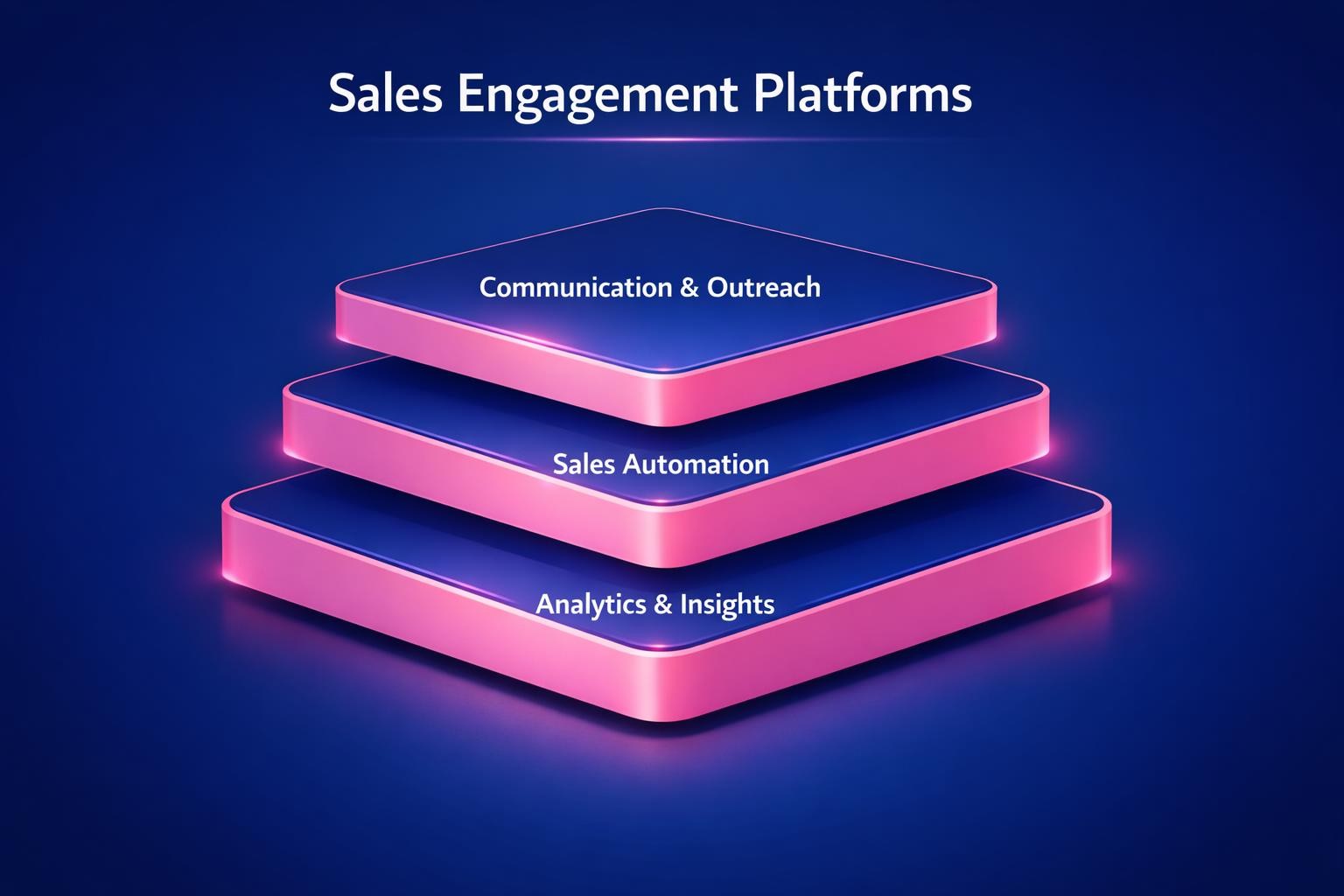
B2B sales engagement software runs multi-step outreach (email, calls, LinkedIn tasks) from one rep queue and logs every touch to the CRM. In 2026 the main options are Outreach and Salesloft for enterprise teams; sequencing built into HubSpot, Salesforce and Dynamics 365; and Apollo.io, Reply.io and Mixmax for leaner, faster-moving teams.
This buyer’s guide explains what the category does, how it differs from sales enablement and CRM, what each platform costs according to its own pricing page, and how to choose. It covers the outreach layer; our companion guide to the best CRM tools for B2B sales covers the system of record that every platform here writes to.
Last updated: 16 October 2026
Disclosure: Revspire publishes this guide. Revspire is a sales enablement and digital sales room platform, not a sales engagement platform, so it is not in the list. Platforms are grouped by category and listed alphabetically within each group. Prices were read on each vendor’s own site on 16 October 2026, in USD as displayed, before tax or negotiated discounts.
What is B2B sales engagement software?
A sales engagement platform (SEP) turns your outreach process into a daily task list for each rep. Teams build sequences (Salesloft calls them cadences): an ordered set of emails, calls, LinkedIn touches and tasks spread over days or weeks, which stops or branches when a buyer replies, books or bounces. Every touch is written back to the CRM against the right account, contact and opportunity.
The capabilities that separate a real platform from a mail-merge tool:
- Sequences and a task queue: mixed step types, conditional branching, A/B tests, and one prioritised list of what each rep does next.
- Dialer: click-to-call, call recording and logging, often with conversation intelligence on top.
- Email delivery controls: sending limits, mailbox connection and rotation, bounce and unsubscribe handling.
- Two-way CRM sync: which objects sync (lead, contact, account, opportunity, custom objects) and in which direction.
- Team analytics: reply, meeting and pipeline results by sequence and by step, not just by rep.
- AI: research, drafting and prioritisation agents, which most vendors now meter with credits on top of seats.
The category is also converging with revenue intelligence. Gartner published its first Magic Quadrant for Revenue Action Orchestration, dated 15 December 2025, and Gong described that market as emerging from the convergence of “previously separate sales engagement and revenue intelligence markets” (Gong press release, 18 December 2025). A Business Wire release from 16 December 2025 says that report named Clari a Leader and Salesloft a Visionary (Business Wire, 16 December 2025); by then the two companies had already announced the completion of their merger, on 3 December 2025. In practice, enterprise SEPs now bundle deal management and forecasting, while CRMs have added their own sequencing.
Sales engagement vs sales enablement vs CRM: what is the difference?
The three systems answer different questions, and larger B2B revenue teams usually end up running all three.
| System | Question it answers | Main users | Core records | Examples |
|---|---|---|---|---|
| CRM | What is the state of every account, deal and forecast? | Sellers, managers, RevOps, finance | Accounts, contacts, opportunities, products, forecast | Salesforce, HubSpot, Dynamics 365 |
| Sales engagement | Who do I contact next, on which channel, with what message? | SDRs, AEs, sales managers | Sequences, tasks, emails, calls | Outreach, Salesloft, Apollo.io |
| Sales enablement | What should I say, send and practise, and what is the buyer doing with it? | Enablement, product marketing, sellers | Approved content, playbooks, training, deal rooms | Seismic, Highspot, Mindtickle |
Put simply, the CRM is the system of record and the engagement platform is the system of action. If you are weighing the second and third rows, our explainer on sales enablement vs sales engagement goes deeper.
Do you need a dedicated platform, or are CRM sequences enough?
Start with the CRM you already pay for. Sequencing built into the CRM is usually enough when:
- sequences are mostly email plus task reminders;
- one team owns them and the volume per rep is modest;
- you already pay for the tier that includes them (HubSpot Sales Hub Professional, Dynamics 365 Sales Enterprise, or a Salesforce edition that includes Sales Engagement).
A dedicated platform earns its cost when:
- an SDR team works high-volume, multichannel sequences every day and needs a dialer in the same queue;
- managers need shared, governed sequences with step-level testing across many reps;
- you run several CRM instances or business units and want one engagement layer;
- you want deal inspection and forecasting from the same vendor (Outreach, Salesloft).
Choose a combined data-and-engagement tool (Apollo.io, or Reply.io with its contact data) when you do not yet license a B2B contact database.
B2B sales engagement platforms compared (2026)
| Platform | Category | Best for | Published pricing (checked 16 Oct 2026) | Free plan / trial |
|---|---|---|---|---|
| Outreach | Enterprise sales execution | Outbound plus deal inspection and forecasting from one vendor | Quote-based: seats plus AI-credit packages | None listed |
| Salesloft (incl. Clari) | Enterprise revenue orchestration | Cadences plus Clari Forecast | Quote-based, no figures published | None listed |
| HubSpot Sales Hub | CRM-native sequences | Teams whose CRM is HubSpot | Sequences from Professional, from $100 per seat per month | Free CRM; sequences not on Free or Starter |
| Microsoft Dynamics 365 Sales | CRM-native sequences | Microsoft-standardised enterprises | Enterprise $105, Premium $150 per user per month, paid yearly | Free trial |
| Salesforce Sales Engagement | CRM-native add-on | Sales Cloud orgs wanting native cadences | $50 per user per month, billed annually, as an add-on | None listed for the add-on |
| Apollo.io | Data plus engagement | Startup and SMB outbound without a separate data contract | Basic $49 (billed annually), Professional $79 per user per month; top tier listed as Custom | Free plan |
| Mixmax | Inbox-first engagement | AEs and small teams working in Gmail | From $29 per user per month billed yearly, priced by recipients | Free plan (50 recipients); 14-day trial |
| Reply.io | Multichannel plus AI SDR | SMB teams and agencies running email, LinkedIn, calls and SMS | Multichannel $89 per user per month billed annually; AI SDR from $500 per month | 14-day trial |
Enterprise sales engagement platforms
Standalone platforms built for large outbound teams, now bundling conversation intelligence, deal management and forecasting.
1. Outreach
A sales execution platform: multichannel sequences, the Outreach Voice dialer, deal and pipeline management, conversation intelligence, forecasting and AI agents.
- Best for: mid-market and enterprise outbound teams that want engagement, deal inspection and forecasting from one vendor.
- Pricing: quote-based. The Outreach pricing page (checked 16 October 2026) combines per-user seats with packaged AI credits: Amplify Essentials 10,000, Core 25,000, Plus 50,000 and Pro 100,000 credits, and states there are no platform fees. Multichannel sequences start at Core; forecasting is listed on Pro.
- 2026 changes: on 27 April 2026 Outreach launched Omni, a conversational agent for revenue teams, plus Agent Studio for building custom agents, and moved its site to outreach.ai (Business Wire, 27 April 2026).
- Limitation: no prices are published, and the entry Essentials package is aimed at conversation intelligence and deal visibility, so engagement buyers need Core or above.
- Choose something else if: you want self-serve pricing, or you only need email sequences on top of an existing CRM.
2. Salesloft (now including Clari)
Salesloft sells Cadence, its sales engagement product, alongside Conversation Intelligence, Deals, Rhythm and Clari Forecast in one revenue platform.
- Best for: teams running structured cadences that also want forecasting and deal inspection from the same vendor.
- The merger: Clari and Salesloft announced their completed merger on 3 December 2025, with Steve Cox as CEO (Salesloft, 3 December 2025). On 2 September 2026 the combined company unified under the Salesloft brand; Clari Forecast kept its name, and Clari’s other capabilities continue inside Salesloft (Salesloft, 2 September 2026).
- What about Groove? Clari announced it was acquiring Groove, a sales engagement provider, in August 2023 (CMOtech UK, 16 August 2023). When we checked on 16 October 2026, groove.co redirected to salesloft.com, where Groove appears only as a customer log-in link. If you run Groove today, ask Salesloft for its roadmap and migration path in writing.
- Pricing: quote-based; the Salesloft pricing page is a talk-to-sales booking flow with no package names or figures (checked 16 October 2026).
- Limitation: packaging is still settling after the merger, so confirm which modules (Cadence, Conversation Intelligence, Deals, Clari Forecast) a quote covers.
- Choose something else if: you need sequences only and no forecasting, or you want a published price.
Sales engagement built into your CRM
If one of these is already your system of record, price its sequencing first: there is no second sync to maintain.
3. HubSpot Sales Hub (sequences)
HubSpot’s sequences tool enrols contacts from CRM records into automated emails and task reminders, so engagement data lives in the same database as marketing and service.
- Best for: teams whose system of record is HubSpot and whose outreach is mainly email plus tasks.
- What you need: Sales Hub or Service Hub Professional or Enterprise and an assigned Sales or Service seat; each sequence is limited to 10 email templates, and HubSpot caps the number of sequences per account (HubSpot Knowledge Base, updated 17 August 2026).
- Pricing: Professional starts at $100 and Enterprise at $150 per seat per month; Starter, from $10 per seat as a new-customer discount on $20, does not list sequences (HubSpot Sales Hub page, checked 16 October 2026).
- 2026 changes: HubSpot’s June 2026 release opened the Prospecting Agent to any paid hub from Starter; it runs on HubSpot Credits (MarTech, 24 July 2026).
- Limitation: sequences require a Professional seat, and AI agents consume credits on top of seat prices.
- Choose something else if: your CRM is Salesforce or Dynamics 365, because HubSpot sequences act on HubSpot records.
4. Microsoft Dynamics 365 Sales (sales accelerator)
Dynamics 365 Sales includes a sales accelerator: a sequence designer for managers and sellers and an intelligent work list that ranks the next lead or opportunity to contact (Microsoft Learn, updated 30 April 2026).
- Best for: enterprises standardised on Microsoft 365 and Teams that want sequencing inside the CRM.
- Pricing: Professional $65, Enterprise $105 and Premium $150 per user per month, paid yearly. Sales engagement is included as base capacity in Enterprise and fully in Premium, and is not listed for Professional; Premium also includes 1,000 Copilot Credits per user per month (Microsoft pricing page, checked 16 October 2026).
- Limitation: Microsoft Learn notes the sales accelerator needs an administrator to configure its workspace for full capability and is not supported on tablets or phones.
- Choose something else if: your team is not on Dynamics 365, or reps work mainly from mobile.
5. Salesforce Sales Engagement
Salesforce’s native engagement product for Sales Cloud: Sales Cadences, Quick Cadences, Work Queue, Prospecting Center, meeting booking and Einstein Conversation Insights.
- Best for: Sales Cloud organisations that want cadences without a second vendor or a separate sync.
- Pricing: $50 per user per month, billed annually, as a paid add-on; the page says it is included in Unlimited Edition and Agentforce 1 Sales Edition (Salesforce Sales Engagement pricing, modified 8 July 2026).
- 2026 changes: at Dreamforce ’26 Salesforce announced Hunter, an outbound agent that finds prospects and builds multi-step cadences across calls and email; Salesforce Ben reported it in pilot with general availability planned for November 2026, bundled in Max Edition at $550 per user per month (Salesforce Ben, 23 September 2026).
- Limitation: the add-on page still names Unlimited and Agentforce 1 editions, while the current Sales Cloud pricing page (modified 21 September 2026) lists Starter, Pro, Core, Advanced and Max, so confirm in writing which edition includes it. The page does not list a dialer.
- Choose something else if: you need one engagement layer across several CRMs.
Sales engagement with built-in B2B data
One contract for contacts and sequences, which suits teams that do not yet license a data provider.
6. Apollo.io
A B2B contact database and sales engagement tool in one: search and enrich contacts, then sequence them, with a dialer on higher plans.
- Best for: startup and SMB outbound teams that want data and sequencing without two contracts.
- Pricing: free plan. Apollo’s own plan guide lists Basic at $49 per user per month billed annually and Professional at $79, plus an Organization plan at $119 with a three-user minimum (Apollo.io, 17 September 2026). The pricing page showed no figures on 16 October 2026 and named the plans Free, Basic, Professional and Custom, so confirm the current top tier with Apollo; it says credits are pooled across the team, reset each billing cycle and do not roll over, and the free plan connects only Gmail.
- 2026 changes: Apollo launched an AI Assistant on 4 March 2026, acquired Pocus on 19 March 2026 and was named flagship data partner for Salesforce’s Hunter agent on 15 September 2026 (Apollo newsroom).
- Limitation: unused credits expire each billing cycle, and current prices are not on the pricing page itself.
- Choose something else if: you already license contact data elsewhere and mainly need governed, enterprise-scale sequencing.
Inbox-first and multichannel sales engagement tools
Lighter tools with published, self-serve pricing, priced by usage as well as by seat.
7. Mixmax
A lightweight engagement tool that sits inside Gmail: sequences of emails, calls, tasks and LinkedIn steps, plus tracking, scheduling and templates, with Salesforce and HubSpot integrations (Mixmax homepage and pricing page).
- Best for: account executives and small teams who live in Gmail and want follow-up automation without a heavy rollout.
- Pricing: priced per user by recipients per month. Free covers 50 recipients; paid plans start at $29 per user per month billed yearly for 100 recipients, with higher tiers at 1,500 and 3,000 recipients; the dialer is a $9 per member per month add-on plus usage; 14-day trial (Mixmax pricing, checked 16 October 2026). The FAQ puts annual savings at 15 to 25% depending on tier.
- Limitation: the homepage names Gmail, not Outlook, and cost scales with the number of recipients you contact.
- Choose something else if: your company runs on Microsoft 365 and Outlook.
8. Reply.io
A multichannel outreach platform covering email, LinkedIn, calls, SMS and WhatsApp in one sequence, with Jason AI SDR and a B2B contact database, Reply Data (Reply.io).
- Best for: SMB sales teams and agencies that want several channels and an AI SDR at a published price.
- Pricing: Multichannel $89 per user per month billed annually or $99 monthly; Email Volume from $49 per user per month billed annually ($59 monthly) at 1,000 active contacts; Jason AI SDR from $500 per month; LinkedIn is a $69 per account per month add-on on Email Volume; 14-day trial; teams of 20 or more are pointed to sales for tailored packages (Reply.io pricing, modified 2 October 2026).
- Limitation: the Email Volume plan is email-only, so LinkedIn and calling cost extra on that plan.
- Choose something else if: you need enterprise deal management and forecasting in the same tool.
How much does sales engagement software cost?
Five pricing models are in use, and they are not directly comparable:
- Seats plus AI credits: Outreach packages credits with seats; HubSpot (HubSpot Credits) and Microsoft (Copilot Credits) meter AI in credits on top of seats.
- Included in a CRM tier: HubSpot Sales Hub Professional and Dynamics 365 Sales Enterprise include sequencing in the seat price.
- Per-user add-on: Salesforce Sales Engagement at $50 per user per month.
- Usage tiers: Mixmax prices by recipients; Reply.io’s Email Volume plan prices by active contacts.
- Quote only: Outreach and Salesloft publish no figures.
Worked example: 25 reps at list price
Illustrative annual list cost for a hypothetical 25-rep team, using the published prices above (seats x monthly price x 12):
- Apollo.io Basic: 25 x $49 x 12 = $14,700, including its contact data credits.
- Salesforce Sales Engagement add-on: 25 x $50 x 12 = $15,000, on top of Sales Cloud licences.
- Reply.io Multichannel: 25 x $89 x 12 = $26,700, though Reply.io points teams of 20+ to sales for tailored packages.
- HubSpot Sales Hub Professional: 25 x $100 x 12 = $30,000, but that seat is also the CRM licence.
The lesson is to compare like with like: an add-on, a standalone tool and a CRM seat that includes sequences are different purchases. Add AI credits, dialer minutes, extra mailboxes or domains, and implementation before you compare totals.
How to choose B2B sales engagement software: a selection checklist
- CRM write-back. List the objects that must sync (leads, contacts, accounts, opportunities, custom objects), the direction and the delay. Test it in a sandbox with your own field mappings, not the vendor’s demo org.
- Email deliverability. Gmail’s sender guidelines require anyone sending more than 5,000 messages a day to Gmail accounts to set up SPF, DKIM and DMARC and to keep the spam rate reported in Postmaster Tools below 0.30%; marketing and subscribed messages also need one-click unsubscribe (Gmail Help: Email sender guidelines). Ask how the tool enforces sending limits, connects mailboxes and handles opt-outs.
- Channels. Confirm the dialer (recording consent, logging), how LinkedIn steps run (manual task or automated action, and whether your legal team is comfortable with the latter), and whether SMS or WhatsApp matter for your buyers.
- AI pricing. Ask what is included in the seat and what draws on credits, whether credits roll over, and whether admins can cap usage per feature.
- Governance. Shared team sequences versus personal ones, approval of templates, and whether reps send approved content from your enablement library rather than old attachments.
- Analytics that reach pipeline. Reply and meeting rates by sequence and step are table stakes; ask whether the tool attributes opportunities and revenue to sequences in your CRM.
- Admin load. Who builds sequences, manages mailboxes and fixes sync errors, and how many hours a week that takes in a team of your size.
- Contract terms. Minimum seats, term length, billing frequency, what happens to recorded calls and email history if you leave, and whether you can export it.
Run a short pilot before signing: one segment, one sequence, one team, with a control group still working the old way, and judge it on meetings and opportunities created, not emails sent. Our B2B sales tech stack design guide covers how the engagement layer fits with the rest of your tools.
Where sales engagement stops: after the buyer replies
Engagement platforms are built to win the first conversation. In multi-stakeholder deals, the work that follows is different: sharing approved content with a buying committee, agreeing a mutual action plan, and seeing which stakeholders actually engage. That is the job of sales enablement and digital sales rooms, which read from and write to the same CRM. Revspire, which publishes this guide, is one such platform: its digital sales rooms combine mutual action plans, stakeholder mapping, AI content recommendations by deal stage and buyer engagement analytics. For the full set of categories, from CRM to scheduling, see our list of the best B2B sales tools and software in 2026.
Frequently asked questions
What is B2B sales engagement software?
B2B sales engagement software helps business-to-business sales teams run multi-step outreach (emails, calls, LinkedIn touches and tasks) from one prioritised queue, and logs every activity to the CRM. Outreach, Salesloft and Apollo.io are standalone examples; HubSpot, Salesforce and Dynamics 365 offer sequencing inside the CRM.
What is the difference between sales enablement and sales engagement?
Sales engagement software decides who a rep contacts next and automates the steps: sequences, dialing and email tracking. Sales enablement software helps reps prepare and sell: approved content, playbooks, training, coaching and often buyer-facing deal rooms. Engagement answers “who do I contact next?”; enablement answers “what do I say and send?”
What is the difference between a CRM and a sales engagement platform?
A CRM is the system of record for accounts, contacts, opportunities and the forecast. A sales engagement platform is the system of action that runs daily outreach and writes the activity back to the CRM; dedicated platforms add dialers, team-wide cadences and step-level analytics.
How much does sales engagement software cost?
On 16 October 2026, published entry prices started at $29 per user per month (Mixmax, billed yearly, 100 recipients) and $49 (Apollo.io Basic, billed annually); Salesforce Sales Engagement was a $50 add-on and Reply.io Multichannel $89, while CRM seats that include sequencing started at $100 (HubSpot Sales Hub Professional) and $105 (Dynamics 365 Sales Enterprise, paid yearly). Outreach and Salesloft are quote-based, and most vendors meter AI with credits on top of seats.
Do I need a sales engagement platform if I already have HubSpot or Salesforce?
Not always. HubSpot includes sequences from Sales Hub Professional, and Salesforce sells Sales Engagement as a $50 per user add-on, which covers email-and-task sequences for many teams. A dedicated platform pays off when SDRs run high-volume multichannel sequences with a dialer, or when you need one engagement layer across several CRMs.
What happened to Clari, Salesloft and Groove?
Clari announced its acquisition of Groove in August 2023. Clari and Salesloft then merged, announcing completion on 3 December 2025, and unified under the Salesloft brand on 2 September 2026, keeping the Clari Forecast name. Groove’s site now redirects to Salesloft, so existing Groove customers should confirm their migration path with Salesloft.
How we chose these platforms
We grouped commonly shortlisted platforms by buying situation and listed them alphabetically within each group. Prices come only from each vendor’s own pricing page, plan guide or documentation, read on 16 October 2026 in USD before tax or discounts; where none is published we say quote-based. Each limitation is a verifiable fact from the vendor’s own pages. We used no user ratings or reviews.
If outreach is working but deals stall once the buying committee gets involved, see how governed content, mutual action plans and buyer engagement analytics work together: book a Revspire demo.
Sources
All pages were accessed on 16 October 2026. Publication or modification dates are shown where the page gives one.
- Gong named a Leader in 2025 Gartner Magic Quadrant for Revenue Action Orchestration, Gong, 18 December 2025
- Clari recognized as a Leader and Salesloft a Visionary in the first 2025 Gartner Magic Quadrant for Revenue Action Orchestration, Business Wire, 16 December 2025
- Outreach pricing, Outreach, undated
- Outreach launches Omni, Business Wire, 27 April 2026
- Salesloft pricing, Salesloft, undated
- Clari and Salesloft complete merger, Salesloft, 3 December 2025
- Salesloft unveils unified brand identity, Salesloft, 2 September 2026
- Clari acquires Groove and expands revenue platform offerings, CMOtech UK, 16 August 2023
- groove.co (redirects to salesloft.com), Groove, checked 16 October 2026
- HubSpot Sales Hub, HubSpot, undated
- Create and edit sequences, HubSpot Knowledge Base, updated 17 August 2026
- HubSpot’s June 2026 updates, MarTech, 24 July 2026
- Sales accelerator overview, Microsoft Learn, updated 30 April 2026
- Dynamics 365 Sales pricing, Microsoft, undated
- Sales Engagement pricing, Salesforce, modified 8 July 2026
- Sales Cloud pricing, Salesforce, modified 21 September 2026
- Top Sales Cloud announcements at Dreamforce ’26, Salesforce Ben, 23 September 2026
- Apollo.io pricing, Apollo.io, undated
- What Apollo’s plans include, Apollo.io, 17 September 2026
- Apollo newsroom: announcements, Apollo.io, entries dated 4 March to 30 September 2026
- Mixmax homepage and Mixmax pricing, Mixmax, undated
- Reply.io homepage and Reply.io pricing, Reply.io, pricing modified 2 October 2026
- Email sender guidelines, Gmail Help (Google), requirements effective 1 February 2024
Leave a Reply