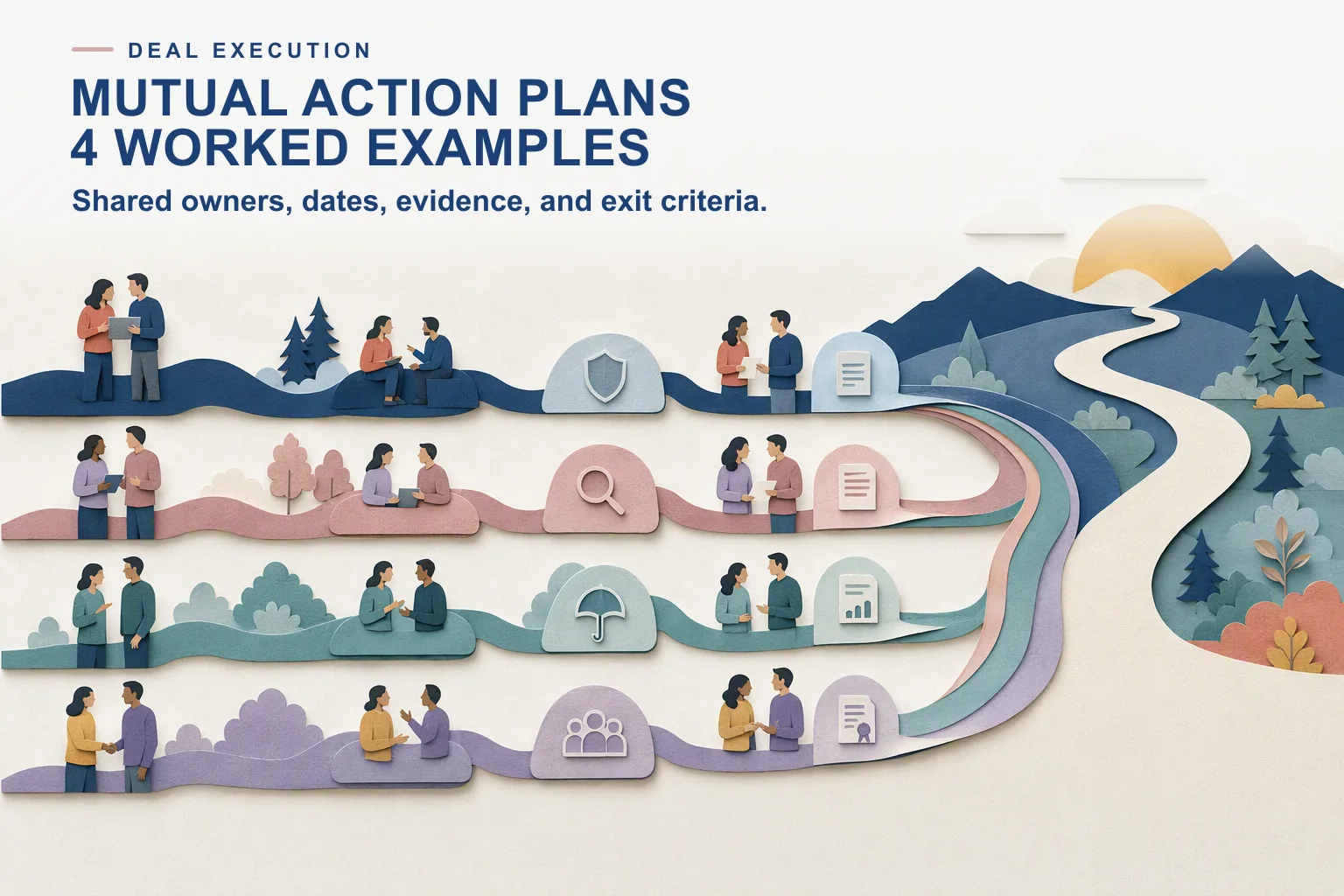
A mutual action plan example is most useful when it matches your deal type. Below are four complete examples: a mid-market SaaS deal, an enterprise deal with a security review, a renewal with expansion and a partner-sourced deal. Each lists the steps, the buyer and seller owner for each step, the timing and what “done” means.
The companies are fictional, and the timings are illustrative; adjust them to your own sales cycle. If you want a blank version to fill in, start from our mutual action plan template.
Last updated: 27 October 2026
Disclosure: Revspire publishes this guide and sells digital sales room software that includes mutual action plans. The examples work in any tool, including a shared spreadsheet.
What goes into a mutual action plan?
A mutual action plan (MAP) is a shared, dated list of the steps buyer and seller agree to take to reach a decision. Every example below uses the same six fields:
| Field | What it holds | Why it matters |
|---|---|---|
| Step | A verb and an outcome: “Security review completed” | Makes the step checkable |
| Buyer owner | A named person on the buyer side | Most delays happen on the buyer side |
| Seller owner | A named person on your side | Shows what you owe the buyer |
| Timing | A date or week | Lets both sides see slippage early |
| Exit criterion | What “done” means | Stops steps being marked done too early |
| Status | Not started, in progress, done, at risk | Gives the champion a quick internal update |
The steps usually follow how buyers decide. Gartner’s B2B buying journey research (undated page, accessed 27 October 2026) names six buying jobs: problem identification, solution exploration, requirements building, supplier selection, validation and consensus creation. It also says a typical buying group for a complex solution has six to 10 decision makers. A good MAP has at least one step for validation and one for consensus, with the people who own them named.
The plan also has to work when you are not in the room. Gartner’s March 2026 survey of 646 B2B buyers found that 67% prefer a rep-free experience. A written plan with buyer-side owners lets the champion move steps forward between meetings.
Example 1: Mid-market SaaS new business (about 6 weeks)
Deal: Ashgrove Software sells scheduling software to Pellowmere Dental Group, a 400-person practice group. Buying group: operations director (champion), finance manager, IT lead and the regional managers’ representative.
| Step | Buyer owner | Seller owner | Timing | Exit criterion |
|---|---|---|---|---|
| Agree goals and success measures | Operations director | Account executive | Week 1 | Three goals written in the buyer’s words |
| Demo for regional managers | Managers’ representative | Sales engineer | Week 2 | Managers confirm the workflow fits |
| IT integration check | IT lead | Sales engineer | Week 3 | Calendar and SSO integration confirmed |
| Proposal reviewed | Finance manager | Account executive | Week 4 | Preferred option chosen |
| Contract redlines agreed | Operations director | Account executive | Week 5 | No open legal points |
| Signature and kickoff booked | Operations director | Account executive | Week 6 | Signed order form and kickoff date |
Why it works: six steps, each with a named owner on both sides. The IT check comes before the proposal, so a technical blocker cannot surface after pricing is agreed.
Example 2: Enterprise deal with a security review (about 16 weeks)
Deal: Ridgeway Identity sells access-management software to Caldermoor Insurance. Twelve stakeholders. Security and procurement run in parallel, which is where most enterprise plans slip.
| Step | Buyer owner | Seller owner | Timing | Exit criterion |
|---|---|---|---|---|
| Business case agreed with sponsor | VP Operations (sponsor) | Account executive | Weeks 1 to 3 | Sponsor signs off the problem and cost of inaction |
| Technical evaluation | Enterprise architect | Sales engineer | Weeks 3 to 6 | Architecture review passed |
| Security questionnaire submitted | Security analyst | Security lead | Week 5 | Questionnaire and evidence delivered |
| Security review completed | CISO delegate | Security lead | Weeks 6 to 11 | Written approval or list of conditions |
| Procurement onboarding | Procurement manager | Deal desk | Weeks 6 to 9 | Vendor record created |
| Legal review (MSA and DPA) | Legal counsel | Your legal team | Weeks 8 to 13 | Agreed contract text |
| Investment committee | VP Operations | Account executive | Week 14 | Budget approved |
| Signature | Chief operating officer | Account executive | Weeks 15 to 16 | Signed contract |
Why it works: the security and procurement tracks start early, in parallel, and each has its own buyer owner. The investment committee step names the person who presents, and a date is fixed weeks ahead because committee calendars rarely move.
Example 3: Renewal with expansion (about 10 weeks before renewal)
Deal: Lanyard Learning renews Bramwell Health, a hospital group, and proposes adding nursing education. Renewal date is fixed; the expansion decision is not.
| Step | Buyer owner | Seller owner | Timing | Exit criterion |
|---|---|---|---|---|
| Value review meeting | Head of learning | Customer success manager | Renewal minus 10 weeks | Agreed summary of results against last year’s goals |
| Renewal quote issued | Procurement | Account manager | Minus 8 weeks | Quote received |
| Nursing education discovery | Director of nursing | Account manager | Minus 7 weeks | Requirements written down |
| Expansion proposal | Director of nursing | Account manager | Minus 5 weeks | Option selected or declined |
| Renewal signed | Head of learning | Account manager | Minus 2 weeks | Signed renewal |
| Expansion signed (if approved) | Director of nursing | Account manager | Any time | Signed amendment |
Why it works: the renewal and the expansion are separate steps, so a slow expansion decision does not put the renewal at risk.
Example 4: Partner-sourced deal (about 8 weeks)
Deal: Copperline Consulting, a systems integrator, brings Sabrevine Analytics into a deal at Hollins Manufacturing. Three companies own steps.
| Step | Owner (company) | Timing | Exit criterion |
|---|---|---|---|
| Joint discovery workshop | Partner lead (Copperline) with buyer’s plant IT manager | Week 1 | Shared requirements list |
| Software demo | Sales engineer (Sabrevine) | Week 2 | Buyer confirms fit |
| Implementation scope and estimate | Partner lead (Copperline) | Week 3 | Statement of work drafted |
| Combined proposal | Account executive (Sabrevine) and partner lead | Week 4 | One document with software and services pricing |
| Buyer budget approval | Plant director (Hollins) | Weeks 5 to 6 | Budget approved |
| Contracts signed | Procurement (Hollins) | Weeks 7 to 8 | Software and services contracts signed |
Why it works: every step names the company as well as the person, and there is one combined proposal so the buyer does not reconcile two quotes.
Mutual close plan, mutual success plan and joint execution plan: are they different?
Mostly in emphasis. A close plan or mutual close plan focuses on the steps to signature. A mutual success plan usually continues past signature into onboarding and the outcomes the buyer wants. A joint execution plan is another common name for the same shared plan. All four examples above can be extended into a success plan by adding onboarding steps after signature.
How vendors structure their own MAP templates
- Dock’s mutual action plan template (accessed 27 October 2026) has five sections: Overview (target kickoff date and success criteria), Plan Progress, Evaluation, Procurement (legal review, security review, contract signoff) and Implementation.
- Dock’s digital sales room template also has a Sales Pilot Plan section with a timeline, stakeholders and success criteria, which suits a proof-of-concept MAP.
- Aligned’s mutual action plan example (published 14 November 2023, by its CEO) recommends six steps: a value summary from the buyer’s view, the full stakeholder list, actionable steps, a schedule with deadlines, a named owner per task and post-sale outcomes.
Dock’s MAP template and Aligned’s guide both carry the plan past signature, and Dock’s puts procurement in the plan, which matches Examples 2 and 3 above.
Mistakes that make a MAP fail
- Seller-only owners. If every step is owned by your team, it is your task list, not a mutual plan.
- No exit criteria. “Security review” is a topic; “written approval from the CISO delegate” is a step.
- Agreed by email only. Walk through the plan with the champion on a call before sharing it widely.
- Missing stakeholders. Map the buying group first; our stakeholder map template helps.
- Never updated. Review it at the end of every buyer meeting and change dates openly when they move.
For data on how teams use MAPs, see our mutual action plan benchmark. Revspire’s Digital Sales Rooms hold mutual action plans with owners and due dates inside the buyer’s room, next to the content each step needs.
Frequently asked questions
What is an example of a mutual action plan?
A mid-market example: agree goals (week 1), demo for users (week 2), IT check (week 3), proposal review (week 4), contract redlines (week 5), signature and kickoff (week 6), each with a buyer owner, a seller owner and an exit criterion.
How many steps should a mutual action plan have?
Usually five to ten for a new business deal. Enterprise plans can run longer when security, procurement and legal each need their own steps. Fewer, clearly owned steps are easier to keep current than a long checklist.
When should you introduce a mutual action plan?
Once the buyer agrees there is a problem worth solving and you know who else is involved, often after discovery. Introducing it before then can feel presumptuous; much later and key steps have already been missed.
What is the difference between a mutual action plan and a close plan?
A close plan can be internal to the seller. A mutual action plan is shared with and agreed by the buyer, with buyer-side owners. Many teams use the terms interchangeably for the shared version.
Related: mutual action plan software, digital sales room examples and digital sales room template.
Sources
- The B2B Buying Journey, Gartner, undated, accessed 27 October 2026
- Mutual Action Plan Template, Dock Labs, undated, accessed 27 October 2026
- Gartner Sales Survey Finds 67% of B2B Buyers Prefer a Rep-Free Experience, Gartner, 9 March 2026, accessed 27 October 2026
- Digital Sales Room Template, Dock Labs, undated, accessed 27 October 2026
- Mutual Action Plan Example, Aligned (Gal Aga), 14 November 2023, accessed 27 October 2026
Leave a Reply