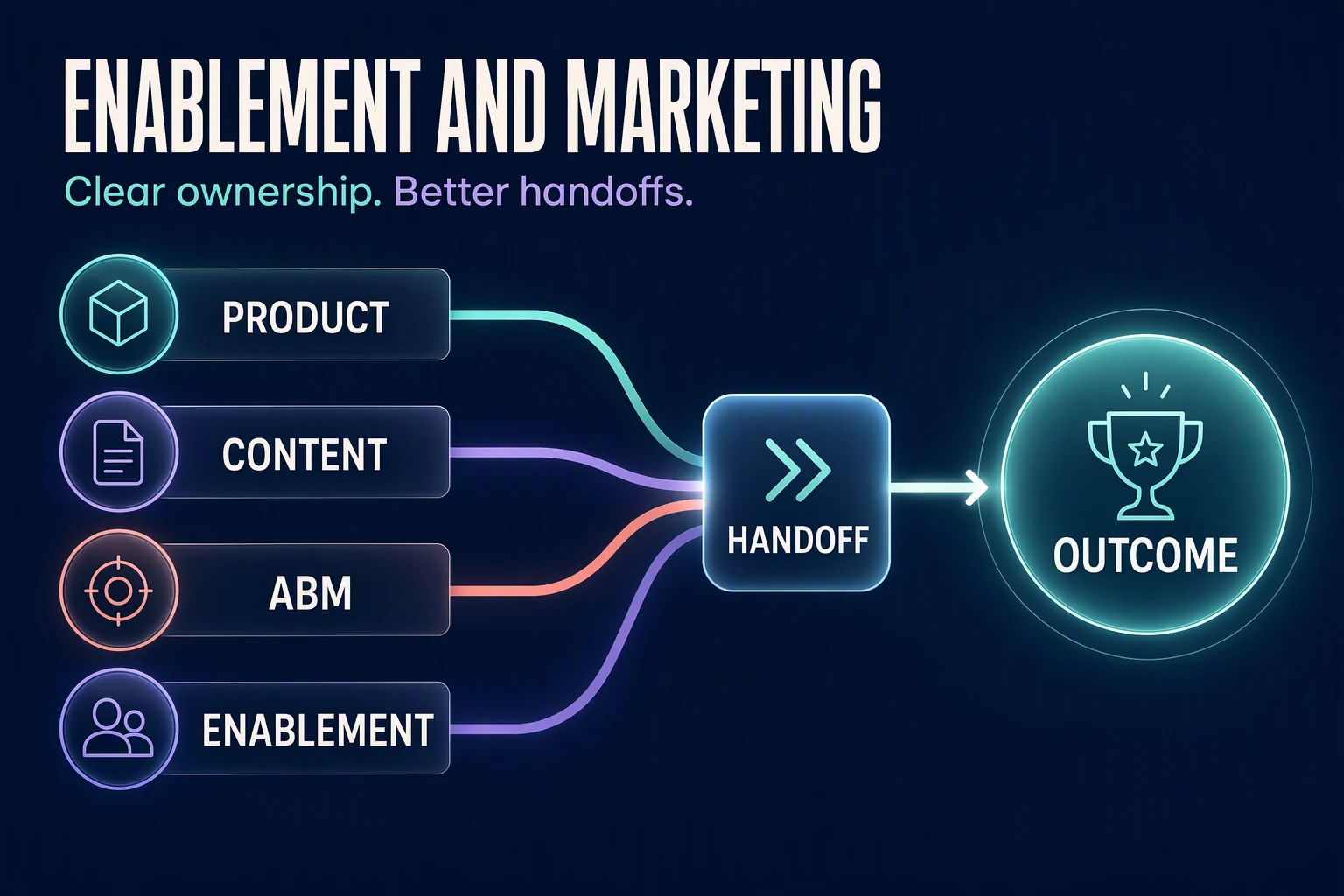
Sales enablement vs product marketing is a difference of audience and job. Product marketing decides what the company says about a product: positioning, messaging, launches and competitive insight, usually from inside marketing. Sales enablement makes sure sellers can say it and use it in real deals, through content access, training, certification and coaching, and typically reports to sales.
Content marketing and account-based marketing (ABM) are marketing disciplines too. Content marketing attracts and educates buyers before they talk to sales; ABM concentrates marketing and sales effort on a named list of accounts. Enablement is the function that turns the output of the other three into consistent seller behavior. This guide defines each one, compares them side by side, shows where they hand off, and ends with a RACI you can adapt.
Last updated: 16 October 2026
What is sales enablement?
Forrester’s long-cited definition frames sales enablement as a continuing, strategic effort to prepare all customer-facing staff to “consistently and systematically have a valuable conversation” with the relevant stakeholders at every stage of the customer’s problem-solving process (Forrester blog, undated on the page).
In practice, an enablement team owns the seller-facing system: onboarding and ramp, training and certification, coaching programs, the sales content library and its governance, and the plays sellers run in deals. Its customer is the seller, and its scoreboard is seller behavior and deal outcomes, not the volume of material produced. Our sales enablement glossary entry covers the basics and how teams measure it.
Many companies now use the wider term revenue enablement. The Revenue Enablement Society, a practitioner community, describes it as the ongoing work of aligning and improving what customer-facing teams depend on (people, process, content, messaging, technology and insight) across the whole revenue lifecycle (Revenue Enablement Society, CREP program page, undated, accessed 16 October 2026). The scope widens from new-business sellers to SDRs, account managers, customer success and partners, but the job is the same: make customer-facing people ready.
What is product marketing?
The Product Marketing Alliance (PMA) defines product marketing as “the process of bringing a product to market and overseeing its ongoing success” (PMA, What is product marketing?, 13 February 2026). Its core jobs are market and competitive intelligence, positioning and messaging, product launches, and equipping sales.
That last job is where the confusion starts. PMA reports that the share of product marketers listing sales enablement as a responsibility rose from 64% in 2024 to 78.7% in its 2025 State of Product Marketing report (PMA, 13 February 2026). In other words, most product marketers do some enablement work.
Product marketing usually lives in marketing. PMA’s 2023 State of Product Marketing report found that more than half of product marketers sit within the broader marketing function and about a fifth report into product (PMA, Where does product marketing fit in a business?, updated 20 September 2023).
The product marketer’s customer is the market: which problem the product solves, for whom, and why it beats the alternatives. Their deliverables (messaging framework, launch brief, pitch narrative, battlecard content) are the raw material that enablement turns into seller capability.
What is content marketing?
The Content Marketing Institute (CMI) describes content marketing as a strategic approach: publishing useful, relevant content on a consistent basis to “attract and retain a clearly defined audience”, with profitable customer action as the end goal (CMI, What is content marketing?, undated, accessed 16 October 2026).
Content marketing is audience-facing: blog posts, research reports, webinars, newsletters and video that buyers find on their own, usually before they talk to a seller. It is measured like a publication. Among the thought-leadership metrics in CMI’s 2026 B2B Content and Marketing Trends report, audience engagement was the most common (80%) and business impact (leads, pipeline influence) was cited by 63%, while 33% named measuring content effectiveness as a top-three challenge (CMI, 8 October 2025, survey of 1,015 B2B marketers).
Sales content is different. A seller uses it inside a deal, at a specific stage, with a specific stakeholder. The same research report can be both: content marketing publishes it to earn attention, and enablement packages it for a discovery call.
What is account-based marketing (ABM)?
TechTarget describes ABM as a strategy for picking out high-value accounts and reaching their buying teams with personalized outreach and content made for them (TechTarget, David Essex, 1 August 2023). The same article notes that the consultancy Momentum ITSMA claims to have coined the term in 2003, and describes three forms:
- One-to-one (strategic ABM): a program designed for a single account, heavily customized.
- One-to-few (ABM lite): a program for a small cluster of accounts, usually fewer than a dozen, with similar needs.
- One-to-many (programmatic ABM): automation and segmentation used to reach larger groups of named accounts.
TechTarget calls getting marketing and sales to work well together “perhaps the biggest challenge” of ABM. About half of B2B marketers use it: in CMI’s 2026 trends survey, 30% of B2B marketers used ABM only and 19% used both ABM and account-based experience (ABX), while 51% used neither. Among users who had measured it, 18% said ABM significantly outperforms traditional marketing and 47% said it somewhat outperforms (CMI, 8 October 2025).
ABM is a go-to-market strategy, not a department. Marketing (an ABM or field marketing lead) usually runs it with account executives, and it depends on enablement for the seller side: account briefs, tailored plays, practice and buyer-facing deal rooms.
Sales enablement vs product marketing vs content marketing vs ABM: side by side
| Sales enablement | Product marketing | Content marketing | ABM | |
|---|---|---|---|---|
| Primary goal | Sellers who run the sales motion well and consistently | Products that win: right positioning, message and launch | Attract and keep a defined audience; create demand | Win and grow a named list of high-value accounts |
| Main audience | Internal: sellers, managers, SDRs, account managers, partners | The market and buyers, plus sales and product teams | External: buyers and prospects, mostly before sales contact | External: buying committees at target accounts, plus their account teams |
| Typical outputs | Onboarding, training, certification, coaching programs, governed content library, plays and talk tracks | Positioning, messaging framework, launch plans, pitch narrative, battlecard content, competitive intel | Blog posts, SEO pages, research reports, webinars, newsletters, video | Target account list, account plans, tailored campaigns and content, account events and outreach |
| Success metrics | Ramp time, certification and readiness, content adoption, win rate and cycle length on enabled plays | Launch adoption, competitive win rate, message adoption, product pipeline and revenue | Audience growth, engagement, organic traffic, leads and pipeline influenced | Engagement and pipeline in target accounts, win rate, deal size, expansion |
| Typical owner | Head or VP of sales (or revenue) enablement | Product marketing manager, VP product marketing | Head of content, content marketing manager | ABM or field marketing manager, with account executives |
| Typical reporting line | Sales leadership (CRO, VP Sales) or revenue operations; sometimes marketing | Marketing (CMO); sometimes product | Marketing (CMO) | Marketing, run jointly with sales |
| Question it answers | “Can our sellers do this in a real deal?” | “What do we say, to whom, and why us?” | “Will buyers find, read and trust us?” | “Are we winning the accounts that matter most?” |
Sales enablement vs marketing: what is the difference?
Marketing as a whole (brand, demand generation, product marketing, content, ABM, events and marketing operations) is accountable for the market: awareness, demand and pipeline. Sales enablement is accountable for the selling system: whether sellers turn that pipeline into revenue the same way every time.
- Customer: marketing’s primary customer is the buyer; enablement’s primary customer is the seller.
- Scoreboard: marketing measures reach, engagement and pipeline; enablement measures readiness, adoption and conversion.
- Content: marketing creates most assets; enablement makes them findable, current, trained on and used.
A quick test for any asset: if a buyer reads it before speaking to sales, marketing owns it. If a seller uses it in a deal or to prepare for one, enablement shares ownership. A pitch deck, for example, is written by product marketing, governed and trained on by enablement, and delivered by sellers.
Clear charters are still the exception. In the Sales Enablement Collective’s 2024 landscape survey, only 42% of respondents believed enablement charters were effective, and when asked which department they wished they had a better relationship with, 13% chose marketing and 10% product marketing (Sales Enablement Collective, Daniel O’Dowd, 25 October 2024).
Sales enablement vs product marketing: where they overlap and hand off
The overlap is real: both create sales content, both train sellers on launches and both care about win rate. The clean split is that product marketing owns the message and enablement owns the seller’s ability to deliver it. For the wider case for sales and marketing alignment, see the synergy of sales and marketing in your GTM strategy.
Product launches
Launches are the most common handoff. An illustrative timeline for a new add-on (adapt the weeks to your release cycle):
- Eight weeks out: product marketing writes the launch brief (target buyer, problem, positioning, pricing and packaging, competitive angle). Enablement reviews it for “sellability”: what reps must do differently and which roles are affected.
- Six weeks out: product marketing drafts the messaging and pitch. Enablement turns them into talk tracks, discovery questions, objection responses and a certification scenario.
- Three weeks out: product marketing trains sellers on the why. Enablement runs practice and certification, publishes assets with stage and persona tags, and retires old versions.
- Launch: sellers who have certified position the product with customers; deal rooms carry only approved assets.
- 30, 60 and 90 days after: enablement reports content usage, certification completion and field feedback. Product marketing adjusts messaging. Win/loss findings go to both teams.
Messaging
Product marketing owns the messaging framework: value propositions, proof points and persona-specific angles. Enablement translates it into what sellers actually say (talk tracks, email snippets, role-play scenarios) and checks through certification and call review whether it lands. The loop only works if enablement brings call evidence back to product marketing. In Revspire, the AI Playbook Engine drafts playbooks grounded in approved revenue knowledge, routes them for approval and publishes role-specific messaging, objection plays and battlecards into seller workflows.
Sales content
Product marketing and content marketing produce most assets. Enablement governs them: one repository, tags by stage and persona, version control, retirement dates and usage analytics, plus a request process for gaps sellers report. A simple rule prevents most conflict: every asset has one owner and one place to find it.
Battlecards and competitive intelligence
Product marketing owns the competitive research and the accuracy of each battlecard. Enablement owns distribution, training, objection practice and the feedback loop from the field, so a battlecard is tested in role-play before a seller needs it on a call.
Signs the handoff is broken
- Sellers rebuild the pitch deck because the official one does not fit their deals.
- Launch training is a recorded webinar, with no check that reps can position the product.
- Three versions of the same one-pager circulate in email.
- Product marketing measures a launch by assets shipped, enablement by training completion, and nobody looks at win rate on the new product.
- Win/loss findings reach only one of the two teams.
Sales enablement vs content marketing
Both produce content, but for different readers and moments:
- Reader: content marketing writes for a buyer who is researching alone; sales content is used by a seller with a buyer.
- Moment: content marketing works mostly before sales engagement; sales content works during the deal and after the sale.
- Form: content marketing is published and discoverable, often search-led; sales content is stage-specific, often tailored, and shared privately or in a deal room.
- Metrics: content marketing tracks traffic, engagement and leads; enablement tracks seller usage, buyer engagement with shared content and deal progression.
Worked example: a company publishes an annual benchmark report. Content marketing builds the landing page, a search-optimized article, a webinar and social clips. Enablement adds a one-slide summary for discovery calls, a talk track that links each finding to a persona’s pain, a follow-up email template, guidance on which deal stage to use it in, and tracking of whether buyers open it when a seller shares it.
So who owns sales content? Creation sits with marketing (product marketing for product content, the content team for thought leadership). Governance and seller adoption sit with enablement.
Sales enablement vs ABM: how ABM programs use enablement
ABM and enablement are not alternatives. ABM decides which accounts to pursue and how to engage them; enablement makes the account team ready for those accounts. How the support changes by ABM tier:
| ABM tier | What marketing runs | What enablement provides |
|---|---|---|
| One-to-one (strategic) | Account research, bespoke campaigns, executive events | Account briefing pack, account-specific talk track, role-play of that account’s likely objections before key meetings, stakeholder map, a dedicated digital sales room with a mutual action plan |
| One-to-few (cluster) | Campaigns per industry or shared need | An industry play (pains, proof, discovery questions), a curated content set for the cluster, a short certification on the play |
| One-to-many (programmatic) | Targeted ads, personalized content at scale, intent-based outreach | Standard plays triggered by intent signals, sequence and email templates, persona content tagged in the repository |
On the seller side, ABM depends on coverage across the buying committee rather than one champion, so enablement’s plays should tell reps who else to engage and with what. Our guide to account-based selling strategy covers stakeholder coverage and account metrics in more depth.
Who owns what? A RACI for sales enablement, product marketing, content and ABM
A RACI assigns each activity one A (accountable: owns the outcome and signs off), one or more R (responsible: does the work), C (consulted before) and I (informed after). Copy this and adjust it to your org; the point is that every row has exactly one A.
| Activity | Product marketing | Content marketing | ABM | Sales enablement | Sales leadership | RevOps |
|---|---|---|---|---|---|---|
| Positioning and messaging framework | A/R | C | C | C | C | I |
| Launch brief and launch plan | A/R | C | I | R (readiness plan) | C | C (CRM, SKUs) |
| Seller launch readiness and certification | C | I | I | A/R | R (manager sign-off) | I |
| Pitch deck and core sales assets | A/R | C | I | C | C | I |
| Battlecards and competitive content | A/R | I | I | R (distribution, practice) | C | I |
| Talk tracks, objection handling, plays | C | I | C | A/R | C | I |
| Thought leadership, blog, SEO, webinars | C | A/R | C | I | I | I |
| Sales content repository and governance | C | C | I | A/R | I | C |
| Target account selection | I | I | A/R | I | R | C (data) |
| Account plans and account-specific content | C | C | R | C | A (account owner) | I |
| Onboarding and ongoing training | C | I | I | A/R | R | I |
| Content usage analytics | I | I | I | A/R | I | C |
| Win/loss analysis | A/R | I | I | C | C | R (data) |
An example org for a 300 to 1,000 employee B2B software company
This is an illustration, not a benchmark:
- Under the CMO: a VP of product marketing with one product marketer per product line plus a competitive intelligence lead; a head of content with writers and a designer; an ABM manager covering the strategic account list.
- Under the CRO: sales leaders by segment; a head of enablement with an onboarding and training lead, a content and tools manager, and an enablement manager aligned to each segment; revenue operations.
- Shared rituals: a monthly GTM council (product marketing, enablement, content, ABM, sales leaders, RevOps) that reviews win/loss, content usage and field requests; a weekly stand-up during launch windows; a quarterly content audit; one shared launch calendar.
For how to organize the enablement team itself, and how it differs from sales operations, see structuring your sales enablement team.
How the split changes with company size
- Small teams: one product marketer often does enablement, and a content marketer writes sales collateral. Write the RACI anyway, so the work is visible when you hire.
- Growth stage: the first dedicated enablement hire usually starts with onboarding, then takes over content governance and launch readiness from product marketing.
- Enterprise: separate functions with specialists. The risk shifts from overlap to silos, so the GTM council and a single content repository matter more.
Where should sales enablement report?
Forrester argues that enablement should report to sales. The public summary of its Data Snapshot says enablement functions are now 75% more likely to report to sales or operations leadership in high-performing sales organizations (the comparison baseline sits in the paywalled report), and links this to enablement’s growth from point solutions into a strategic selling partner (Forrester, 28 July 2025). In the Sales Enablement Collective’s 2024 survey, teams reporting directly to a C-suite executive gave enablement the highest average value score, 6.85 out of 10, against an overall average of 6.56 (Sales Enablement Collective, 25 October 2024).
Our view: put enablement under the CRO or sales leadership, with a standing link to product marketing through the launch calendar and the GTM council. If enablement sits in marketing, make sure it has direct access to sales managers and deal data; without that it tends to become a content desk.
Frequently asked questions
Is sales enablement part of marketing?
It can be, but in many B2B companies it is a separate function aligned with sales, and Forrester’s 2025 data links a sales or operations reporting line with high-performing sales organizations. It still works closely with marketing, because marketing produces most of the messaging and content that enablement turns into seller capability.
What is the difference between sales enablement and product marketing?
Product marketing decides the positioning, messaging and launch plan for a product. Sales enablement makes sure sellers can use that message in real deals, through content governance, training, certification and coaching. One owns the message; the other owns the seller’s ability to deliver it.
What is the difference between sales enablement and ABM?
ABM is a strategy that focuses marketing and sales on named high-value accounts; sales enablement is a function that prepares sellers. They work together: ABM programs rely on enablement for account briefs, tailored plays, objection practice and deal rooms.
Sales enablement vs content marketing: who owns sales content?
Marketing usually creates it, with product marketing writing product content and the content team writing thought leadership. Enablement owns governance and adoption: where the asset lives, which version is current, when sellers should use it and whether they do. Give each asset one named owner.
Who owns battlecards, product marketing or sales enablement?
Product marketing owns the competitive research and the accuracy of the battlecard. Enablement owns how sellers get it, train on it and practice with it, and it brings field feedback back to product marketing. Agree that split before the first battlecard is written.
Should product marketing or sales enablement run sales training?
Both contribute. Product marketing supplies the product, market and competitive content. Enablement designs the program, runs practice and certification, reinforces it over time and measures whether behavior changed.
Put the handoff into practice with one shared artifact: our sales battlecard template pairs each differentiator with proof and a one-sentence talk track, and includes landmine questions and objection responses that enablement can turn into role-play scenarios.
Sources
All pages were accessed on 16 October 2026. Publication or update dates are shown where the page gives one.
- Sales Enablement Is Strategic and Cross-Functional, So Says Panel, Forrester (undated on the page). Accessed 16 October 2026.
- Revenue Enablement Should Report To Sales And No Other B2B Function, Forrester Data Snapshot, 28 July 2025. Accessed 16 October 2026 (public summary; full report paywalled).
- Certified Revenue Enablement Professional (CREP) program, Revenue Enablement Society (undated). Accessed 16 October 2026.
- What is product marketing?, Product Marketing Alliance, Charley Gale, 13 February 2026. Accessed 16 October 2026.
- Where does product marketing fit in a business?, Product Marketing Alliance, Charley Gale, 4 November 2021, updated 20 September 2023. Accessed 16 October 2026.
- What is content marketing?, Content Marketing Institute (undated). Accessed 16 October 2026.
- B2B Content and Marketing Trends: Insights for 2026, Content Marketing Institute and MarketingProfs, Robert Rose, 8 October 2025. Accessed 16 October 2026.
- What is account-based marketing (ABM)?, TechTarget, David Essex, 1 August 2023. Accessed 16 October 2026.
- 5 sales enablement statistics you need to know, Sales Enablement Collective, Daniel O’Dowd, 25 October 2024. Accessed 16 October 2026.
Leave a Reply