AI agents turn an old content problem into an operating risk
A rep can notice that a battle card looks old, ask a colleague, and decide not to use it. An AI agent may retrieve the same card, combine it with other fragments, and produce a confident answer in seconds. If the source is obsolete, restricted, or ambiguous, faster retrieval simply spreads the mistake faster.
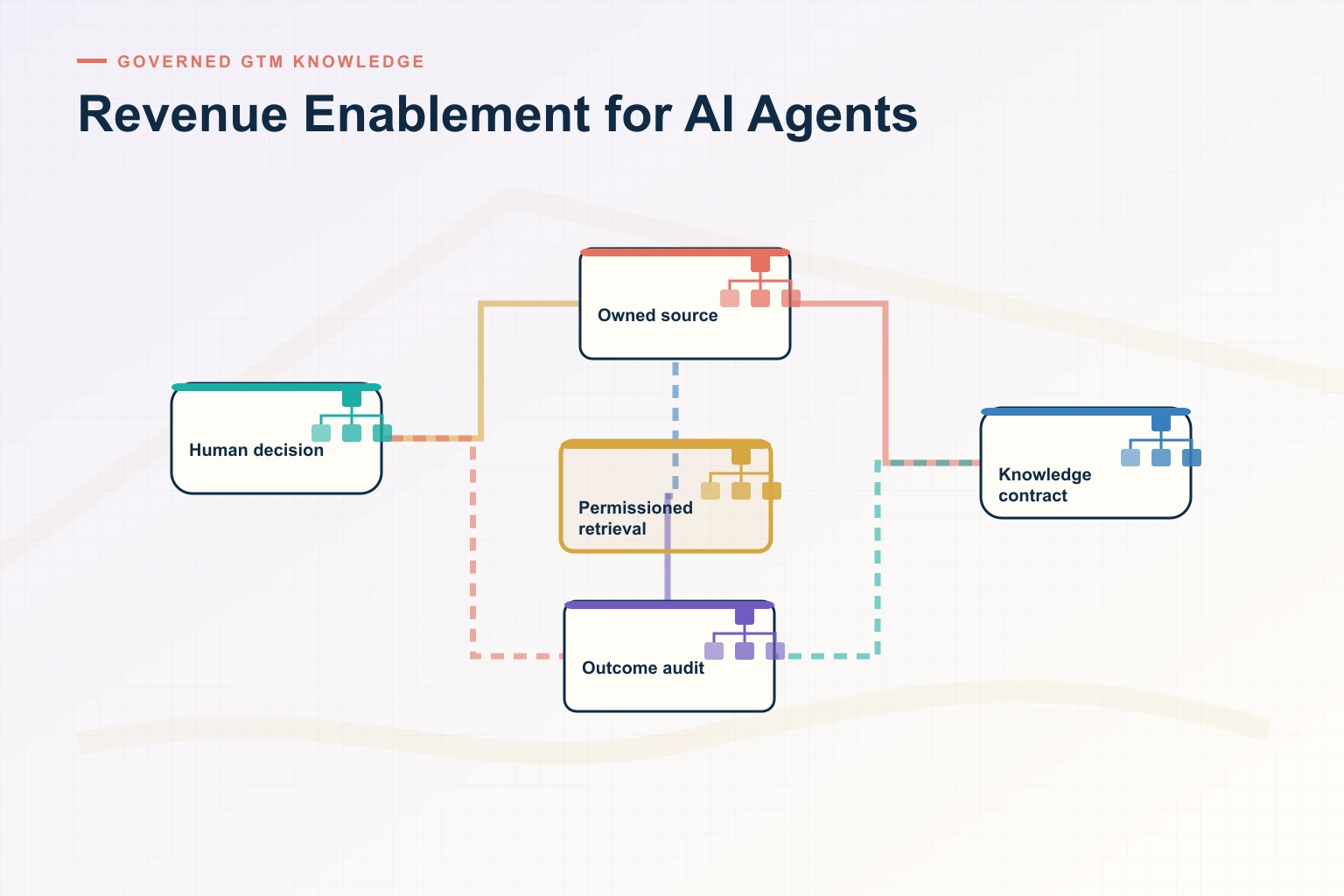
That is why revenue enablement for AI agents is not mainly a prompt-writing project. It is the work of making go-to-market knowledge governable: named owners, approved claims, effective dates, access rules, traceable retrieval, action limits, evaluations, and a correction path. The same foundation should serve human sellers and software agents, but the delivery and controls cannot be identical.
The NIST AI Risk Management Framework describes four functions—govern, map, measure, and manage. Its companion Generative AI Profile applies that risk-management approach to generative systems. Together they provide a durable frame: establish accountability, understand the context, test what happens, and respond to observed risk.
Define the knowledge plane before choosing an agent
The knowledge plane is the governed layer between source systems and every experience that consumes GTM information. It is not necessarily a new repository. It may index approved material from content management, CRM, product documentation, ticketing, and enablement systems while leaving each system of record in place.
A retrieval-augmented system generally combines model generation with retrieved external material. The original Retrieval-Augmented Generation paper describes combining parametric and non-parametric memory. In a commercial deployment, retrieval alone is not governance. The organization still has to decide which source is authoritative, who may see it, whether it is current, and what an agent may do with the result.
| Requirement | Rep experience | Agent requirement |
|---|---|---|
| Freshness | Show updated date and owner | Exclude expired versions at retrieval time |
| Access | Display only resources the user may open | Evaluate identity and purpose before retrieval and again before action |
| Provenance | Link to the source | Return source ID, version, excerpt, and retrieval time with the answer |
| Ambiguity | Offer alternatives and ask the rep to choose | Ask a clarifying question or abstain when confidence/evidence is insufficient |
| Action | Rep decides what to send or update | Separate read, draft, recommend, and execute permissions |
| Correction | Flag outdated or wrong content | Capture the trace, stop repeated use, and route to the source owner |
A governed content hub can provide the source discipline, while playbooks package approved guidance around roles, situations, and stages. The important architecture choice is to preserve ownership and permissions when that material appears in search, chat, training, or an automated workflow.
Give every knowledge object a contract
Folders and tags help people browse, but agents need more explicit metadata. Treat every approved asset, answer, policy, or reusable claim as a knowledge object with a contract. The contract tells the retrieval layer when the object is eligible and tells reviewers why it exists.
| Contract field | Question it answers | Example |
|---|---|---|
| Canonical ID and source | Where is the authoritative record? | Product policy in the controlled document system |
| Owner and approvers | Who corrects and signs off the content? | Product marketing owner; security reviewer |
| Audience and region | Who may use it, and where? | Enterprise AEs in France and Germany |
| Purpose | Which tasks is it approved to support? | Drafting an internal discovery brief; not a contractual response |
| Effective and review dates | When is it valid? | Effective on release; review in 90 days |
| Sensitivity | What access and handling apply? | Internal, customer-shareable, confidential, or restricted |
| Claim boundaries | What may not be inferred? | No commitment about a future integration |
| Supersedes / superseded by | Which version wins? | Pricing guidance v4 replaces v3 |
| Evidence requirements | What must accompany an answer? | Current control description plus approved evidence link |
Do not rely on a modified timestamp as a freshness policy. A document can be recently moved but substantively obsolete. Require an owner attestation, an effective date, and a review trigger tied to events such as a price change, product release, new competitor claim, regulatory update, or contractual-policy revision.
Apply permissions during retrieval, not after generation
Filtering a completed answer is too late if restricted content has already entered the model context or tool call. Identity, group, geography, account assignment, purpose, and object sensitivity should constrain candidate retrieval. The agent should carry the requesting user’s authorization where appropriate, not inherit a broad service account by default.
NIST SP 800-207 on Zero Trust Architecture says trust should not be granted implicitly based only on physical or network location. Applied here, being inside the company chat or CRM is not sufficient authorization. Check the subject, resource, and requested operation.
| Capability | Low-risk default | Higher-risk condition requiring approval |
|---|---|---|
| Search | Return entitled sources with citations | Cross-account or restricted repository search |
| Draft | Create an internal draft marked for review | Use personal data, legal terms, or non-public roadmap context |
| Share | Prepare a link for a rep to inspect | Send externally or change link permissions |
| CRM update | Recommend a field value with evidence | Write a forecast category, close date, or customer commitment |
| Commercial action | Explain approved options | Quote, discount, approve, sign, or accept terms |
Use least privilege and short-lived authorization for tools. Preserve a log of retrieved sources, policy decisions, tool inputs, outputs, errors, and human approvals. Logs need their own retention and access policy; collecting everything indefinitely is not governance.
Design for prompt injection, poisoned knowledge, and excessive agency
An uploaded document can contain instructions aimed at the model rather than information for the user. A web page, CRM note, or customer attachment can do the same. Treat retrieved content as untrusted data: delimit it, prevent it from overriding system policy, restrict tools, and require confirmation before consequential actions.
The OWASP Top 10 for LLM Applications provides a practical threat catalog that includes prompt injection, sensitive-information disclosure, data and model poisoning, and excessive agency. Use it during threat modeling, but convert each risk into a tested control. A policy document without an attack simulation is not evidence that the control works.
For revenue workflows, seed tests with realistic adversarial material: an attachment that says to ignore approval policy, a CRM note containing a fake discount, an old battle card labeled as current, a customer email requesting another account’s data, and a tool response that times out halfway through an update. The expected behavior should be explicit—ignore, abstain, ask, escalate, or roll back.
Measure answer quality and action safety separately
A fluent answer can still cite the wrong version; a correct answer can still be unsafe to send. Build an evaluation set from real, sanitized jobs and score separate dimensions.
| Evaluation | Evidence | Failure example |
|---|---|---|
| Retrieval eligibility | All sources pass audience, region, date, and sensitivity rules | Expired price sheet retrieved because it shares more keywords |
| Grounded accuracy | Material claims are supported by cited excerpts | Answer combines two sources into an unsupported promise |
| Abstention | Agent asks or refuses when approved evidence is absent | Model fills a security questionnaire from general knowledge |
| Permission integrity | Unauthorized sources and tools remain inaccessible | Service identity bypasses a user’s content restriction |
| Action correctness | Right tool, record, fields, and idempotency behavior | Retry creates two customer-facing tasks |
| Human control | Required approvals are visible and enforced | Draft email is sent without the rep’s confirmation |
| Trace completeness | Source versions, policy result, tool calls, and reviewer are recorded | Team cannot reproduce why an answer was produced |
Keep a fixed regression set for known failures and a rotating set for new products, regions, and adversarial patterns. Slice results by language, role, source type, and workflow. An aggregate pass rate can hide a complete failure in a small but important segment. When a source changes, rerun the evaluations that depend on it before broad release.
Use an operating model with named decision rights
Revenue enablement should own taxonomy, workflow fit, and adoption; domain teams should own the truth of their content; security and privacy should define control requirements; IT or engineering should own identity, integration, and reliability; and business leaders should decide which actions may be delegated. One committee does not need to review every update, but each risk class needs a clear approver and service level.
- Propose: a domain owner creates or changes a knowledge object.
- Review: required functions approve claims and handling rules.
- Publish: the system versions and indexes the approved object.
- Retrieve: runtime policy filters by identity, purpose, and currency.
- Respond or act: the agent cites evidence and respects action limits.
- Observe: owners review usage, errors, flags, and evaluation results.
- Correct or retire: invalid knowledge is quarantined and downstream indexes are refreshed.
A permission-aware delivery surface can reduce context switching. Revspire’s Slack integration, for example, is designed to respect Revspire permissions and gives users control over personal search authorization. The governance test is whether those controls remain intact from the source through the final conversation.
A 90-day implementation sequence
| Window | Scope | Exit evidence |
|---|---|---|
| Days 1–30 | Select one read-only use case; inventory sources; define owners, classifications, and prohibited content; create a baseline evaluation set | Approved knowledge map, access matrix, threat model, and measured baseline |
| Days 31–60 | Implement filtered retrieval, citations, expiry, abstention, feedback, and trace logging; run adversarial tests | Documented test results and closure plan for material failures |
| Days 61–90 | Pilot with a limited user group; monitor corrections and source gaps; add one reversible draft or recommendation action | Named production owners, incident path, rollback method, and go/no-go review |
Do not begin with autonomous external communication. A read-only answer with citations reveals source and permission defects at lower consequence. Then progress to drafts, recommendations, and finally narrow actions when evidence supports the step.
GTM knowledge governance checklist
- Every indexed object has a canonical source, owner, sensitivity, audience, effective date, and review date.
- Superseded content is excluded from retrieval, not merely labeled old.
- Runtime access reflects the requesting identity and intended operation.
- Answers expose usable citations and source versions.
- The agent abstains when evidence or authorization is insufficient.
- Untrusted retrieved text cannot override agent policy or tool permissions.
- Read, draft, recommend, and execute are separate capabilities.
- Consequential actions require explicit approval and safe retry behavior.
- Evaluation sets cover ordinary, edge, restricted, stale, and adversarial cases.
- Users can flag an answer and the owning team can quarantine a source quickly.
- Logs are sufficient for investigation but follow retention and access limits.
- Release, incident, and retirement decisions have named owners.
Make governed knowledge the shared product
Reps and agents do not need two competing versions of GTM truth. They need one governed knowledge plane with experiences appropriate to each consumer. When ownership, eligibility, evidence, and action boundaries are explicit, automation becomes easier to test—and corrections improve the human workflow too.
To examine how Revspire can organize permission-aware content, playbooks, and enablement delivery around your existing process, request a Revspire demo. Use one bounded knowledge domain as the evaluation case and bring your actual access and approval requirements.
Leave a Reply